


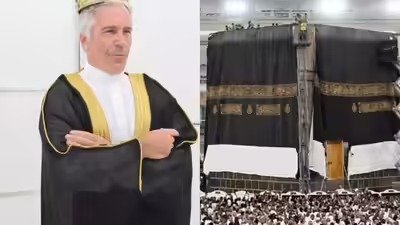
Jeffrey Epstein, the notorious convicted sex offender, reportedly obtained a piece of the sacred Kaaba cloth, known as the Kiswah, through a businessman from the United Arab Emirates. The revelation comes from recently released court documents linked to Epstein’s estate.
According to Daljoog News analysis, the acquisition highlights Epstein’s long-standing fascination with rare and historically significant artifacts, extending beyond his criminal exploits. The Kiswah, considered deeply sacred in Islam, adds a new layer of controversy to his documented network of elite connections.
The documents, primarily from 2017, detail how the cloth traveled from Mecca to Epstein’s Florida residence, during a period when he had already served time for sexual offenses. This discovery provides insight into the unusual avenues through which Epstein acquired high-profile artifacts.
What Happened?
Court records and emails released in early 2026 indicate that Epstein received a fragment of the Kaaba’s Kiswah through UAE businessman Aziza Al Ahmadi. The Kiswah is a black cloth with intricate gold embroidery that covers Islam’s most sacred site in Mecca and is replaced annually.
The emails, dated February and March 2017, show Ahmadi stressing the religious and historical significance of the cloth to Epstein. Ahmadi described it as an artifact touched by millions of Muslims, noting its spiritual and cultural value.
The Kiswah fragment was reportedly sent via British Airways to Epstein in the United States. By the time it arrived at his home, Epstein had already completed a prison sentence for prior sexual offenses. The correspondence also reveals ongoing communication between Epstein’s staff, including his secretary Leslie Graff, and Ahmadi, suggesting a sustained relationship.
Why This Matters
The revelation raises ethical and religious concerns. The Kiswah is revered by Muslims worldwide, and its handling outside of sacred spaces is highly sensitive. Epstein’s possession of such a piece underscores his access to global elites and controversial networks.
It also exemplifies how objects of immense cultural and religious significance can be commodified or diverted into private collections. Experts note that while Epstein is primarily remembered for his criminal actions, this incident highlights his interest in collecting rare and symbolically powerful artifacts.
What Analysts or Officials Are Saying
Legal and cultural analysts have expressed alarm at the report. Some observers describe it as a troubling intersection of criminal behavior and the exploitation of religious symbols.
Experts in Islamic heritage emphasize that Kiswah fragments are historically valuable and often preserved in museums or religious institutions. Handling such a piece for personal possession can be seen as deeply disrespectful.
Daljoog News Analysis
Daljoog News analysis suggests that Epstein’s interest in the Kiswah aligns with a broader pattern of seeking items tied to prestige and power. From rare art to culturally significant artifacts, Epstein’s network allowed him access to objects few could ever acquire.
This case also underscores the challenges in protecting religious and cultural heritage from private acquisition, especially when intermediaries, like Ahmadi, facilitate transfers across borders. The combination of illicit wealth, elite connections, and global travel enabled Epstein to navigate these gray areas with relative ease.
What Happens Next
While Epstein is deceased, the handling of the Kiswah fragment may prompt investigations into its provenance and current custody. Institutions safeguarding Islamic heritage may seek its return or ensure it is housed in an appropriate religious context.
The documents also offer potential leads for ongoing probes into Epstein’s global network of associates. Scholars and officials may use this case to advocate for stricter oversight on the trade and transfer of sacred artifacts.
This revelation reminds the public that Epstein’s reach extended far beyond the U.S., influencing international networks and raising questions about accountability and ethical stewardship of culturally significant items.