


Iran says many of its recent missile attacks against US and Israeli targets were carried out using weapons developed more than a decade ago. Officials claim the country’s most advanced missile systems remain unused and are being reserved for a possible longer war.
According to Daljoog News analysis, the statement appears designed to send a strategic message: Tehran may still hold significant military capabilities in reserve despite weeks of high-intensity strikes across the region.
The claim comes as the conflict between Iran, Israel, and the United States expands into one of the most volatile military confrontations in the Middle East in years, with missile exchanges now targeting major cities and strategic infrastructure.
What Happened?
Iranian military officials say most of the missiles launched so far in strikes on Israeli and US-linked targets were produced between 2012 and 2014.
A senior Iranian source speaking to state-linked media said Tehran intentionally relied on older stockpiled weapons during the early phase of the conflict. The decision, officials suggest, was part of a long-term strategy anticipating a drawn-out confrontation.
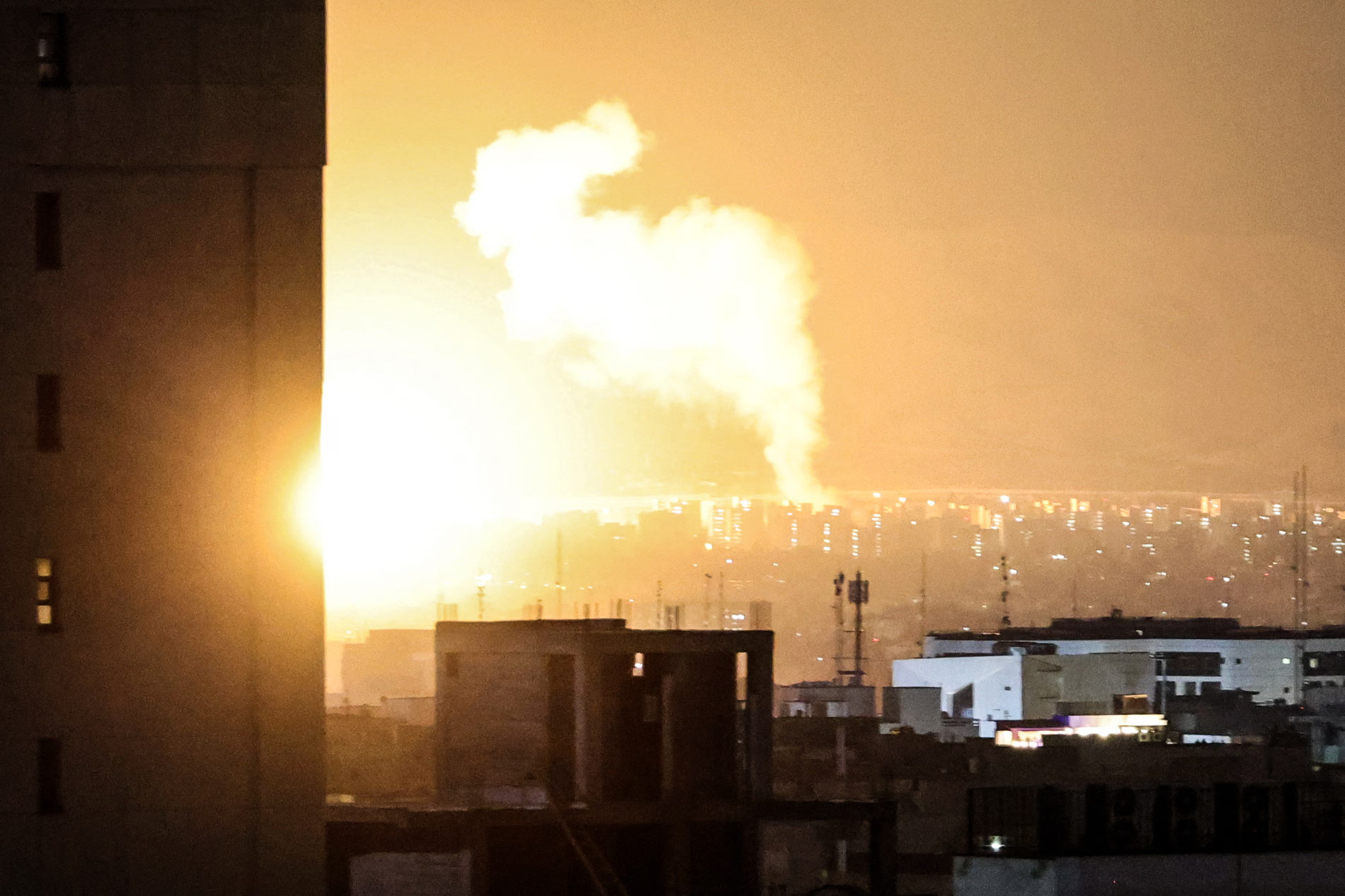
Despite using what Iran describes as older systems, attacks have continued across Israel. Missile strikes have reportedly targeted areas including Tel Aviv, Haifa, and the vicinity of Ben Gurion Airport, all of which are considered strategic locations.
Iran’s Islamic Revolutionary Guard Corps (IRGC) said a new wave of strikes began Friday under an operation code name referencing a historical Islamic figure. During this phase, Iranian forces reportedly launched multiple missile systems, including variants of the Khorramshahr, Khaibar, and Fattah missiles.
Iranian authorities claim the strikes were carried out in retaliation for an earlier attack that killed civilians, including children, in the Iranian city of Minab. Tehran framed the latest missile barrage as part of a broader campaign targeting Israeli military infrastructure.
The IRGC says that in addition to older missiles, it has now begun deploying newer systems during the conflict. Among them is the latest generation of the Khorramshahr missile, described by Iranian officials as a heavy long-range weapon capable of carrying a two-ton explosive payload.
Iran also claims to have used the Fattah hypersonic missile system, which it says can travel at extremely high speeds and maneuver during flight, making interception by traditional missile defense systems more difficult.
Why This Matters
Iran’s claim that it has relied primarily on older missiles raises significant strategic questions.
If accurate, the statement suggests Tehran may still possess a substantial reserve of more advanced weapons. This could extend the conflict’s duration and increase the risk of further escalation if those systems are deployed.
Hypersonic missiles, in particular, represent a growing concern for modern air defense networks. These weapons can travel at several times the speed of sound and may be capable of maneuvering mid-flight, complicating interception efforts.
For Israel and the United States, the possibility that Iran is holding back its most advanced arsenal introduces uncertainty into military planning. Defensive systems such as missile interception batteries depend heavily on radar detection and response time.
A shift toward faster or more maneuverable missiles could challenge those defenses and alter the balance of the current confrontation.
What Analysts or Officials Are Saying
Iranian military officials have emphasized that their strategy is evolving with each wave of attacks.
IRGC spokesperson Brigadier General Ali Ahmad Naini indicated that future operations could introduce technologies not previously used in combat. According to Iranian messaging, upcoming strikes may include longer-range and more advanced missile systems.
Regional security analysts note that such statements serve both military and psychological purposes. Public claims about unused advanced weapons can deter opponents by creating uncertainty about what capabilities remain available.
However, independent verification of the exact missile types used in recent strikes remains limited.
Defense experts also point out that missile performance and effectiveness depend not only on speed or payload but also on targeting intelligence, launch coordination, and counter-defense conditions.
Daljoog News Analysis
Iran’s messaging about older missiles may reflect a calculated information strategy as much as a military one.
By claiming that its most advanced weapons have not yet been deployed, Tehran signals endurance and strategic depth. This narrative can influence both domestic audiences and international observers by portraying Iran as capable of sustaining a prolonged conflict.
At the same time, such statements complicate threat assessments for adversaries.
If Iran truly retains significant numbers of advanced missiles, future attacks could involve higher payloads, greater speed, or more sophisticated evasion capabilities. That possibility could force Israel and the United States to adjust defensive strategies and increase surveillance.
Yet analysts caution that wartime claims often serve political or psychological goals. Military capabilities may be exaggerated to strengthen deterrence or morale.
Regardless of the exact accuracy of the claims, the broader reality remains clear: missile warfare has become the central feature of the current Middle East confrontation.
What Happens Next
Military observers expect Iran to continue missile strikes in phases rather than a single large campaign. This approach allows Tehran to test defenses, measure responses, and gradually escalate pressure.
Israel and its allies are likely to strengthen air defense operations and expand surveillance to detect potential launches earlier.
The next phase of the conflict may reveal whether Iran truly introduces more advanced hypersonic or long-range missile systems.
If that occurs, the technological dimension of the war could intensify rapidly, increasing both the scale of destruction and the risks of wider regional escalation.