



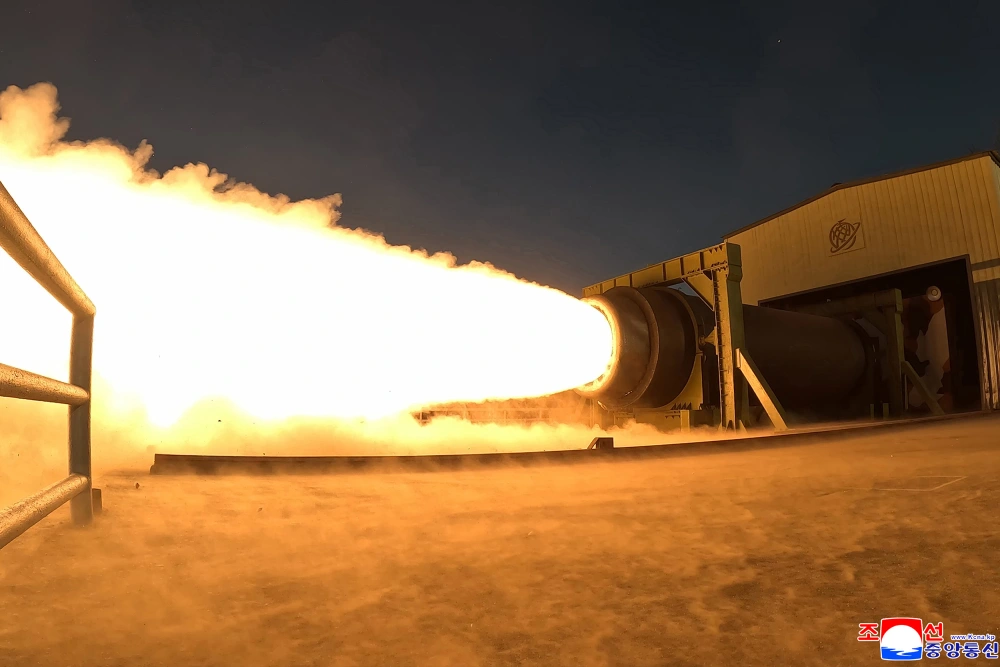
North Korea has conducted a ground test of an advanced rocket engine, marking a significant step in its weapons development program. State media confirmed that leader Kim Jong Un personally oversaw the test, underscoring its importance.
According to Daljoog News analysis, the development points to a clear effort by Pyongyang to strengthen its long-range missile capabilities, particularly those powered by solid fuel systems.
The test comes amid rising geopolitical tensions and follows renewed rhetoric from North Korea about expanding its nuclear and missile arsenal, raising fresh concerns among global security analysts.
What Happened?
North Korea carried out a ground test of a high-thrust rocket engine, according to its state news agency. The test was conducted as part of the country’s ongoing defense modernization plan, although officials did not disclose the exact date or location.
Leader Kim Jong Un was present during the test and supervised the process, signaling the strategic value placed on this development. The engine is believed to be designed for use in long-range ballistic missiles, including intercontinental systems.
State media described the test as a success and highlighted improvements in engine performance. Earlier tests had achieved thrust levels of around 1,971 kilonewtons, but the latest trial reportedly pushed that figure to approximately 2,500 kilonewtons.
This marks the first officially confirmed high-power solid fuel engine test since September last year, indicating continued progress under the country’s current five-year defense plan.
Why This Matters
Solid fuel rocket engines represent a major advancement in missile technology. Unlike liquid fuel systems, they require significantly less preparation time before launch, making them harder to detect and intercept.
For North Korea, this capability enhances its ability to deploy missiles quickly in a conflict scenario. It also increases the survivability of its arsenal, as launch systems can be mobilized with minimal warning.
The reported increase in thrust suggests that future missiles could carry heavier payloads or travel longer distances. This raises concerns that North Korea is moving closer to perfecting intercontinental ballistic missiles capable of reaching the United States mainland.
The test also signals ongoing investment in strategic weapons despite international sanctions and diplomatic pressure.
What Analysts or Officials Are Saying
Defense experts believe the test is part of a broader push to modernize North Korea’s missile forces. By improving engine power and efficiency, Pyongyang can expand both the range and payload capacity of its weapons.
Analysts also point out that North Korea has already demonstrated the ability to launch missiles capable of reaching long distances using lower-thrust engines. The latest development could further enhance those capabilities.
Some experts suggest that the country may be working toward deploying missiles equipped with multiple warheads. Such systems can strike several targets at once and are designed to overwhelm missile defense networks.
North Korean leadership has reinforced these concerns through recent political messaging. Kim Jong Un has publicly reiterated his commitment to strengthening the country’s nuclear status and criticized the United States over its global military role.
Daljoog News Analysis
The latest test highlights a steady and calculated approach by North Korea toward refining its strategic weapons. Rather than relying solely on high-profile missile launches, Pyongyang is focusing on underlying technologies that determine long-term capability.
Improving engine thrust is not just a technical upgrade. It directly affects how far a missile can travel, how much it can carry, and how effectively it can evade defenses. This suggests a deeper level of planning aimed at achieving credible deterrence.
The emphasis on solid fuel systems is particularly significant. It reduces vulnerability during launch preparation, a phase where missile systems are typically most exposed. This shift reflects lessons learned from past confrontations and surveillance pressures.
What Happens Next
North Korea is expected to continue testing and refining its missile technology, potentially leading to future flight tests of upgraded systems. These could include long-range missiles powered by the newly tested engine.
Regional and global powers will likely respond by increasing monitoring and strengthening missile defense systems. Diplomatic tensions may also rise, particularly if North Korea pairs technical advancements with further provocative actions.
In the longer term, the test could accelerate an arms competition in the region. It also complicates efforts to restart negotiations over North Korea’s nuclear program, as each technological gain strengthens its bargaining position.