

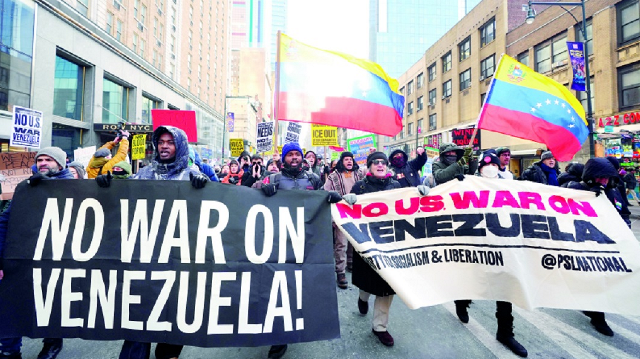
Thousands of people marched in major cities over the weekend to protest the U.S. military operation in Venezuela. The largest demonstration took place in New York City, where a diverse crowd walked from Times Square through Manhattan, calling the action illegal and an imperialist intervention.
In New York, protesters included unions, civil society groups, and residents from various ethnic communities. They carried signs saying “U.S. hands off Venezuela,” “No war for oil,” and “Trump, resign.” Participants argued the strike served economic interests rather than justice. City Councilman Zohran Mamdani supported the protest, calling the military operation “an act of war” and a violation of both U.S. and international law.
The protests were not limited to the United States. In Paris, demonstrators gathered at Place de la République, waving banners reading “End imperialist attacks on Venezuela” and burning U.S. flags. In Spain, far-left and communist groups organized marches featuring slogans such as “We don’t want to be a U.S. colony” and “U.S. Embassy bloody.” Anti-intervention protests also appeared in Germany, the Netherlands, Belgium, and Tunisia.
Experts say the coordinated protests highlight widespread global concern over unilateral military actions. Many argue that such interventions undermine the principles of national sovereignty and international law. Nations like Türkiye, which emphasize diplomatic solutions, see these public demonstrations as reflecting a universal principle: countries should be free to determine their own futures without outside interference.
Analysts note that the global reaction could influence U.S. foreign policy debates. Public opposition, expressed both domestically and abroad, underscores how military operations intended to change foreign governments face scrutiny not only from other states but also from citizens worldwide.
The New York march, among the largest, showed the intensity of public feeling. Organizers stressed the need for peaceful diplomacy and international cooperation rather than military force. Many participants said the strike endangered civilians and risked escalating regional instability.
Observers say that such mass protests signal a shift in public awareness. Citizens are increasingly calling for accountability in foreign policy decisions and questioning whether military actions align with international law and ethical standards.
The weekend demonstrations demonstrate that military actions are now subject to global public scrutiny. From the streets of Manhattan to European capitals, citizens are uniting around shared values of sovereignty, peace, and lawful conduct in international affairs.
These protests come amid rising debate over U.S. foreign interventions. The widespread coverage reflects not only opposition to a specific operation but also broader concerns about the use of force in global politics. Analysts predict that governments will face increased pressure from domestic and international publics to justify military actions clearly and transparently.