
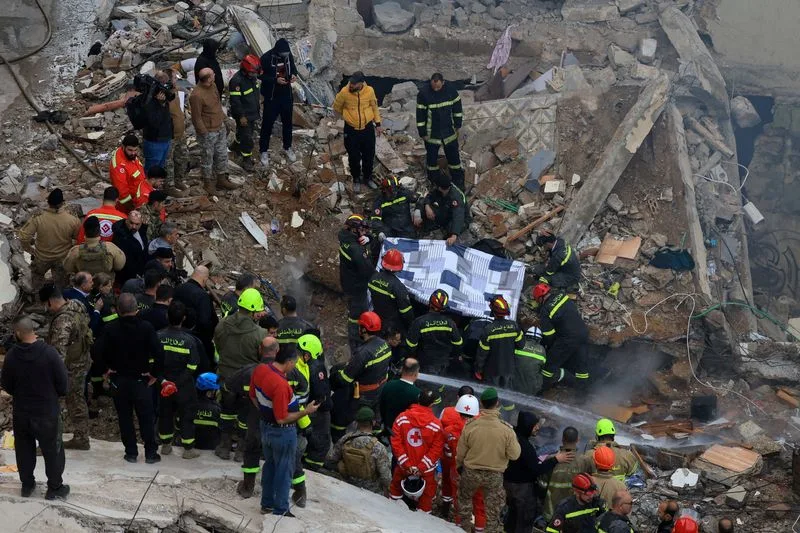
Fourteen people were confirmed dead after two residential buildings collapsed in the northern Lebanese city of Tripoli, bringing search and rescue operations to an end after days of recovery work. Authorities said several residents were also pulled alive from the rubble, while uncertainty remains over whether others are still unaccounted for.
According to Daljoog News analysis, the tragedy reflects a deeper and more dangerous pattern in Lebanon, where aging housing stock, weak oversight, and years of economic collapse are combining into a growing public safety crisis. The Tripoli incident is not an isolated failure but part of a broader breakdown.
The collapse occurred at a moment when Lebanon’s institutions are struggling to function, and when cities like Tripoli, already among the country’s poorest, face mounting pressure from neglect, overcrowding, and decaying infrastructure that has long gone without repair.
What Happened?
The collapse took place in Bab al-Tabbaneh, a densely populated neighborhood in Tripoli, Lebanon’s second-largest city. According to Lebanon’s National News Agency, two adjoining residential buildings gave way, sending concrete slabs and debris crashing down on residents inside.
Civil defence director general Imad Khreiss confirmed that rescue teams recovered 14 bodies from the site. Eight people were rescued alive and transferred to hospitals for treatment. Search and rescue operations ended after crews cleared the remaining rubble and found no further survivors.
Local officials said the buildings housed multiple families. Earlier estimates from civil defence officials suggested that around 22 people lived in the two structures, but authorities have not confirmed whether all residents were accounted for at the time of the collapse.
Tripoli municipal council head Abdel Hamid Karameh said it remained unclear if anyone was still missing. He acknowledged that poor records, informal housing arrangements, and population movement make it difficult to determine exact occupancy figures in many older buildings across the city.
The incident followed a series of smaller structural failures reported in Tripoli in recent weeks. Municipal officials have repeatedly warned that dozens of residential buildings are at risk due to age, lack of maintenance, and damage worsened by years of power outages and water leaks.
Why This Matters
The deadly collapse underscores the growing physical danger facing residents in Lebanon’s urban centers, especially in low-income areas. In Tripoli, many buildings date back several decades and were constructed without modern safety standards or consistent inspections.
Lebanon’s prolonged financial crisis has left both homeowners and municipalities unable to carry out basic repairs. With banks restricting access to savings and the national currency sharply devalued, even minor structural fixes have become unaffordable for many families.
Tripoli is particularly vulnerable. The city has long suffered from high unemployment, underinvestment, and political marginalization. As buildings deteriorate, residents are often forced to stay despite visible cracks, sagging walls, or water damage, because they have nowhere else to go.
Beyond the immediate loss of life, the collapse raises serious questions about public safety enforcement. Building inspections are sporadic, warning notices are rarely followed by action, and evacuations are difficult to enforce without offering alternative housing options.
The incident also risks deepening public anger at a time when trust in state institutions is already fragile. Each collapse reinforces the perception that authorities respond only after tragedy strikes, rather than preventing disasters before they happen.
What Analysts or Officials Are Saying
Civil defence officials described the operation as complex and dangerous, noting that unstable debris and narrow streets slowed rescue efforts. They stressed that teams worked around the clock despite limited equipment and funding.
Municipal authorities have again pointed to the condition of Tripoli’s building stock, saying many structures are well beyond their intended lifespan. Local officials argue that years of central government neglect have left municipalities with responsibilities but few resources.
Urban planning specialists in Lebanon have warned that the risk of further collapses is rising, particularly during winter months when rainwater seeps into foundations and weakens already fragile structures. Power cuts also prevent the use of pumps that could reduce water buildup in basements.
Some officials have called for emergency surveys of at-risk buildings, while acknowledging that previous assessments were never fully implemented due to funding shortages and political paralysis. Others argue that without national-level intervention, local governments cannot address the scale of the problem.
Daljoog News Analysis
This collapse should be seen less as a sudden accident and more as the predictable outcome of long-term neglect. Lebanon’s infrastructure crisis is not limited to electricity or water systems; it is now visibly eroding the safety of homes themselves.
Tripoli’s experience highlights a dangerous cycle. Poor residents live in aging buildings because they cannot afford alternatives. Municipalities identify risks but lack funds to act. Central authorities delay decisions amid political deadlock. When a building finally collapses, responsibility is shared so widely that accountability disappears.
What makes the situation more alarming is the normalization of these incidents. As collapses become more frequent, public outrage fades faster, replaced by resignation. This gradual acceptance is perhaps the most damaging consequence, as it reduces pressure for meaningful reform.
Daljoog News analysis suggests that without an emergency housing and inspection program backed by international support, similar tragedies are likely to repeat. Preventive action would cost far less, both financially and socially, than continued disaster response.
The collapse also exposes inequality in Lebanon’s recovery narrative. While parts of the country show signs of economic adaptation, cities like Tripoli remain trapped in decline, bearing the heaviest human cost of state failure.
What Happens Next
Authorities are expected to conduct structural assessments of nearby buildings in Bab al-Tabbaneh to determine whether additional evacuations are necessary. However, experience suggests such measures may be limited in scope and duration.
Families displaced by the collapse now face uncertain housing options. Temporary shelter arrangements are often short-term, and long-term relocation remains rare due to funding constraints. Aid organizations may step in, but their reach is limited compared to the scale of need.
At the national level, the incident could renew calls for a comprehensive building safety audit, particularly in older urban districts. Whether those calls translate into action will depend on political will and access to external financial support.