
The United States launched a military strike on Kharg Island, a vital artery of Iran’s oil exports, escalating tensions in the Middle East. The operation targeted Iranian military installations while leaving oil infrastructure largely intact.
According to Daljoog News analysis, the attack signals a deliberate US strategy to pressure Tehran without fully halting crude exports, sending a warning about potential disruption of global oil flows.
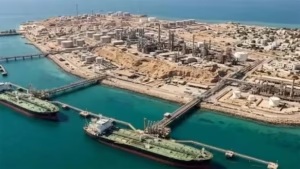
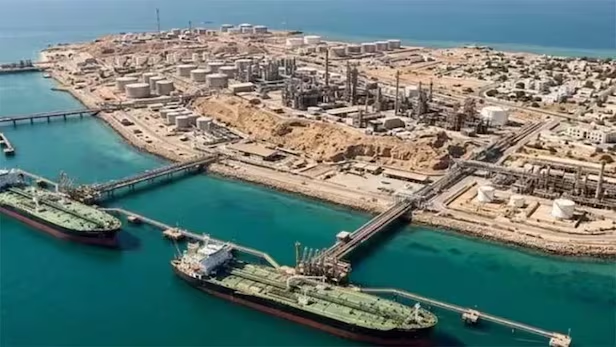
Kharg Island, located about 30 kilometers off Iran’s northern Persian Gulf coast, is central to the country’s energy economy, handling up to 90% of Iran’s crude exports via deepwater ports that allow large tankers to access international markets.
What Happened?
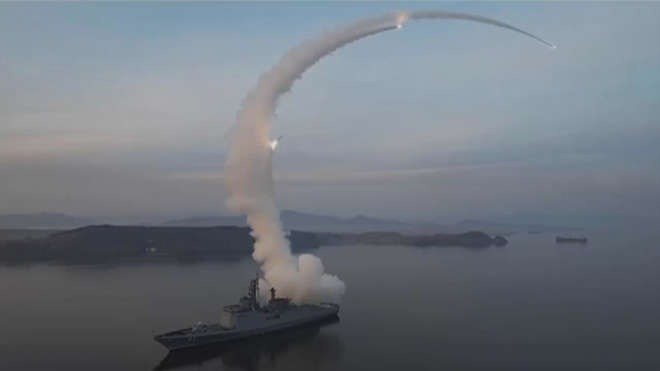
In the early hours of the strike, multiple bombs detonated across Kharg Island, shaking the island and creating massive smoke plumes visible from miles away. The White House described the operation as one of the most significant US military actions in the region in recent years.
US officials clarified that the primary focus was on military targets, leaving the oil terminals and pipelines operational. Analysts note this was a calculated decision: to demonstrate capability while avoiding an immediate energy crisis.
The island’s strategic location near the Strait of Hormuz makes it critical for the global energy supply. Iran channels crude from its main oil fields via pipelines to Kharg Island, where tankers transport it to markets in Asia, including China, and beyond.
Why This Matters
Kharg Island is considered a “nerve center” of Iran’s economy. Any significant disruption could instantly cripple Tehran’s oil exports, sending shockwaves through global energy markets.
The attack has already caused fluctuations in oil prices, reflecting market anxiety about supply from the Persian Gulf. Approximately 20% of global oil shipments pass through the Strait of Hormuz, amplifying the risk to energy security.
Analysts warn that this strike marks a new phase in US-Iran tensions, reviving memories of attacks on Kharg Island during the Iran-Iraq war in the 1980s, when Saddam Hussein targeted the island to weaken Iran economically.
What Analysts or Officials Are Saying
Defense experts describe the strike as a “strategic warning” rather than a full-scale disruption of Iran’s oil exports. By targeting military installations while sparing oil terminals, the US demonstrates its ability to escalate operations if needed.
Energy analysts caution that even limited attacks on Kharg Island could create global ripple effects, particularly for Asian markets heavily reliant on Iranian crude.
Officials suggest that the operation also sends a political message to Tehran: while Washington is avoiding a total blockade, it reserves the right to strike energy infrastructure at any time, underscoring the vulnerability of Iran’s oil-dependent economy.
Daljoog News Analysis
The Kharg Island strike reflects a calculated escalation by the US in response to Iran’s missile campaigns and broader Middle East tensions. By leaving oil infrastructure intact, Washington balances immediate military objectives with the avoidance of a full-blown energy crisis.
However, the symbolic and strategic impact is significant. The operation underscores Iran’s economic vulnerability, highlighting a single point that sustains nearly all of its crude exports. Analysts argue that this approach sends a clear deterrent message while increasing pressure on Tehran.
Market reactions indicate heightened sensitivity to potential supply disruptions, particularly in Asia. Any miscalculation could spark broader regional instability, reinforcing the interconnected nature of military action and global energy markets.
What Happens Next
The immediate focus will be on monitoring Iranian responses and the security of maritime oil routes from Kharg Island.
Energy markets will continue to react to geopolitical developments, particularly given the island’s proximity to the Strait of Hormuz.
Further US military actions could target additional Iranian military facilities, but analysts expect Washington to proceed cautiously to avoid directly halting exports.