
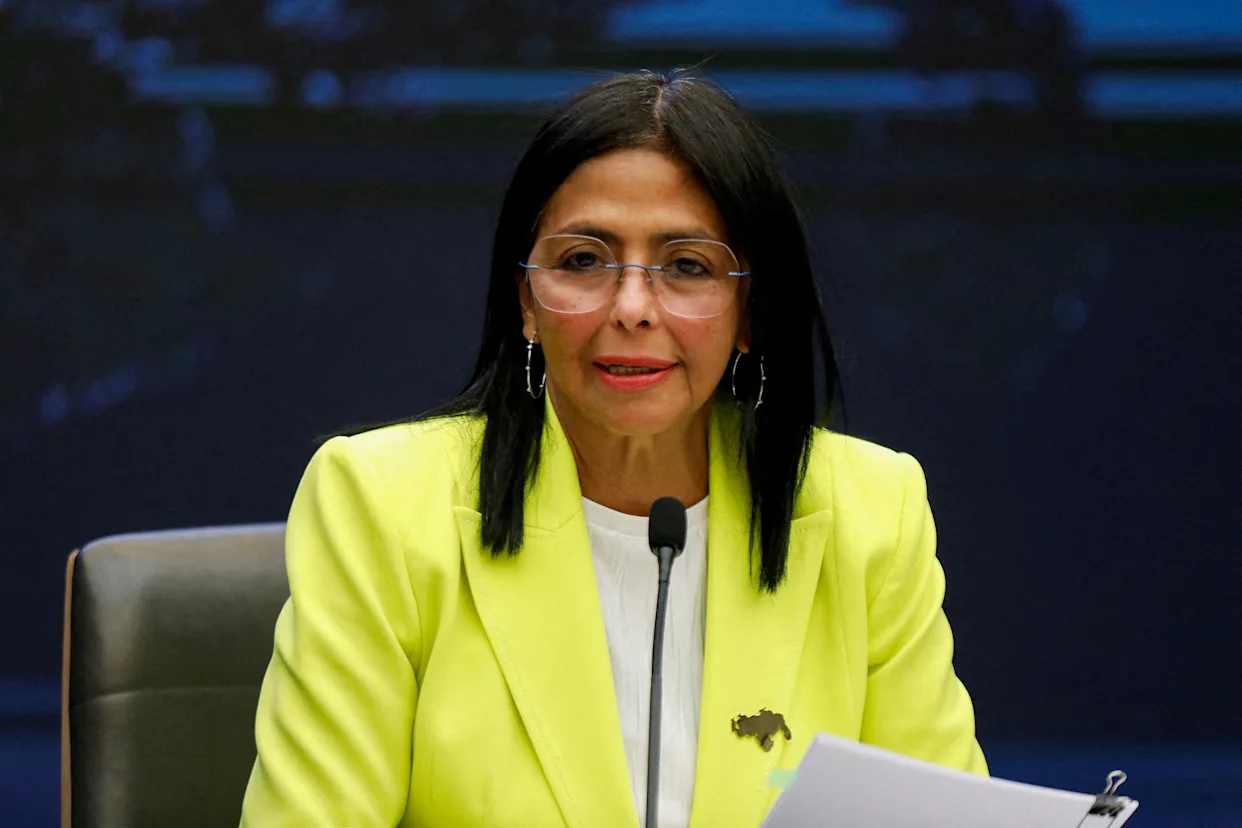
Venezuela’s interim President Delcy Rodriguez has signaled a shift in tone, saying she is ready to work with the United States on the country’s future.
Rodriguez, who was Maduro’s deputy since 2018, became interim leader after the Supreme Court of Venezuela appointed her following the capture of President Nicolás Maduro and his wife, Cilia Flores, by US special forces. The operation has been described as one of the riskiest since the Navy SEAL raid in Pakistan that killed Osama bin Laden in 2011.
On Sunday, Rodriguez posted on Telegram, “We consider it a priority to move towards a balanced and respectful relationship between the US and Venezuela.” She added, “We extend an invitation to the US government to work together on an agenda for cooperation that is aimed towards shared development.”
The announcement represents a major change from her immediate response after Maduro’s capture. In a televised address on Saturday, Rodriguez condemned the US operation as “an atrocity that violates international law,” insisting that “the only president of Venezuela [is] President Nicolás Maduro.”
Her initial remarks created tension with the Trump administration. In the immediate aftermath, Trump had suggested that Rodriguez was willing to cooperate with US officials. However, after she labeled his administration “extremists” on television, Trump escalated his rhetoric.
“If she doesn’t do what’s right, she is going to pay a very big price, probably bigger than Maduro,” Trump told The Atlantic in a Sunday interview. He also warned that further strikes in Venezuela could occur and did not rule out deploying “boots on the ground,” declaring that the US was now “in charge.”
Rodriguez’s latest statements, in contrast, aim to reduce tensions and build dialogue with the United States. Observers note that this approach could help stabilize Venezuela’s political situation and avoid escalating conflicts with the international community.
In addition, Rodriguez has launched a commission to seek the release of Maduro and Flores from US detention. Maduro is currently facing charges including “narcoterrorism conspiracy, cocaine importation conspiracy, possession of machineguns and destructive devices, and conspiracy to possess machineguns and destructive devices.”
The commission will be co-chaired by Venezuelan Foreign Minister Yvan Gil and her brother, Jorge Rodriguez, who is president of Venezuela’s National Assembly. Its goal is to negotiate with US authorities and explore possible legal or diplomatic resolutions.
Political analysts note that Maduro’s situation could resemble that of former Panamanian President Manuel Noriega. Noriega was seized by US forces in 1990, faced racketeering, drug smuggling, and money laundering charges, and served time in multiple countries before his death in 2017.
Maduro is scheduled to appear in a New York federal court on Monday. US officials describe his capture as a law enforcement action linked to criminal charges filed in 2020. The charges accuse Maduro of narco-terrorism and related crimes.
Trump, however, has suggested that other factors motivated the raid. He cited Venezuela’s previous nationalization of US oil assets and recent increases in Venezuelan immigration to the United States as contributing reasons.
The unfolding situation has drawn international attention and sparked protests in the US and worldwide. Critics argue that the US operation contradicts Trump’s “America First” promise to avoid endless foreign conflicts, as well as his past warnings against regime change, including the Iraq War.
Rodriguez’s outreach may mark a turning point in US-Venezuelan relations. By emphasizing cooperation and shared development, she seeks to move past initial confrontations and create space for dialogue. Her approach could be key to preventing further escalation and stabilizing the country’s political and economic environment.
Observers are closely monitoring the new commission and Rodriguez’s interactions with US officials. The coming days may reveal whether her willingness to cooperate will ease tensions or face challenges amid high-profile legal proceedings and international scrutiny.