


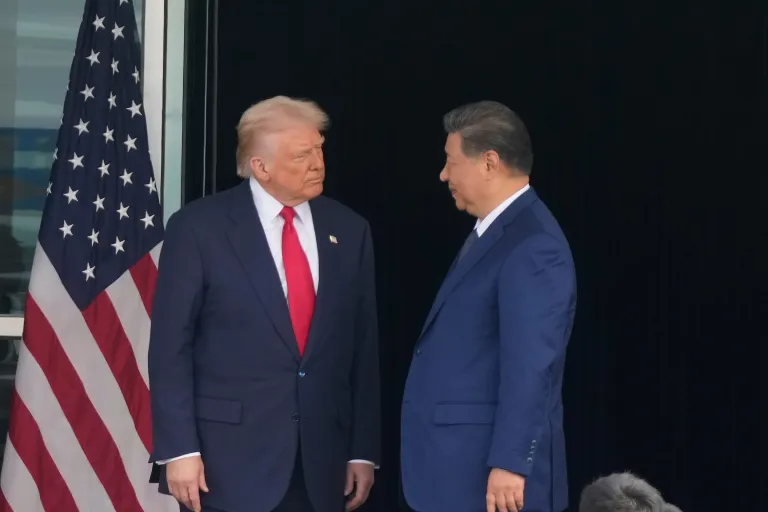
President Donald Trump announced Monday that he will travel to Beijing in April and host Chinese President Xi Jinping for a U.S. state visit later in the year.
Trump announced a phone call with Xi, weeks after their in-person meeting in South Korea in late October. He called the relationship “extremely strong” on Truth Social, adding that the visits aim to focus on the “big picture” of U.S.-China relations.
“President Xi invited me to visit Beijing in April, which I accepted, and I reciprocated, where he will be my guest for a State Visit in the U.S. later in the year,” Trump wrote.
The travel plans come amid ongoing trade negotiations. The Trump administration outlined a trade deal framework with China that includes renewed purchases of U.S. soybeans and eased export restrictions on rare earth minerals. Both commitments remain pending full compliance from China.
According to White House press secretary Karoline Leavitt, the hour-long call focused on the trade deal, agricultural exports, fentanyl, and broader U.S.-China relations. Leavitt described the conversation as “very positive” and said it highlighted progress in moving relations forward.
Chinese state media reported that the discussion touched on Taiwan, with Xi reiterating that “Taiwan’s return to China is an integral part of the post-war international order.” Trump noted that Taiwan had not been discussed during their South Korea meeting.
Trump’s planned April visit to Beijing and Xi’s later U.S. trip are part of ongoing efforts to strengthen bilateral relations. During their October meeting in South Korea, Trump first mentioned the reciprocal visits, suggesting Xi would travel to either Florida or Washington, D.C., after Trump’s China trip.
The trade discussions are seen as a key element of the visits. Soybeans are a major U.S. export to China, and rare earth minerals are critical for industries such as electronics and renewable energy. Analysts say the trade framework could signal progress in reducing tensions over tariffs and economic competition, though full implementation remains uncertain.
Trump has emphasized the importance of these visits in terms of diplomacy and economic engagement. The announcements underscore his focus on forging direct relationships with foreign leaders and pursuing trade agreements that benefit U.S. interests.
Observers note that the visits could also have geopolitical implications. While trade and agriculture are central topics, discussions on regional security, including Taiwan and North Korea, are likely to be important background issues. The call reportedly also included brief discussion of the Russia-Ukraine war and its broader effects on global trade and security.
If the visits proceed as planned, Trump will return to China for the first time since leaving office, while Xi will make a formal state visit to the U.S., strengthening diplomatic channels and signaling a willingness to engage at the highest level.
Trump’s announcements follow a pattern of direct engagement with China, highlighting his approach to combining economic and political discussions in high-profile meetings. Political analysts suggest that these trips could have implications for U.S.-China trade policy and may also affect global markets, particularly in agriculture and technology sectors.
The April trip and reciprocal state visit later in the year mark the first major schedule of formal visits between the two leaders since Trump left office. Officials from both sides say the visits will provide opportunities to discuss trade, security, and diplomatic cooperation while reinforcing mutual commitments to dialogue and stability.