



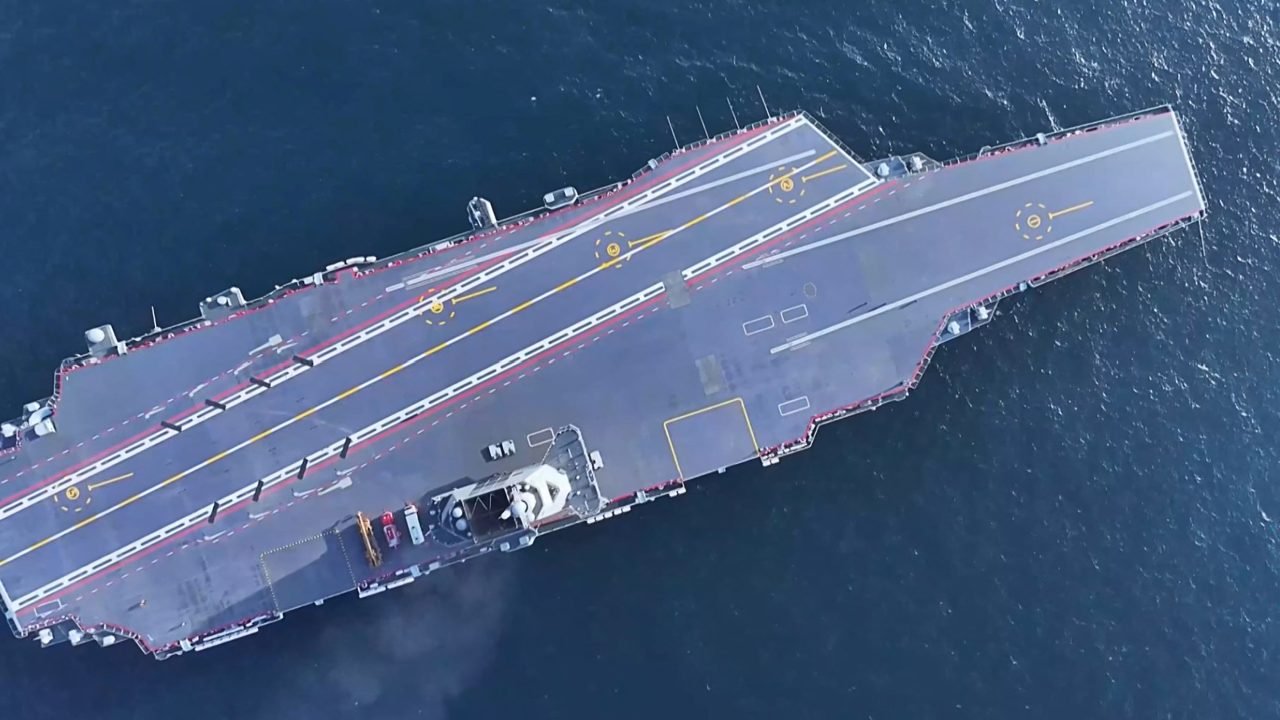
Chinese military watchers are closely monitoring the country’s aircraft carrier expansion, focusing on whether a new conventional carrier, dubbed the Type 003A, is in the works. While satellite imagery has confirmed a nuclear-powered Type 004 carrier under construction, no concrete evidence yet confirms a new conventional carrier.
In November 2025, China commissioned the Type 003 Fujian, a CATOBAR carrier capable of launching both fighter jets and early warning aircraft. This marks a major upgrade from its earlier carriers, the Type 001 Liaoning and Type 002 Shandong, which use ski jumps for STOBAR operations. Fujian also supports China’s new fifth-generation J-35 fighter, in addition to the older J-15.
China’s rapid naval expansion—from one carrier in 2018 to three today—has fueled speculation that a Type 003A could appear to maintain fleet growth while the Type 004 nuclear carrier is being developed. Analysts suggest that building additional conventional carriers could allow China to keep pace with U.S. carrier numbers in the Western Pacific, especially given plans to field up to nine carriers by 2035.
Clues pointing to a potential Type 003A include developments at Wuhan, where a large carrier-shaped training facility has been used to practice deck operations. The facility has been reconfigured in ways observers say could accommodate both the larger Type 004 and a new conventional carrier design. Modifications to the tower and smoke stack have led some Chinese analysts to suggest that the configuration could reflect the Type 003A.
Additional hints include unverified ship models shared on Chinese social media showing a Type 003A with a tower and exhaust layout similar to the Wuhan facility. Analysts argue these changes could address design challenges identified on the Fujian, such as the placement of the smoke stack relative to other systems.
However, major uncertainties remain. Satellite imagery of Jiangnan Shipyard, where the Fujian was built, has not revealed any clear hull under construction for a Type 003A. This has led some observers to question whether the carrier is being built at all or if the Type 004 nuclear carrier will be prioritized instead.
Some analysts point out logical inconsistencies in the Wuhan setup. For example, building a Type 003A tower at the same facility used for the Type 004 could complicate testing. The tower’s current placement does not fully align with either Type 004 or speculative Type 003A models.
Despite these uncertainties, there is strong reasoning for China to build more conventional carriers. Even though they are less capable than nuclear carriers, conventional carriers remain effective platforms and could allow the navy to maintain fleet numbers while Type 004 construction and testing proceed. Historically, the U.S. operated conventional carriers alongside nuclear carriers to meet strategic fleet requirements.
Ultimately, whether the Type 003A is under construction remains uncertain. Analysts agree that if China intends to expand its carrier fleet rapidly, a new conventional carrier would make sense. Without evidence of its construction soon, the assumption that China will continue fleet expansion at its current pace could be challenged.
For now, the Type 003A exists in a state of limbo. It is widely discussed and anticipated, yet unconfirmed. Observers will continue to watch satellite imagery, shipyard activity, and naval training facilities closely to determine whether China’s next conventional carrier will join its rapidly evolving fleet.