


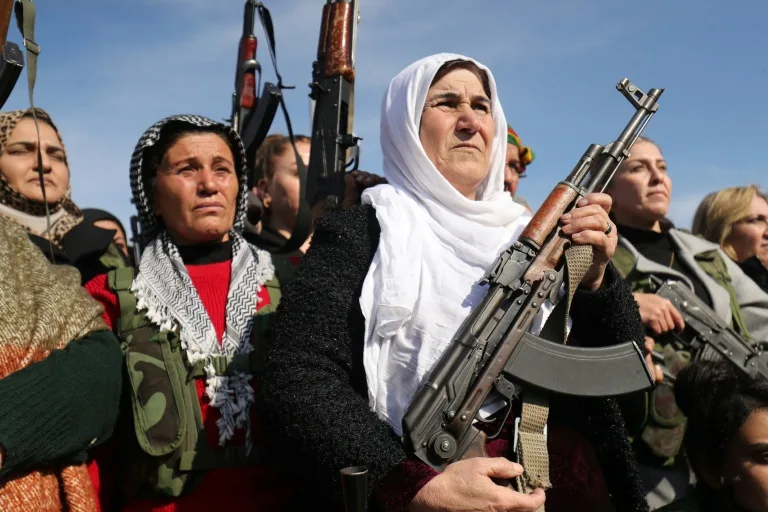
Syria’s government and Kurdish forces reached a historic deal on Friday to gradually integrate the Kurds’ military and civilian institutions into the state. Washington called the agreement a “historic milestone.”
In recent weeks, the Kurdish-led Syrian Democratic Forces (SDF) have handed over large areas of Arab-majority land to government forces. These territories were previously held by the Kurds after battles against the Islamic State, supported by a U.S.-led coalition.
The deal, released by both sides, aims to “unify Syrian territory and achieve full integration” of the Kurdish-majority region. It maintains a ceasefire and introduces a gradual integration of Kurdish forces and administrative institutions.
SDF leader Mazloum Abdi told Kurdish television the agreement would take effect on February 2. Both sides will pull back forces from frontline positions in Kobane and the al-Jazeera area in the northeast. He added, “A limited internal security force will enter the security districts in Hasakeh and Qamishli to implement the integration agreement. No military forces will enter any Kurdish city or town.”
The SDF was a key partner of Washington in the anti-IS campaign. Since Syria’s longtime ruler, Bashar al-Assad, was toppled in late 2024, the United States has moved closer to the new authorities in Damascus. Washington recently declared the Kurdish alliance largely over and helped mediate talks between the government and the Kurds.
The new deal follows an earlier understanding on the future of majority-Kurdish areas in Hasakeh province and Kobane. It appears to meet some Kurdish demands, including establishing brigades of SDF fighters in Kurdish-majority regions. Damascus had previously rejected the idea of ethnically based military units.
Kurdish politician and negotiator Elham Ahmad said the deal enforces a “permanent ceasefire.” She added that the United States and France are guarantors of the agreement, though talks continue over integration details. Raman Sido, a resident of Qamishli, said the deal’s main benefit is reducing Kurdish-Arab tensions and avoiding conflict, but he warned it still lacks clarity on administration and implementation.
During Syria’s civil war, the Kurds carved out a de facto autonomous region as they advanced against IS. Syria’s new authorities now aim to extend state control across the country. Syria’s state media reported that under the agreement, “the state will assume control over all civilian and governmental institutions, as well as border crossings.” A government source added, “No part of the country will remain outside its control.”
For years, Kurdish forces controlled long stretches of the border with Turkey and Iraq. With most crossings closed, traffic passed mainly through one gateway with Iraqi Kurdistan. The deal integrates three SDF brigades into the Syrian army in Hasakeh, and another brigade in Kobane, around 200 kilometers from Hasakeh. Administrative institutions will also merge into state structures, retaining existing employees.
Lars Hauch, a Syria expert, said the deal “suggests remnants of the SDF will continue to exist, but the text is vague on administrative and security decentralization.” He described it as “an advanced memorandum of understanding, not a final agreement.”
US envoy to Syria Tom Barrack called the deal a “historic milestone” that reflects inclusion, mutual respect, and collective dignity for all Syrian communities. Ahmad criticized Washington for declaring the SDF’s mission against IS over, hoping the US will “play a fair role for everyone in Syria.”
French President Emmanuel Macron welcomed the agreement and pledged support for its full implementation. However, some Kurds remain cautious. Shop owner Abu Ali said, “We don’t trust this government,” recalling past massacres blamed on government forces against minorities.
The agreement marks a key step toward unifying Syria, ending long-standing tensions, and integrating Kurdish-held regions under state control.