


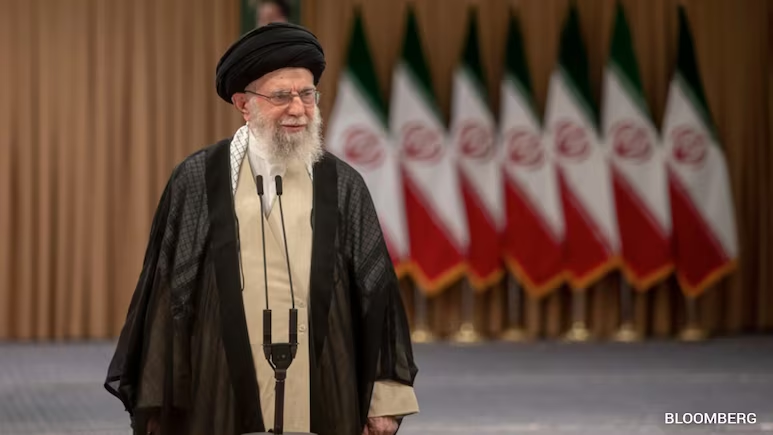
Iran has long been perceived as a shadow in Western political imagination—an entity that was expected to fade from history. Yet, it remains active, influential, and capable of strategic negotiation.
According to Daljoog News analysis, Iran’s endurance is less about raw military power and more about its institutional resilience. Its survival challenges assumptions that it could be easily sidelined or transformed by external pressure.
The country’s continuing presence in regional and international affairs, despite decades of sanctions and diplomatic isolation, underscores a reality that Western policymakers often struggle to accept.
What Happened?
For decades, the United States and much of Europe have treated Iran as a stalled political system. Elements like religious leadership, the Revolutionary Guard, anti-Western rhetoric, and its nuclear program were often portrayed as relics of the past rather than part of a functioning state.
This framing created the impression that the Islamic Republic was a temporary anomaly whose collapse was inevitable. However, the reality repeatedly contradicts this narrative. Despite sanctions and diplomatic pressure, Iran has adapted its strategy, formed new alliances, and retained its negotiation leverage.
This resilience has unsettled Western policymakers, as the state they once sought to marginalize now regularly sits at negotiation tables, including recent talks in Muscat, Oman.
Why This Matters
Iran’s endurance challenges a key assumption of Western foreign policy: that sanctions and diplomatic isolation will force political transformation. Instead, Iran has used these pressures to refine its strategy and maintain sovereignty, institutional stability, and clear national interests.
The country’s political model combines sovereignty, religious authority, and revolutionary legitimacy. Unlike a failed state, Iran deliberately pursues a model that balances internal control with engagement on its own terms. This makes it a persistent and strategic actor in global affairs.
What Analysts or Officials Are Saying
Analysts note that Western approaches to Iran have historically oscillated between coercive pressure and conditional dialogue. Both strategies often operate under the assumption that the Islamic Republic is temporary and can be reshaped.
Former Australian Human Rights Commissioner Chris Sidoti has emphasized that Western governments sometimes struggle to reconcile diplomatic protocol with accountability, given Iran’s enduring presence. Current negotiations demonstrate that Iran is not merely reacting—it actively asserts its role as a stakeholder in regional and international decisions.
Daljoog News Analysis
From a Daljoog News perspective, Iran represents a clash of expectations versus reality. Western policymakers often view the country as a relic or a state destined for transformation. In practice, Iran navigates the present and asserts itself into the future.
The complexity arises because Iran does not see integration into Western liberal frameworks as mandatory. Its strategies are calculated, combining national sovereignty with pragmatic engagement. This approach has made Iran a resilient actor capable of surviving pressures that would destabilize many other states.
What Happens Next
Negotiations and diplomatic meetings with Iran continue to unfold. While immediate breakthroughs may be limited, the discussions themselves demonstrate a recognition: Iran is a permanent player in the international system.
Western states must now contend with the reality that sanctions, neglect, or rhetorical pressure cannot erase Iran from the global stage. Coexistence and strategic engagement appear to be the only practical path forward.
Iran’s example highlights a critical lesson for global diplomacy: resilience, institutional memory, and strategic patience often outweigh short-term coercion in shaping the international order.