


President Donald Trump has threatened to block the opening of a major new bridge linking Michigan and Canada, injecting fresh uncertainty into an already strained U.S.–Canada relationship and placing a key cross-border trade project at risk.
According to Daljoog News analysis, the threat marks a sharp escalation in Trump’s use of infrastructure as leverage, tying a long-planned transportation link to broader disputes over trade, tariffs, and Canada’s foreign policy choices.
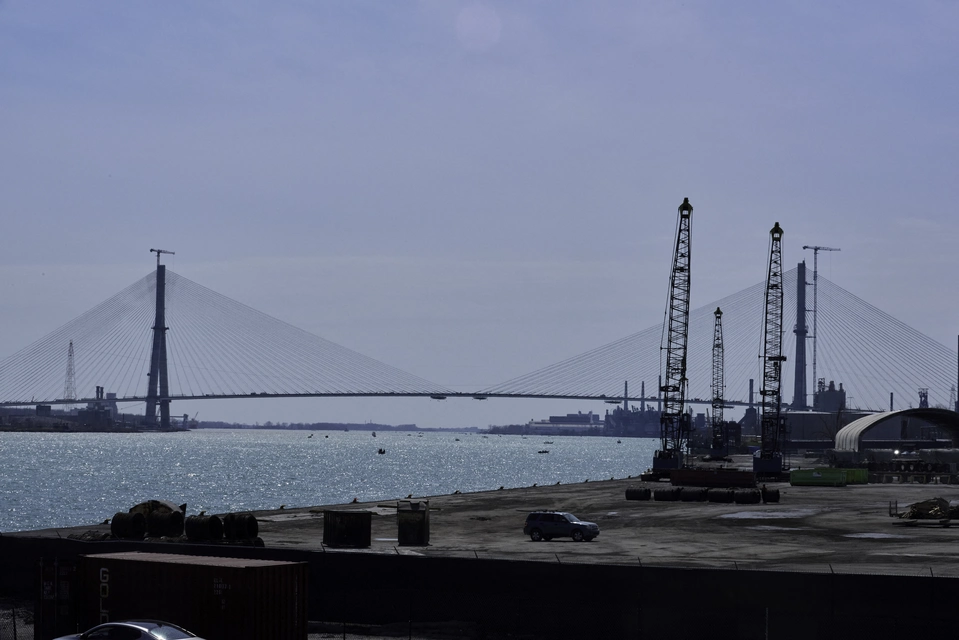
The warning comes as the Gordie Howe International Bridge nears completion ahead of an expected early 2026 opening, raising concerns among businesses, regional leaders, and trade groups on both sides of the border.
What Happened?
In a Monday evening post on Truth Social, Trump said he would not allow the Gordie Howe International Bridge to open unless the United States is “fully compensated” for past support to Canada and receives what he described as fair and respectful treatment.
Trump also said negotiations over the bridge would begin immediately and suggested that the United States should own at least half of the asset, despite the project being financed and overseen by Canada.
The bridge spans the Detroit River and will connect Detroit, Michigan, with Windsor, Ontario. Once operational, it is expected to ease congestion at existing crossings and become the only bridge between the two cities that accommodates pedestrians and cyclists.
Construction began in 2018 and is being carried out under the Windsor-Detroit Bridge Authority, a Canadian federal Crown corporation. Canada is responsible for funding the project and for operating, maintaining, and rehabilitating the bridge for the next 36 years.
Trump’s remarks targeted Prime Minister Mark Carney’s government, which he accused of acting hostile toward U.S. interests. He pointed to Canada’s decision to remove American-made spirits, including bourbon, from government-controlled liquor stores, a move Ottawa took in response to Trump’s repeated suggestions that Canada should become the 51st U.S. state.
He also criticized Carney’s recent engagement with Chinese President Xi Jinping, warning that a deal to allow greater access for Chinese electric vehicles would weaken Canada’s position with Washington.
Why This Matters
The Gordie Howe International Bridge is not just a regional infrastructure project. It sits at the heart of one of the world’s busiest trade corridors, carrying billions of dollars in goods each year between the United States and Canada.
Automotive manufacturing, agriculture, and advanced manufacturing all depend on reliable crossings between Michigan and Ontario. Any disruption or delay could ripple through supply chains already strained by tariffs, labor shortages, and geopolitical uncertainty.
Trump’s threat also raises legal and diplomatic questions. Presidential permits for cross-border infrastructure are governed by federal authority, but the bridge has already received approvals and is nearing completion. Blocking its opening could prompt court challenges and further strain bilateral relations.
For Canada, the remarks revive concerns that major U.S. infrastructure and trade decisions may once again become subject to abrupt political pressure. For U.S. border states, the dispute risks undermining years of planning aimed at modernizing aging trade routes.
What Analysts or Officials Are Saying
Canadian officials did not immediately respond to Trump’s comments. Spokespersons for Prime Minister Carney and Ontario Premier Doug Ford declined to comment when contacted.
Carney has pushed back on claims that Canada is pursuing a free-trade agreement with China, acknowledging that such a move would jeopardize Canada’s trade relationship with the United States. His government has insisted that engagement with Beijing does not come at Washington’s expense.
Business leaders reacted with concern. Candace Laing, president and CEO of the Canadian Chamber of Commerce, warned that blocking or barricading bridges would be economically self-defeating. She argued that long-term prosperity depends on strengthening, not dismantling, established trade corridors.
Trump also used his post to revisit older grievances. He criticized former President Barack Obama for granting Canada a waiver related to the Buy American Act, claiming it allowed Canadian projects to bypass the use of U.S.-made steel and materials.
That criticism contrasts with Trump’s own past support for the bridge. During his first term, Trump and then-Prime Minister Justin Trudeau issued a joint statement in 2017 expressing support for the project and calling for its rapid completion. Trump’s transition team also reportedly listed the bridge as an infrastructure priority that year.
In addition, Trump cited Canada’s long-standing dairy tariff system, which imposes high duties on imports above certain quotas. He said the policy has harmed U.S. farmers and remains unacceptable.
Daljoog News Analysis
The bridge dispute illustrates how Trump increasingly blends trade, diplomacy, and domestic politics into a single negotiating framework. Infrastructure, once treated as a technical or economic matter, is now being wielded as a pressure point.
By threatening to block a project largely financed by Canada, Trump is signaling that no cross-border asset is immune from renegotiation. That approach may appeal to supporters who favor aggressive bargaining, but it also introduces instability into long-term planning for both governments and businesses.
The reference to Chinese electric vehicles is especially telling. The administration appears determined to limit Beijing’s influence in North American markets and is willing to pressure allies publicly to achieve that goal. Canada’s balancing act between economic diversification and U.S. dependence is becoming harder to maintain.
There is also a credibility question. Trump’s previous endorsement of the bridge weakens the argument that it is fundamentally unfair to the United States. Reversing course at this late stage risks reinforcing perceptions of unpredictability in U.S. policy.
For regional economies in Michigan and Ontario, the uncertainty is costly. Delays or ownership disputes could discourage future cross-border infrastructure investments, even as trade volumes continue to grow.
What Happens Next
It remains unclear whether Trump will follow through on blocking the bridge or use the threat as leverage in broader negotiations with Ottawa.
If formal talks begin, they are likely to involve multiple federal agencies, state officials in Michigan, and Canadian counterparts. Legal challenges could arise if the administration attempts to alter ownership or operational agreements already in place.
Canada may also seek to rally business groups and U.S. border-state leaders to push back against any disruption, emphasizing the economic costs for American workers and exporters.
As the expected 2026 opening approaches, the bridge has become a symbol of more than connectivity. It now stands at the intersection of trade disputes, great-power competition, and the future tone of U.S.–Canada relations. Daljoog News will continue to monitor developments closely.