


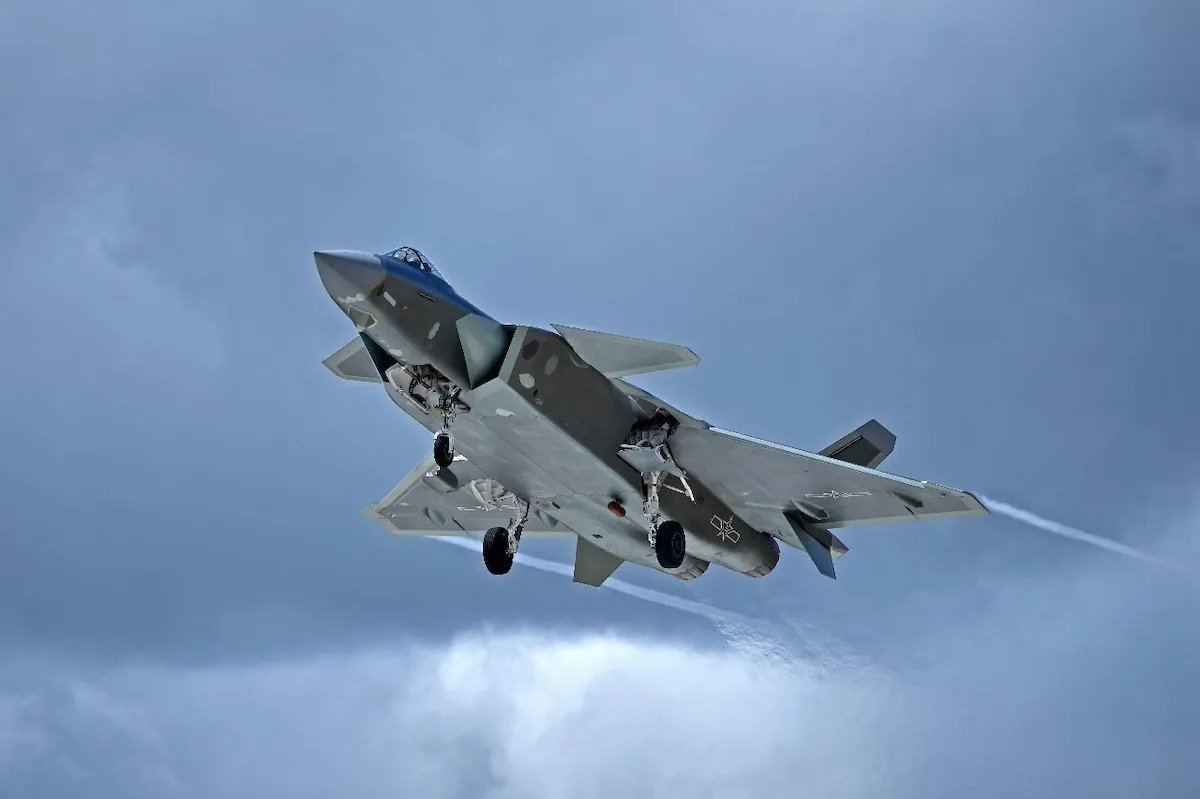
Speculation intensified after a scale model of China’s fifth-generation fighter jet, the Chengdu J-20, was presented to an Iranian military commander during a ceremony in Tehran. Images and video shared by Iranian media quickly sparked debate over whether the gesture signals a future weapons transfer.
According to Daljoog News analysis, the event does not confirm an actual delivery of the aircraft. However, it highlights growing defense coordination between Beijing and Tehran at a time of rising regional tension.
The moment comes as Iran seeks to modernize its military under heavy Western sanctions. At the same time, strategic rivalry between the United States and China is increasingly intersecting with Middle Eastern security dynamics.
What Happened?
During a formal event in Tehran, a senior Chinese military official handed a model of the J-20 fighter jet to Brigadier General Bahman Behmard. Iranian state media broadcast the ceremony, fueling immediate speculation.
The J-20 is China’s fifth-generation stealth fighter developed by Chengdu Aerospace Corporation. The aircraft officially entered service in 2017 and is known for its stealth design, long-range missile capability, and advanced avionics.
China’s Defense Ministry spokesperson Jiang Bin stated that Beijing is willing to share defense development achievements with friendly nations. He did not confirm any actual export of the J-20 to Iran.
Meanwhile, analyst Farzin Nadimi from The Washington Institute warned that supplying a fifth-generation jet to Iran would significantly strengthen Tehran’s deterrence posture and signal Beijing’s readiness to challenge U.S. sanctions pressure.
As of now, no independent source has verified that Iran has received the aircraft.
Why This Matters
Iran’s air force relies heavily on aging platforms, including pre-1979 American F-4 jets and Soviet-era MiG-29 aircraft. Sanctions have severely limited Tehran’s ability to modernize its fleet.
If Iran were to acquire the J-20, it would mark a major shift in the Middle East’s air power balance. The aircraft’s stealth capability could complicate regional air defense strategies and alter deterrence calculations.
Such a move would also raise concerns in Israel and the United States. Israel operates U.S.-supplied F-35 jets and has maintained a qualitative military edge in the region. A fifth-generation fighter in Iranian service would intensify competition in contested airspace.
Beyond military implications, heightened tensions in the Persian Gulf and the Strait of Hormuz could affect global energy markets and maritime security.
What Analysts or Officials Are Saying
Some defense experts believe the model presentation may be symbolic diplomacy rather than a sign of imminent delivery. Exporting one of China’s most advanced combat aircraft would represent a significant escalation in military cooperation.
Others argue that Beijing has been steadily expanding its defense export footprint. Joint projects with other nations show China’s willingness to enter competitive arms markets. However, the J-20 remains among China’s most sensitive platforms.
U.S. policymakers are closely monitoring the situation. A confirmed transfer would likely trigger diplomatic pushback and possibly additional sanctions.
Iranian officials have not publicly announced any procurement agreement. Still, Tehran continues to emphasize its determination to strengthen national defense capabilities despite restrictions.
Daljoog News Analysis
At this stage, evidence of an actual aircraft transfer is absent. A ceremonial model does not equate to operational deployment. Yet symbolic gestures in defense diplomacy often carry strategic meaning.
China is positioning itself as a global security actor, not only an economic partner. Deepening military ties with Iran could serve broader geopolitical objectives, particularly amid rising U.S.–China rivalry.
For Iran, access to next-generation airpower would represent a strategic breakthrough after decades of isolation. However, such a move would likely intensify international scrutiny and pressure.
Daljoog News assesses that the significance of this development lies less in the immediate hardware question and more in what it signals about shifting alliances and power balances in the Middle East.
What Happens Next
Attention will focus on whether any formal defense agreements emerge. A confirmed sale or transfer would provoke a swift international reaction.
The United States and its allies could respond with new sanctions or diplomatic measures aimed at discouraging advanced arms cooperation.
Regional states may accelerate their own air defense upgrades, potentially fueling a new phase of military competition.