


The U.S. Department of Defense transported a next-generation nuclear reactor by military aircraft from California to Utah on Sunday, marking a significant step in the Trump administration’s effort to modernize nuclear energy systems for national defense.
According to Daljoog News analysis, the airlift signals more than a technical milestone. It reflects a strategic shift toward deploying advanced nuclear systems to strengthen energy resilience at military installations and remote defense sites.
The operation follows a series of executive actions signed by President Donald Trump aimed at accelerating domestic nuclear development. Officials argue the move will reduce reliance on vulnerable grid infrastructure and reinforce long-term national security.
What Happened?
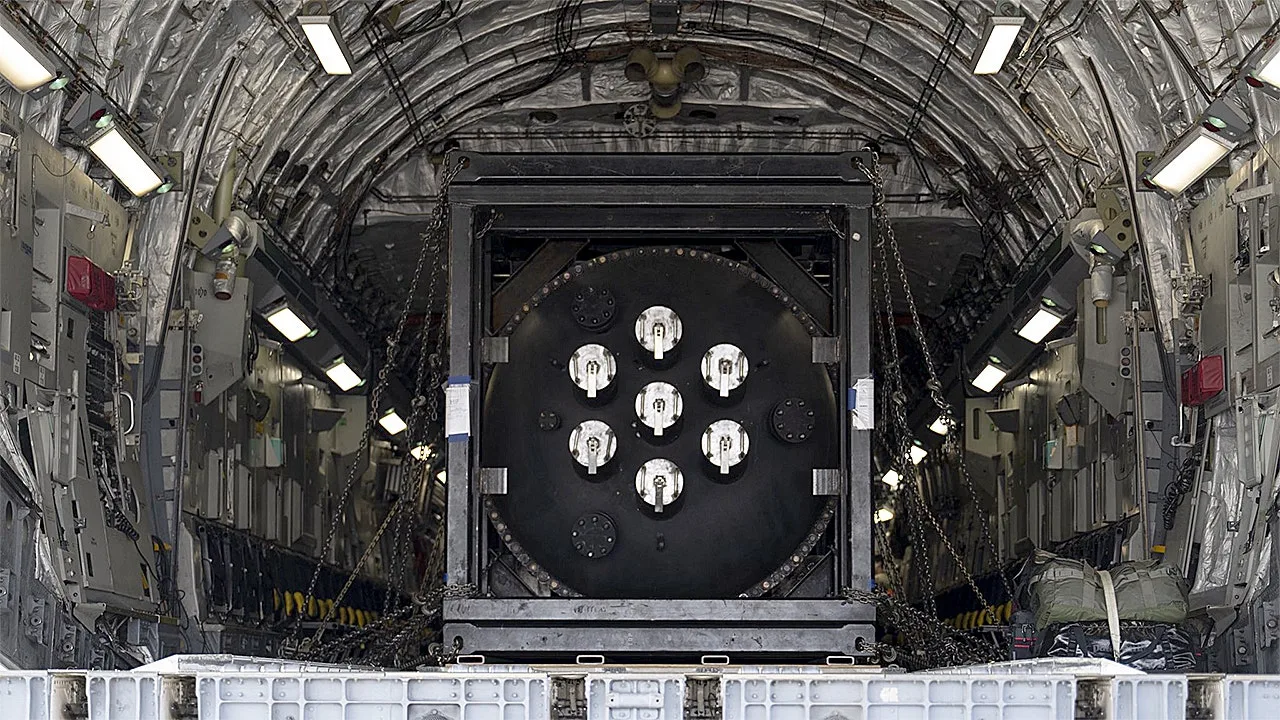
The reactor was flown aboard a U.S. Air Force C-17 cargo aircraft from March Air Reserve Base in California to Hill Air Force Base in Utah. Defense officials confirmed that the unit will next be transported to the Utah San Rafael Energy Lab in Orangeville for testing and evaluation.
Images shared by the Department of Defense showed the compact reactor being loaded onto the aircraft before departure.
The airlift aligns with executive orders signed by Donald Trump in May to expand nuclear energy research and deployment. Those directives call for faster reactor testing at national laboratories and pilot programs for new advanced reactor construction.
Defense leaders describe the transported system as a next-generation nuclear reactor designed to operate more flexibly than traditional large-scale nuclear plants. Officials say such systems could eventually power isolated military bases, Arctic installations, or overseas operations where stable grid access is limited.
The Department of Defense stated that successful installation and evaluation of the reactor would demonstrate the feasibility of using advanced nuclear energy for strategic defense purposes.
Why This Matters
Energy security is increasingly viewed as inseparable from national security. Military bases depend heavily on stable electricity to operate radar systems, cyber infrastructure, communications networks, and emerging technologies such as artificial intelligence.
Small or advanced nuclear reactors promise long-duration power generation without the fuel supply vulnerabilities associated with diesel or gas generators. In contested environments, supply lines can become strategic weak points.
The Trump administration has framed nuclear expansion as essential to maintaining U.S. global leadership in both energy and defense innovation. Officials argue that next-generation reactors could reduce dependency on foreign fuel sources while strengthening domestic industrial capacity.
The initiative also intersects with broader debates about grid reliability. Recent executive actions emphasize strengthening the electric grid against disruptions and reducing reliance on intermittent sources such as wind and solar.
What Analysts or Officials Are Saying
Defense Secretary Pete Hegseth has indicated that nuclear capacity could provide a competitive advantage in maintaining continuous military operations, particularly as energy demands rise with expanding digital infrastructure.
Interior Secretary Doug Burgum previously stated that U.S. nuclear leadership declined due to regulatory stagnation and overregulation. Administration officials argue that new reforms will streamline research and licensing processes.
The White House has described nuclear power as critical to supporting next-generation technologies and ensuring long-term industrial dominance. Officials contend that advanced reactors offer scalable, resilient solutions for defense applications.
Energy policy analysts note that advanced nuclear designs often feature modular construction, enhanced safety systems, and the ability to operate in remote locations. However, they also caution that testing and certification timelines can be lengthy.
Industry observers view the Utah test phase as a proving ground. Demonstrating operational reliability in a controlled environment will be key before broader deployment across military facilities.
Daljoog News Analysis
The airlifted reactor represents more than symbolism. It signals that nuclear modernization is moving from policy announcements to physical deployment.
For decades, nuclear innovation in the United States slowed as regulatory complexity increased and large-scale plant costs escalated. Advanced reactors aim to reverse that trajectory by offering smaller, more adaptable systems.
From a defense perspective, decentralized power generation could transform operational planning. Military planners increasingly consider infrastructure resilience as critical as weapons capability.
However, scaling this approach presents challenges. Advanced reactors must meet strict safety standards, secure fuel supply chains, and address long-term waste management concerns. Public acceptance also remains a factor, especially when reactors are tested near populated areas.
The administration’s emphasis on pairing nuclear modernization with traditional energy sources reflects a broader strategy to diversify rather than replace energy inputs. Whether this balanced approach holds over time will depend on performance results from pilot projects like the Utah deployment.
Daljoog News assesses that the testing phase will determine whether advanced nuclear systems transition from experimental assets to core elements of defense infrastructure.
What Happens Next
The immediate next step involves transporting the reactor to the Utah San Rafael Energy Lab for installation and technical evaluation. Engineers will conduct performance testing to assess output stability, safety mechanisms, and operational resilience.
If results meet federal benchmarks, the Department of Defense could expand pilot deployments to additional bases. Lawmakers may also consider funding allocations for wider infrastructure upgrades.
Regulatory coordination with the Department of Energy and the Nuclear Regulatory Commission will shape the pace of expansion. Approval processes for broader use remain complex.
Longer term, policymakers must decide whether advanced reactors become central to U.S. defense energy planning or remain limited to specialized applications.
The Utah milestone suggests that nuclear modernization is no longer confined to policy frameworks. It is entering the testing stage — where technical performance, safety validation, and strategic value will ultimately determine its future role in national security.