



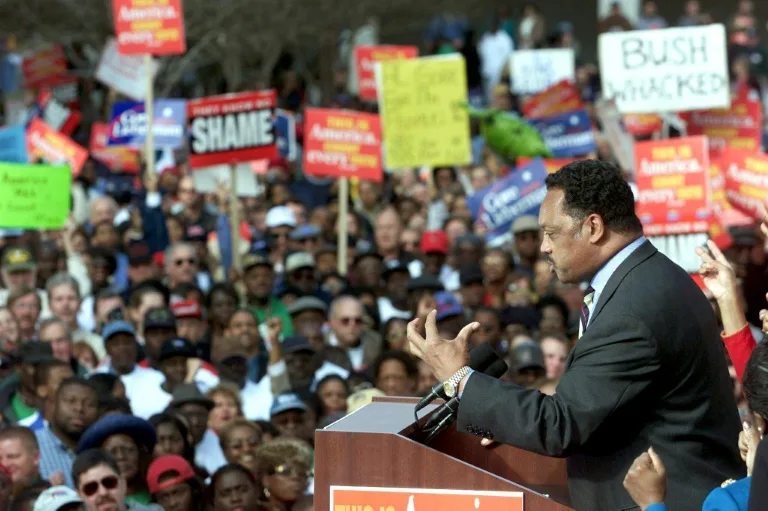
Veteran civil rights leader Reverend Jesse Jackson has died at the age of 84, his family confirmed Tuesday morning. The Baptist minister spent decades championing racial justice and equality in the United States and beyond.
According to Daljoog News analysis, Jackson’s passing marks the end of an era for American civil rights activism. His influence spanned from grassroots protests to presidential politics, shaping the fight for social justice for more than half a century.
Jackson’s death comes amid ongoing national conversations about racial equity, police reform, and political representation, highlighting the continuing relevance of the causes he championed throughout his life.
What Happened?
Jesse Jackson passed away peacefully on Tuesday, according to a family statement. He had battled Parkinson’s disease, which he publicly disclosed in 2017, and had been hospitalized in November amid concerns over another neurological condition.
Born Jesse Louis Burns on October 8, 1941, in Greenville, South Carolina, Jackson overcame a childhood marked by poverty and racial segregation. After excelling academically and athletically in high school, he earned a football scholarship to the University of Illinois before transferring to North Carolina Agricultural and Technical College, where he studied sociology.
Jackson first entered activism in 1960 with sit-ins in Greenville and later participated in the Selma-to-Montgomery marches in 1965, which brought him to the attention of Martin Luther King Jr. He marched alongside King in Memphis in 1968, witnessing the events surrounding the civil rights leader’s assassination.
Beyond domestic activism, Jackson became an international mediator. He campaigned against apartheid in South Africa, served as presidential envoy for Africa under Bill Clinton, and led missions to free American detainees in countries such as Syria, Iraq, and Serbia. He also founded the Rainbow PUSH Coalition in 1996, a Chicago-based organization advocating for social justice, political engagement, and economic opportunity.
Why This Matters
Jackson’s death leaves a void in U.S. civil rights leadership. For decades, he elevated the political visibility of African Americans and other marginalized groups, both through grassroots mobilization and his presidential campaigns in the 1980s. He paved the way for future Black political leaders, culminating in Barack Obama’s 2008 election.
His work extended beyond politics into public advocacy, highlighting systemic racism, police misconduct, and global human rights issues. Jackson’s ability to connect movements, institutions, and international actors made him a rare figure capable of translating protest into policy impact.
What Analysts or Officials Are Saying
Civil rights organizations and political figures are recognizing Jackson as a unifying force and a relentless advocate for justice. Analysts note that his blend of moral authority, strategic thinking, and public charisma enabled him to mediate complex disputes and elevate African American voices in every arena he entered.
Internationally, Jackson’s missions to negotiate humanitarian issues underscored the influence U.S. civil rights leaders could exert on the world stage, demonstrating how domestic activism can translate into global diplomacy.
Daljoog News Analysis
Jesse Jackson’s passing is not just the loss of a civil rights figure—it is a reminder of how leadership rooted in both moral conviction and tactical skill can shape society over decades. While Jackson faced setbacks, including unsuccessful presidential bids, his enduring impact lies in the institutions he built, the causes he advanced, and the generations of activists he inspired.
In today’s polarized political environment, Jackson’s approach—blending protest, negotiation, and institutional engagement—offers lessons for modern movements seeking to translate advocacy into lasting change. His death may renew conversations about the unfinished work of racial equality, economic justice, and global human rights.
What Happens Next
Jackson’s death is expected to prompt nationwide tributes and memorials. Political leaders, civil rights organizations, and communities he influenced will likely honor his contributions through public events and initiatives.
In the long term, Jackson’s legacy will continue through the Rainbow PUSH Coalition and the broader civil rights networks he strengthened. Current and future leaders may draw from his example as they navigate ongoing struggles over racial equity, voting rights, and international advocacy.
For those following U.S. civil rights history, Jackson’s passing marks both an endpoint and a challenge: to carry forward the principles he championed, ensuring that his decades of work inspire action long after his death.