

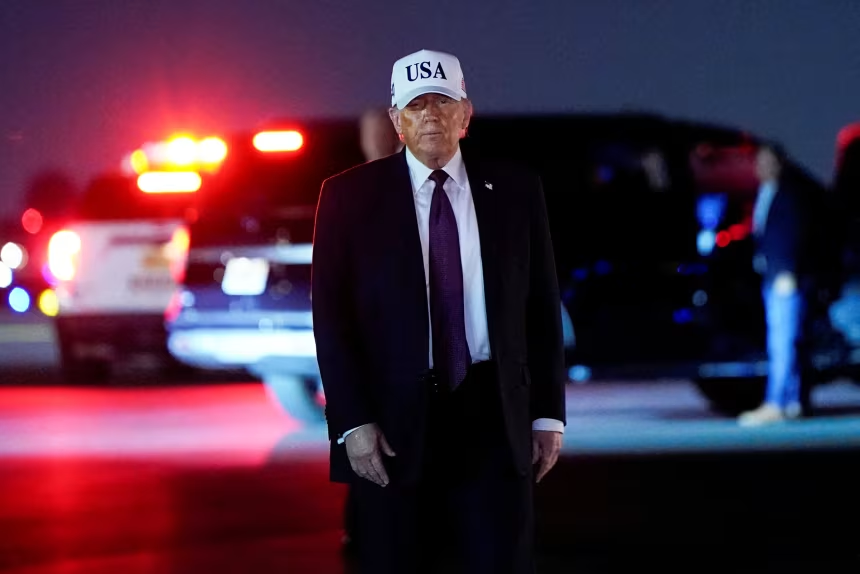
U.S. President Donald Trump has publicly claimed full responsibility for the war against Iran, distancing his administration from earlier remarks suggesting the conflict was driven by Israel. Speaking at the White House, Trump said he personally pushed Israeli Prime Minister Benjamin Netanyahu into the confrontation and denied that Tel Aviv had provoked Tehran.
According to Daljoog News analysis, Trump’s statement reveals internal differences within Washington over how the war narrative is being presented. It also signals a deliberate attempt by the president to assert direct control over both military strategy and political messaging.
The comments come as tensions between the United States and Iran reach a critical point, with military operations expanding and diplomatic options appearing increasingly limited.
What Happened?
Just a day earlier, U.S. Secretary of State Marco Rubio suggested that the United States was supporting a war initiated by Israel against Iran. That framing implied Washington was backing an ally rather than leading the campaign.
Trump rejected that interpretation.
At the White House, he declared that Israel did not incite the attack on Tehran. Instead, he claimed he had anticipated an Iranian strike on U.S. bases and decided to move first. According to Trump, he believed Tehran would launch attacks during ongoing negotiations.
The president further asserted that U.S. forces have already destroyed significant parts of Iran’s air force, navy, and air defense systems. He stated that American troops have targeted more than 1,700 sites and warned that operations would continue until Iran’s defensive capabilities are fully dismantled.
Trump also addressed Iran’s leadership. He said that the worst outcome would be if a future Iranian leader continued what he described as hostile policies. He dismissed the idea of exiled figure Reza Pahlavi becoming Iran’s next leader and insisted that any successor should emerge from within Iran itself.
In a striking claim, Trump said that all potential successors to Supreme Leader Ali Khamenei had been eliminated. The statement has not been independently verified.
On social media, the president said Iran had offered to negotiate after joint U.S.-Israeli strikes began. He rejected the possibility of talks, declaring that the time for negotiation had passed.
Why This Matters
Trump’s remarks shift responsibility for the conflict squarely onto Washington.
By taking ownership, the president eliminates ambiguity about U.S. involvement. That move may strengthen his image among supporters who favor decisive action. However, it also increases political and diplomatic pressure on the United States.
If military operations escalate or civilian infrastructure suffers damage, the White House will face direct accountability.
The comments also complicate U.S.-Israel dynamics. Publicly stating that he pushed Netanyahu into war reframes the alliance narrative and could affect regional perceptions of Israeli decision-making independence.
For Iran, Trump’s rejection of negotiations narrows diplomatic space. The declaration that talks are over raises the risk of prolonged confrontation.
Financial markets are also watching closely. Military campaigns of this scale can disrupt oil flows, investor confidence, and global trade patterns.
What Analysts or Officials Are Saying
Political analysts see Trump’s comments as an attempt to dominate the narrative at a time of visible internal disagreement.
Some observers argue that the president is positioning himself as the decisive architect of the campaign, reducing space for alternative interpretations from cabinet members such as Rubio.
Security experts caution that declaring the near-total destruction of Iran’s military capabilities could set unrealistic expectations. Independent verification of battlefield claims remains limited.
Diplomatic observers warn that ruling out negotiations may harden Iran’s position rather than weaken it. Historically, conflicts in the region have required some form of indirect communication to prevent uncontrolled escalation.
Meanwhile, critics question the claim that all potential successors to Khamenei have been killed, calling it unlikely and difficult to confirm.
Daljoog News Analysis
Trump’s decision to personally claim responsibility marks a high-stakes political calculation.
Presidents rarely frame international conflict as their own initiative so directly. By doing so, Trump removes ambiguity and projects strength. Yet the strategy carries substantial risk.
If the campaign achieves rapid military objectives, the administration may present it as proof of effective leadership. If the conflict drags on or triggers regional backlash, the president’s words will return as a focal point of criticism.
The internal divergence between Trump and Rubio also suggests strategic messaging challenges inside the administration. Unified communication is critical during wartime. Mixed signals can create confusion among allies and adversaries alike.
Another critical factor is diplomacy. Declaring that negotiations are finished closes doors that may later need reopening. Even during intense conflicts, backchannel talks often play a stabilizing role.
Daljoog News notes that wars in the Middle East rarely unfold according to initial projections. Early military dominance does not automatically translate into long-term stability.
What Happens Next
Attention now turns to whether military operations expand further.
If the United States intensifies strikes, regional actors may become more directly involved. Iran could also adjust its strategy, potentially targeting U.S. interests through indirect means.
Diplomatic channels, even if publicly dismissed, may continue quietly. International mediators could attempt to reopen communication lines.
Domestically, the political debate in Washington is likely to intensify as lawmakers seek clarity on objectives, timelines, and long-term strategy.
For now, Trump has made one position clear: he sees the conflict as a deliberate choice under his leadership, not as a war imposed by others. Whether that framing strengthens or weakens the United States will depend on how the next phase unfolds.