


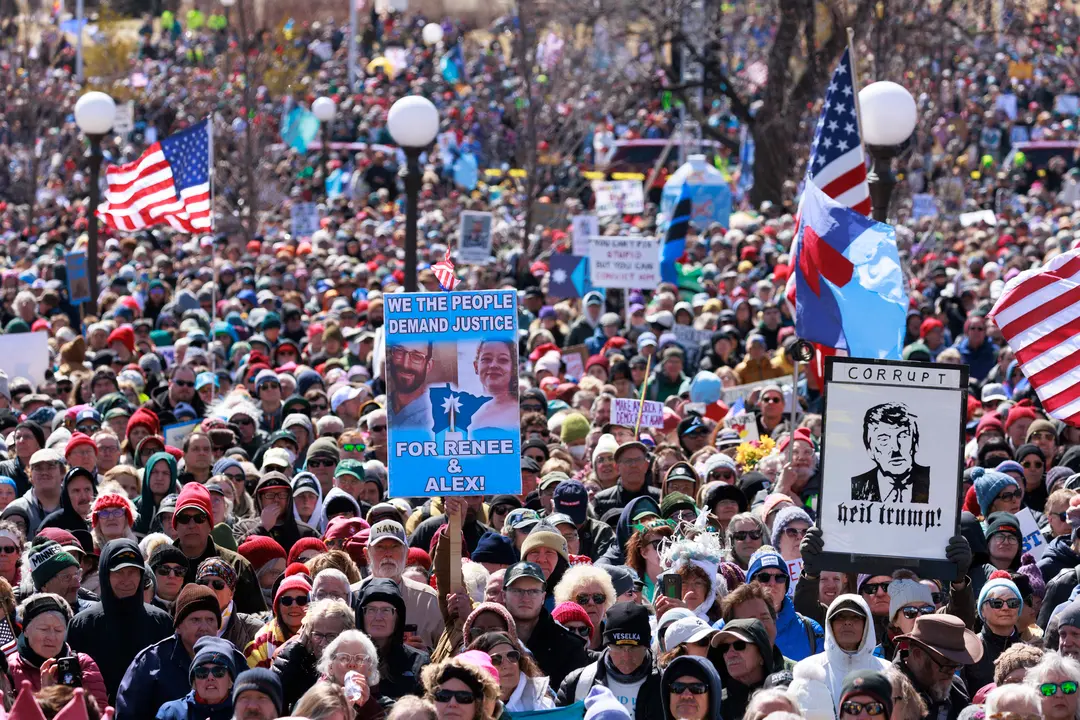
Large-scale “No Kings” protests have erupted across the United States for the third time since Donald Trump returned to power for a second term. Demonstrations have taken place in all 50 states, with thousands of coordinated events drawing widespread participation.
According to Daljoog News analysis, the protests signal growing public resistance to policies seen as overly aggressive, particularly on foreign policy and domestic enforcement measures.
The movement has also expanded beyond U.S. borders. Demonstrations in major European cities suggest that opposition to current U.S. policies is gaining international visibility at a critical geopolitical moment.
What Happened?
Organisers report that more than 3,200 protest events were planned across the United States, making it one of the largest coordinated protest days in recent years.
Major cities such as New York City, Los Angeles, and Washington, D.C. saw significant turnout, with large crowds gathering in central locations. However, nearly two-thirds of the events took place in smaller towns and rural areas, highlighting the movement’s broad geographic reach.
In Philadelphia, hundreds marched through city streets, converging near City Hall for a major rally. Protesters carried signs, chanted slogans, and moved through key routes in an organised demonstration.
In Washington, D.C., crowds gathered near prominent landmarks, including the Lincoln Memorial. Demonstrators displayed symbolic imagery, including effigies and protest art, targeting the administration.
Internationally, similar protests were reported in cities like Rome, Paris, and Berlin. In Madrid, around 100 American citizens gathered at Puerta del Sol to voice opposition to U.S. policies.
Why This Matters
The scale and spread of the protests highlight a significant level of public mobilisation. Nationwide participation across both urban and rural areas indicates that concerns are not limited to major metropolitan centres.
One of the central issues driving the protests is the ongoing U.S.-Israel military activity involving Iran. The conflict, now entering its fourth week, has raised concerns about escalation and long-term regional instability.
Domestically, protesters have also criticised immigration enforcement policies and broader governance approaches, which they describe as heavy-handed and out of step with democratic values.
The international dimension adds another layer. Demonstrations outside the United States suggest that American domestic and foreign policies are being closely watched—and contested—by global audiences.
What Analysts or Officials Are Saying
Political observers describe the protests as one of the most coordinated grassroots mobilisations in recent U.S. history. The breadth of participation suggests a well-organised network capable of mobilising quickly across multiple regions.
Some analysts argue that the protests reflect deeper polarisation within American society. They point to growing divisions over foreign policy decisions and the balance between security and civil liberties.
Officials have not dismissed the protests but have emphasised the importance of maintaining public order. Authorities in several cities increased security presence to ensure demonstrations remained peaceful.
International observers have also taken note, particularly of the protests spreading into European capitals. This has raised questions about the global perception of current U.S. leadership and policy direction.
Daljoog News Analysis
The “No Kings” protests represent more than a single-day event. They reflect a broader shift in how public dissent is organised and expressed in the digital age.
The ability to coordinate over 3,000 events simultaneously points to a high level of organisational capacity. It also suggests that dissatisfaction with current policies has reached a level where decentralised movements can gain national traction.
The inclusion of smaller towns is particularly notable. It indicates that political discontent is no longer concentrated in traditional urban strongholds but is spreading across diverse communities.
At the same time, the protests’ focus on foreign policy—especially the Iran-related conflict—shows how international decisions can quickly influence domestic sentiment.
If sustained, this level of mobilisation could begin to shape political narratives, influence policy debates, and affect upcoming electoral dynamics.
What Happens Next
Organisers are likely to build on the momentum, potentially planning further demonstrations or expanding their message to include additional policy concerns.
Government response will be closely watched. How authorities engage with protesters—whether through dialogue or stricter enforcement—could shape the movement’s trajectory.
The ongoing conflict involving Iran will also remain a key factor. Any escalation could intensify public opposition and drive further protests.
Internationally, the spread of demonstrations suggests that global scrutiny of U.S. actions will continue. This could influence diplomatic relations and public opinion abroad.
The coming weeks will determine whether the “No Kings” movement evolves into a sustained political force or remains a series of high-impact protest events.