


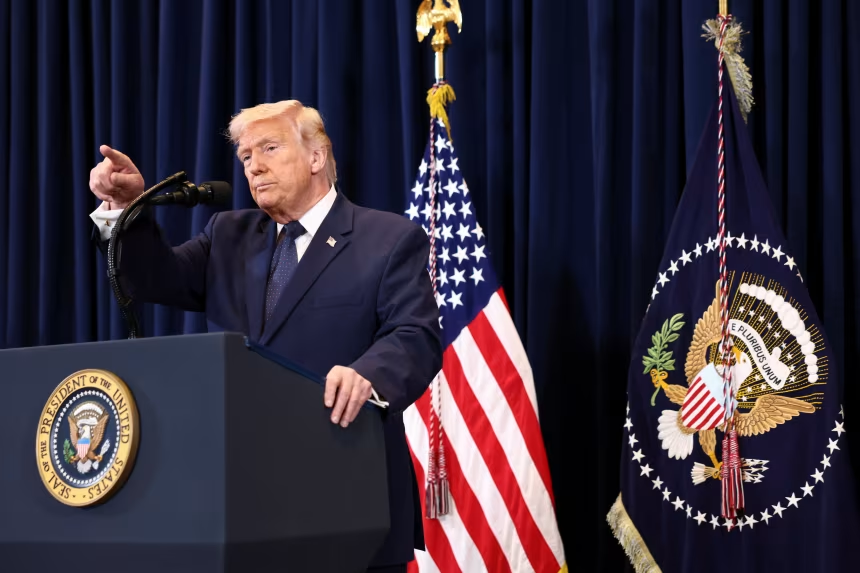
U.S. President Donald Trump is facing growing backlash after issuing aggressive threats against Iran’s civilian infrastructure in a series of social media posts. His remarks included warnings of attacks on power plants and bridges, raising alarm among lawmakers and legal experts.
According to Daljoog News analysis, the president’s language has intensified concerns not only about military escalation but also about potential violations of international law.
The controversy comes at a critical moment in the ongoing standoff over the Strait of Hormuz, where tensions between Washington and Tehran are already at a dangerous level.
What Happened?
Donald Trump posted a series of messages on social media threatening to target key Iranian infrastructure if Tehran fails to meet U.S. demands. The posts included harsh language and references that drew criticism for their tone as well as their substance.
Legal observers quickly raised concerns that explicitly targeting civilian infrastructure—such as electricity networks and bridges—could breach international humanitarian law. Such actions, if carried out, may fall under the definition of war crimes depending on intent and impact.
The statements also triggered a swift political response within the United States. Several Democratic lawmakers condemned the remarks, describing them as reckless and potentially dangerous in an already volatile geopolitical situation.
Yassamin Ansari called for consideration of the 25th Amendment, a constitutional mechanism that allows for the removal of a president deemed unfit to serve. Other senior figures, including Hakeem Jeffries and Bernie Sanders, characterized the threats as unethical and inconsistent with international norms.
At the same time, Republican voices offered support. Senator Lindsey Graham and Congressman Don Bacon defended the president’s stance, arguing that strong language may be necessary to deter adversaries.
Why This Matters
The debate highlights a deeper divide within U.S. politics over how to handle escalating tensions with Iran. While some view strong rhetoric as a strategic tool, others see it as a dangerous step toward conflict.
Beyond domestic politics, the issue carries significant legal implications. International humanitarian law sets strict limits on targeting civilian infrastructure, especially when such actions could harm non-combatants.
If threats are interpreted as intent, they could complicate the United States’ position on global norms and accountability. This may affect diplomatic relations and weaken Washington’s ability to advocate for international legal standards in other conflicts.
The timing also matters. With tensions already high in the Gulf region, such statements risk further escalation, increasing the likelihood of miscalculation.
What Analysts or Officials Are Saying
Legal experts emphasize that attacks on civilian targets are heavily restricted under international law. Even in wartime, parties must distinguish between military objectives and civilian infrastructure.
Some analysts note that rhetoric alone does not constitute a war crime, but it can signal intent and shape expectations. This creates both legal and diplomatic challenges, especially when statements come from a head of state.
Democratic lawmakers have framed the issue as a matter of national responsibility and global leadership, arguing that such threats undermine established norms.
Meanwhile, Republican supporters argue that the president’s approach reflects a broader strategy of deterrence, aimed at forcing Iran to reconsider its actions without immediate military engagement.
Daljoog News Analysis
This episode reveals how quickly rhetoric can become a strategic risk. Trump’s statements go beyond traditional diplomatic pressure, entering territory that raises serious legal and ethical questions.
While strong language has long been part of geopolitical signaling, the explicit mention of civilian infrastructure marks a notable shift. It blurs the line between deterrence and escalation, making it harder to control the narrative once tensions rise.
The domestic political divide further complicates the situation. Calls for invoking constitutional measures, such as the 25th Amendment, show how foreign policy decisions can trigger internal instability.
At the same time, support from key Republican figures suggests that the administration retains backing for its hardline approach. This split reduces the likelihood of a unified U.S. response, potentially weakening its negotiating position.
From a global perspective, the controversy risks undermining established norms. If major powers appear willing to disregard legal boundaries, it may encourage similar behavior elsewhere.
What Happens Next
The immediate focus will be on whether the rhetoric translates into action. If no military steps follow, the statements may be seen as part of a pressure strategy.
However, any move toward targeting infrastructure would significantly raise the stakes, likely triggering retaliation and broadening the conflict.
Lawmakers are expected to continue debating the issue, with possible hearings or formal statements addressing the legal and strategic implications.
Internationally, allies and partners may seek clarification on U.S. policy, particularly regarding compliance with humanitarian law.
For now, the situation remains fluid. The combination of strong rhetoric, political division, and regional tension creates a volatile environment where the next decision could have far-reaching consequences.