

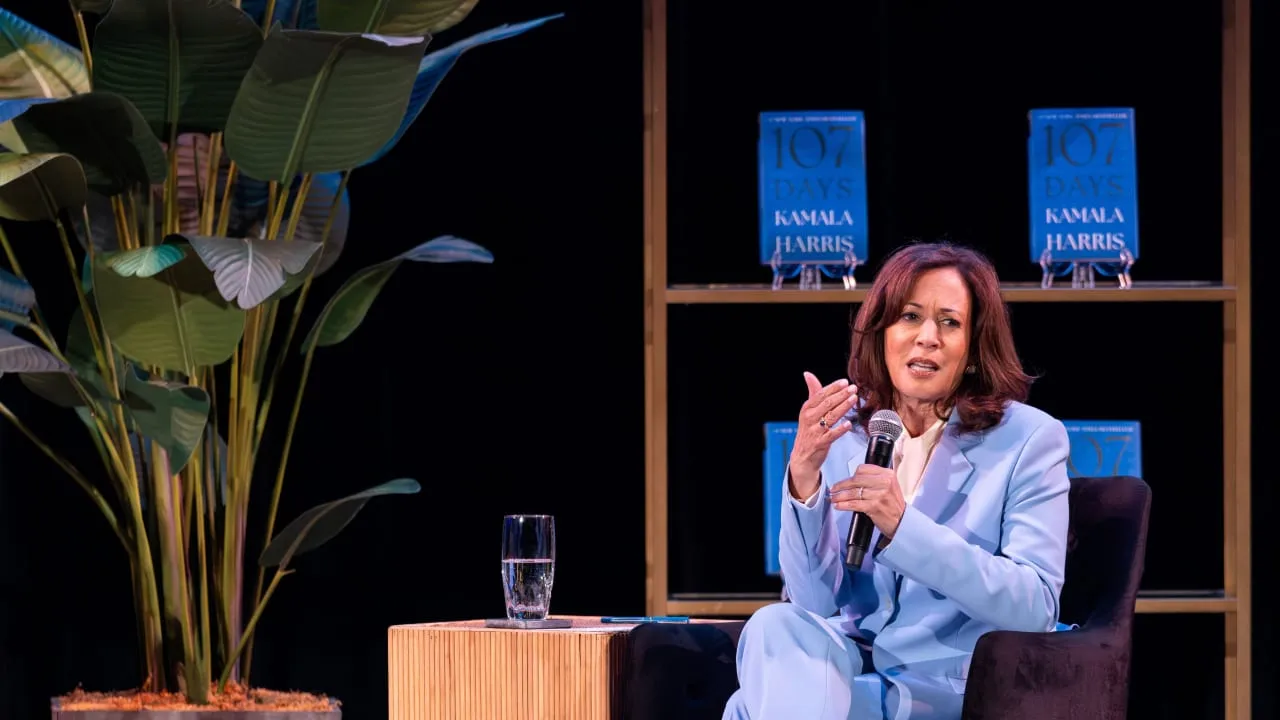
Former US Vice President Kamala Harris has accused President Donald Trump of being drawn into a potential Iran conflict influenced by Israel’s leadership. The remarks were made during a Democratic fundraising event in Detroit, Michigan, where she sharply criticized the administration’s foreign policy direction.
According to Daljoog News analysis, the Kamala Harris Trump Iran conflict remarks highlight growing political divisions in Washington over military involvement in the Middle East and the risks of escalation.
The issue comes at a sensitive time for US foreign policy, as tensions involving Iran and regional alliances continue to raise concerns about possible wider conflict and the role of American leadership.
WHAT HAPPENED? Kamala Harris Trump Iran conflict
Kamala Harris delivered a strong political attack on President Donald Trump during a Democratic Party fundraising event in Detroit. She claimed that the United States has been pulled into an Iran-related conflict dynamic influenced by Israel’s leadership.
She warned that the Kamala Harris Trump Iran conflict situation is unnecessary and could place American troops at risk. Harris argued that most US citizens do not support deeper military involvement in another Middle East conflict.
She also expanded her criticism to the broader Trump administration, describing it as historically ineffective and accusing it of poor governance and weak decision-making in foreign policy matters.
At the same time, Israeli Prime Minister Benjamin Netanyahu rejected the claims. He stated that no external actor can dictate US presidential decisions and insisted that American leaders act independently based on national interests.
WHY THIS MATTERS Kamala Harris Trump Iran conflict
The Kamala Harris Trump Iran conflict controversy highlights how US foreign policy remains deeply tied to domestic political debates. Any suggestion of military escalation involving Iran carries serious global security implications.
The situation also reflects ongoing sensitivity in US-Israel relations. While both countries maintain strong strategic cooperation, public debate over influence and decision-making continues to shape political narratives.
From a security standpoint, concerns about troop safety and regional escalation remain central. Even political statements alone can increase diplomatic pressure and uncertainty in already unstable regions.
WHAT ANALYSTS OR OFFICIALS ARE SAYING Kamala Harris Trump Iran conflict
Political analysts say Harris’s comments reflect a broader opposition strategy to question the administration’s foreign policy direction. The Kamala Harris Trump Iran conflict narrative is being viewed as part of wider political positioning ahead of future electoral cycles.
Officials aligned with the administration argue that US decisions are based on internal national security assessments and long-term strategic interests rather than external influence.
Diplomatic observers note that such exchanges often intensify during periods of Middle East tension, where public messaging becomes politically sensitive and internationally visible.
DALJOOG NEWS ANALYSIS Kamala Harris Trump Iran conflict
The Kamala Harris Trump Iran conflict debate shows how foreign policy issues are increasingly being used in domestic political competition. Claims of external influence may be difficult to prove, but they play a strong role in shaping public perception.
In reality, US foreign policy decisions involve multiple institutional layers, including intelligence, defense, and diplomatic agencies. This makes direct attribution to outside pressure complex.
However, the political impact of such allegations is significant. They can influence trust in leadership, raise questions about transparency, and affect how international partners view US policy consistency.
The broader risk is that foreign policy becomes more polarized, reducing room for bipartisan agreement on sensitive global issues. That could affect long-term strategic stability.
WHAT HAPPENS NEXT Kamala Harris Trump Iran conflict
The Kamala Harris Trump Iran conflict debate is expected to continue as political tensions in Washington increase. More statements from both parties are likely as foreign policy becomes a central issue in public discourse.
Officials may also respond with clarifications regarding US positioning on Iran-related regional security concerns and its coordination with allies.
As tensions in the Middle East remain unstable, even political rhetoric could influence diplomatic dynamics and international reactions in the coming weeks.