


Close Menu
Daljoog News
    What's Hot
    Munich Police Investigate Arson At Defense Firm

    Munich Police Investigate Arson At Defense Firm

    September 5, 2026
    Argentine President Javier Milei announced that Argentina threatens Falklands oil sanctions against energy companies planning exploration activities near the disputed islands, escalating long standing tensions over sovereignty claims that have persisted for decades between Argentina and Britain. Milei stated that the prospect of two oil companies conducting exploration work in waters surrounding the islands represents an urgent threat to Argentine national interests, signaling potential economic consequences for firms proceeding with drilling activities in the contested area. The Falkland Islands, known in Argentina as the Malvinas, have remained a source of diplomatic tension since Britain and Argentina fought a brief war over the territory in the early 1980s. Britain has maintained control of the islands throughout the decades since that conflict concluded. Downing Street responded firmly to Milei's comments, emphasizing that the islanders' right to self determination extends to their ability to develop and exploit their own natural resources, reflecting Britain's consistent position on sovereignty and resource rights regarding the territory. This latest dispute highlights how resource development can reignite longstanding territorial tensions, even in situations where the underlying sovereignty dispute has remained largely dormant for extended periods without significant diplomatic escalation between the involved nations. Energy companies considering exploration activities near the islands now face additional political risk beyond the standard commercial and technical challenges typically associated with offshore drilling projects, given the potential for sanctions or other punitive measures from the Argentine government. International legal experts note that sovereignty disputes over resource rich territories often intensify when actual economic development becomes a realistic prospect, transforming what may have been largely symbolic territorial claims into disputes with genuine financial stakes for involved parties. The islanders themselves, who have consistently expressed strong preference for remaining under British administration through previous referendums, find themselves once again at the center of a diplomatic dispute despite having limited direct influence over how the broader sovereignty question ultimately gets resolved. Argentina's renewed assertiveness regarding the islands comes amid broader efforts by the Milei government to establish clear positions on various national interest issues, potentially reflecting domestic political considerations alongside genuine concerns about resource development near the disputed territory. British officials have consistently maintained that sovereignty over the islands is not subject to negotiation, a position reinforced by the strong preference islanders have expressed for continued British administration whenever the question has been formally put before them in previous votes. As this latest dispute unfolds, energy companies with interests in the region will need to carefully weigh the potential diplomatic and economic risks against the commercial opportunities associated with exploration activities near the islands. The broader sovereignty dispute appears likely to remain unresolved for the foreseeable future, continuing to periodically resurface whenever practical questions like resource development bring it back into focus.

    Argentina Threatens Sanctions Over Falklands Oil

    September 5, 2026
    Kakapo Population Reaches New Milestone Number

    Kakapo Population Reaches New Milestone Number

    September 5, 2026
    Facebook X (Twitter) Instagram
    Saturday, September 5
    Daljoog News
    Facebook X (Twitter) YouTube Instagram
    • Home
    • General
    • World
    • Business
    • Technology
    • Politics
    • Finance
    • Health
    • Lifestyle
    • Sports
    • Travel
    Daljoog News
    Home»Politics»China and Canada Retaliate as Trump’s Trade Tariffs Take Effect
    Politics

    China and Canada Retaliate as Trump’s Trade Tariffs Take Effect

    Daljoog NewsBy Daljoog NewsMarch 4, 2025Updated:June 1, 2025No Comments4 Mins Read
    Facebook Twitter Pinterest LinkedIn Tumblr Email
    Follow Us
    Google News
    China and Canada Retaliate as Trump’s Trade Tariffs Take Effect
    China and Canada Retaliate as Trump’s Trade Tariffs Take Effect
    Share
    Facebook Twitter LinkedIn Pinterest Email

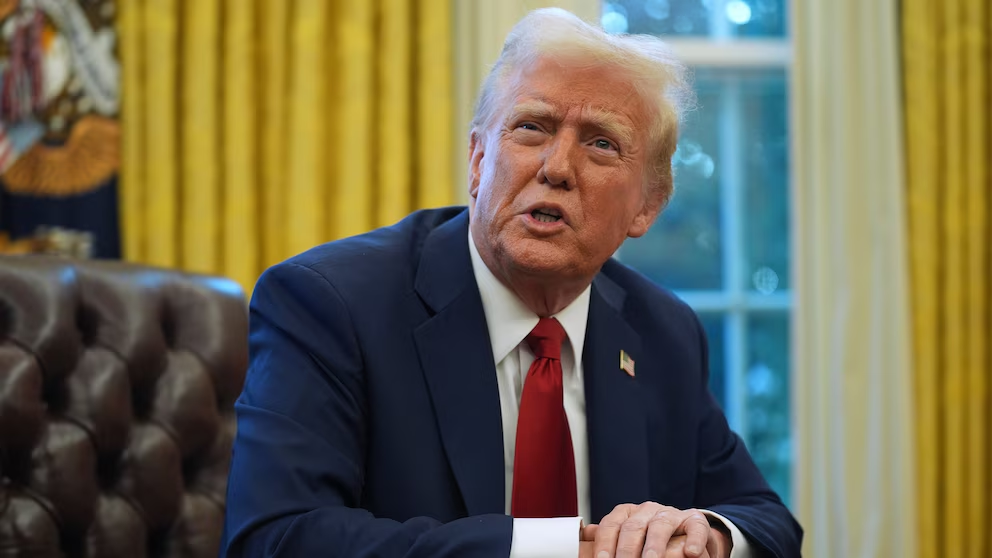
    The U.S.-China-Canada trade dispute has taken a dramatic turn as both China and Canada implement countermeasures in response to U.S. President Donald Trump’s sweeping tariffs. These newly imposed trade restrictions, which took effect at midnight U.S. time, have sparked concerns about a prolonged economic standoff that could destabilize global markets and key industries.

    Trump’s Tariff Plan: A Bold but Risky Strategy

    In a major escalation, the United States has implemented a 25% tariff on imports from Canada and Mexico—its largest trading partners. Additionally, tariffs on Chinese goods have been doubled to 20% compared to the previous month.

    According to trade data from the U.S. Census Bureau, these tariffs impact over $918 billion worth of imports across various sectors, including agriculture, manufacturing, and consumer goods. Economists warn that such drastic measures could trigger inflationary pressures, disrupt supply chains, and increase costs for American businesses and consumers.

    China’s Swift Response: Targeting U.S. Agriculture

    In a direct response, China’s Ministry of Finance announced new tariffs on key American agricultural products, dealing a blow to U.S. farmers.

    The Chinese counter-tariffs include:

    • 15% tariff on chicken, wheat, corn, and cotton
    • 10% tariff on sorghum, soybeans, pork, beef, aquatic products, fruits, vegetables, and dairy

    These tariffs, set to take effect next week, could heavily impact U.S. farmers who depend on exports to China, the largest buyer of American soybeans. According to the American Farm Bureau Federation, U.S. agricultural exports to China totaled $36.4 billion in 2023, making these tariffs a serious economic threat.

    Financial Markets React with Uncertainty

    Asian stock markets reacted negatively to the escalating trade war:

    • Japan’s Nikkei index fell by over 2%
    • Hong Kong’s Hang Seng index dropped by 1.5%

    Market analysts predict continued volatility, warning that ongoing trade uncertainties could dampen global economic recovery efforts.

    Canada Strikes Back: Trudeau Defends Canadian Trade Interests

    Canadian Prime Minister Justin Trudeau wasted no time in retaliating against U.S. tariffs. Canada has imposed a 25% tariff on C$30 billion ($20.7 billion) worth of U.S. imports, targeting popular American goods such as:

    • Beer and wine
    • Bourbon whiskey
    • Home appliances
    • Florida orange juice

    If the U.S. tariffs remain in place for more than 21 days, Canada plans to extend its counter-tariffs to an additional C$125 billion ($86.2 billion) worth of American products.

    “Tariffs will disrupt an incredibly successful trading relationship,” Trudeau stated, emphasizing that these tariffs violate the U.S.-Mexico-Canada Agreement (USMCA)—a trade deal Trump himself signed during his first term.

    Mexico Expected to Announce Its Own Retaliatory Tariffs

    Mexico, also affected by Trump’s tariffs, is expected to announce countermeasures soon.

    • Mexican President Claudia Sheinbaum is set to outline Mexico’s trade strategy.
    • Reports indicate that Mexico’s economy ministry is considering tariffs on key U.S. goods.

    Impact on U.S. Businesses and Consumers

    While Trump and his allies argue that the tariffs will strengthen the U.S. economy, many economists and business leaders warn of negative consequences.

    According to a report from the Peterson Institute for International Economics, these tariffs could:

    • Increase prices for American consumers, costing the average U.S. household an extra $1,200 per year
    • Hurt small businesses that rely on affordable imports
    • Disrupt supply chains in key industries

    Trade organizations, including the National Retail Federation, have also voiced concerns about potential job losses and rising production costs.

    Trump Signals More Tariffs Could Be on the Way

    Despite mounting opposition, Trump has hinted at additional trade restrictions. The president has threatened to impose “reciprocal” tariffs on countries that currently have tariffs on U.S. goods.

    Some analysts speculate that these tariffs could take effect as early as next month, potentially worsening trade relations worldwide.

    What’s Next for Global Trade?

    As China, Canada, and the U.S. continue their trade standoff, uncertainty remains over the long-term effects on the global economy.

    Experts warn that if diplomatic solutions are not reached soon, industries already affected by inflation and supply chain disruptions may face prolonged financial difficulties.

    For the latest developments on international trade, follow Daljoog News for real-time updates and in-depth analysis.


    Share. Facebook Twitter Pinterest LinkedIn Tumblr Email
    Daljoog News
    Daljoog News
    • Website
    • Facebook
    • X (Twitter)
    • Instagram

    Daljoog News is a trusted online news platform delivering timely and accurate reports on a wide range of topics, including General News, World Affairs, Business, Technology, Politics, Finance, Health, Lifestyle, Sports, and Travel. Committed to journalistic excellence, Daljoog News provides in-depth analysis, breaking news, and insightful stories to keep readers informed about the latest global and local developments. Stay ahead with Daljoog News—where facts meet clarity.

    Related Posts

    Trump Threatens Trade Retaliation After Ruling

    Trump Threatens Trade Retaliation After Ruling

    September 5, 2026
    Bessent Warns Nations Against Iran Support

    Bessent Warns Nations Against Iran Support

    September 4, 2026
    Germany's eastern state of Saxony Anhalt heads to the polls this week, with the Saxony Anhalt election AfD gains narrative dominating coverage as the far right Alternative for Germany party hopes to build on recent momentum partly fueled by public fatigue over the ongoing war in Ukraine. The election arrives at a particularly tense moment in German politics, coinciding with a diplomatic dispute between Berlin and Moscow over an alleged Russian backed drone attack on an airport in the eastern part of the country. That controversy has become intertwined with the campaign's broader political dynamics. The Alternative for Germany's lead candidate for the state has campaigned heavily on themes of war weariness and skepticism toward continued German support for Ukraine, arguments that appear to be resonating with a segment of voters increasingly frustrated by the economic costs associated with the ongoing conflict. Chancellor Friedrich Merz's governing coalition has faced mounting criticism over its handling of both the war and broader economic challenges, including factory closures and rising living costs that opposition parties have used to argue the current government has failed to adequately protect German interests. The far right party's leader has directly criticized the chancellor's approach, accusing him of prioritizing international politics over domestic concerns and suggesting his government has lost meaningful connection with everyday voters struggling with economic pressures across the country. Allies of the chancellor have pushed back forcefully against these characterizations, with one prominent supporter accusing the far right party's leadership of effectively serving Russian interests by amplifying narratives that could weaken Western unity and support for Ukraine at a critical moment in the conflict. Polling ahead of the election suggests the Alternative for Germany could make significant gains compared to previous results in the state, though most political analysts do not expect the party to secure enough support to lead a governing coalition given ongoing resistance from mainstream parties to cooperate with it. This election is being closely watched as a broader indicator of political sentiment across eastern Germany, a region that has historically shown stronger support for the far right party compared to western parts of the country, partly reflecting distinct economic and social conditions in the formerly communist east. International observers have noted the election's significance beyond domestic German politics, given its potential implications for continued Western unity on Ukraine policy. Any significant far right gains could be interpreted as a warning sign for mainstream parties navigating similar political pressures elsewhere in Europe. The broader dispute over the alleged Russian drone attack has added additional complexity to the campaign's final days, with the far right party's rhetoric around the incident drawing sharp criticism from government officials who argue it reflects a troubling willingness to dismiss legitimate security concerns. As voters prepare to cast their ballots, the outcome will offer important insight into how deeply war fatigue and economic frustration have penetrated German political sentiment. Regardless of the final results, this election is likely to shape ongoing debates about Germany's role in supporting Ukraine through the challenging months ahead

    Saxony Anhalt Election Looms Amid AfD Gains

    September 3, 2026

    Comments are closed.

    Our Picks
    Trump Threatens Trade Retaliation After Ruling

    Trump Threatens Trade Retaliation After Ruling

    September 5, 2026
    Bessent Warns Nations Against Iran Support

    Bessent Warns Nations Against Iran Support

    September 4, 2026
    Germany's eastern state of Saxony Anhalt heads to the polls this week, with the Saxony Anhalt election AfD gains narrative dominating coverage as the far right Alternative for Germany party hopes to build on recent momentum partly fueled by public fatigue over the ongoing war in Ukraine. The election arrives at a particularly tense moment in German politics, coinciding with a diplomatic dispute between Berlin and Moscow over an alleged Russian backed drone attack on an airport in the eastern part of the country. That controversy has become intertwined with the campaign's broader political dynamics. The Alternative for Germany's lead candidate for the state has campaigned heavily on themes of war weariness and skepticism toward continued German support for Ukraine, arguments that appear to be resonating with a segment of voters increasingly frustrated by the economic costs associated with the ongoing conflict. Chancellor Friedrich Merz's governing coalition has faced mounting criticism over its handling of both the war and broader economic challenges, including factory closures and rising living costs that opposition parties have used to argue the current government has failed to adequately protect German interests. The far right party's leader has directly criticized the chancellor's approach, accusing him of prioritizing international politics over domestic concerns and suggesting his government has lost meaningful connection with everyday voters struggling with economic pressures across the country. Allies of the chancellor have pushed back forcefully against these characterizations, with one prominent supporter accusing the far right party's leadership of effectively serving Russian interests by amplifying narratives that could weaken Western unity and support for Ukraine at a critical moment in the conflict. Polling ahead of the election suggests the Alternative for Germany could make significant gains compared to previous results in the state, though most political analysts do not expect the party to secure enough support to lead a governing coalition given ongoing resistance from mainstream parties to cooperate with it. This election is being closely watched as a broader indicator of political sentiment across eastern Germany, a region that has historically shown stronger support for the far right party compared to western parts of the country, partly reflecting distinct economic and social conditions in the formerly communist east. International observers have noted the election's significance beyond domestic German politics, given its potential implications for continued Western unity on Ukraine policy. Any significant far right gains could be interpreted as a warning sign for mainstream parties navigating similar political pressures elsewhere in Europe. The broader dispute over the alleged Russian drone attack has added additional complexity to the campaign's final days, with the far right party's rhetoric around the incident drawing sharp criticism from government officials who argue it reflects a troubling willingness to dismiss legitimate security concerns. As voters prepare to cast their ballots, the outcome will offer important insight into how deeply war fatigue and economic frustration have penetrated German political sentiment. Regardless of the final results, this election is likely to shape ongoing debates about Germany's role in supporting Ukraine through the challenging months ahead

    Saxony Anhalt Election Looms Amid AfD Gains

    September 3, 2026
    Tributes Pour In For Former French PM

    Tributes Pour In For Former French PM

    September 2, 2026
    Stay In Touch
    • Facebook
    • Twitter
    • Instagram
    • YouTube
    Don't Miss
    Mongolia's PM Resigns Amid Corruption Protests

    Mongolia’s PM Resigns Amid Corruption Protests

    Politics June 3, 2025

    Mongolia is experiencing political uncertainty following the resignation of Prime Minister Oyun-Erdene Luvsannamsrai early Tuesday.…

    Asian Shares Rise as Wall Street Closes Higher, Fed Holds Rates Steady

    Asian Shares Rise as Wall Street Closes Higher, Fed Holds Rates Steady

    May 8, 2025
    Belarus Sustainable Development Forum

    Belarus Sustainable Development Forum

    July 19, 2025
    UK Prime Minister Ready to Deploy Troops to Ukraine for Peacekeeping

    UK Prime Minister Ready to Deploy Troops to Ukraine for Peacekeeping

    February 17, 2025
    About Us

    Daljoog News is a trusted news platform that brings you the latest global and local updates with accuracy and fairness. We are committed to clear and unbiased reporting, covering topics like politics, business, technology, science, and culture and more. Using the latest technology and expert journalism, we provide reliable coverage of important stories. Stay informed, inspired, and empowered with Daljoog News—your source for breaking news, the latest updates, and videos that matter.

    Email Us: info@daljoognews.com

    Our Picks
    Nine More Drugmakers Join Pricing Deal Program

    Nine More Drugmakers Join Pricing Deal Program

    September 5, 2026
    Broadcom AI Chip Revenue Surges 221 Percent

    Broadcom AI Chip Revenue Surges 221 Percent

    September 4, 2026
    Cybersecurity Stocks Rally On AI Driven Demand

    Cybersecurity Stocks Rally On AI Driven Demand

    September 3, 2026
    Latest News
    Munich Police Investigate Arson At Defense Firm

    Munich Police Investigate Arson At Defense Firm

    September 5, 2026
    Argentine President Javier Milei announced that Argentina threatens Falklands oil sanctions against energy companies planning exploration activities near the disputed islands, escalating long standing tensions over sovereignty claims that have persisted for decades between Argentina and Britain. Milei stated that the prospect of two oil companies conducting exploration work in waters surrounding the islands represents an urgent threat to Argentine national interests, signaling potential economic consequences for firms proceeding with drilling activities in the contested area. The Falkland Islands, known in Argentina as the Malvinas, have remained a source of diplomatic tension since Britain and Argentina fought a brief war over the territory in the early 1980s. Britain has maintained control of the islands throughout the decades since that conflict concluded. Downing Street responded firmly to Milei's comments, emphasizing that the islanders' right to self determination extends to their ability to develop and exploit their own natural resources, reflecting Britain's consistent position on sovereignty and resource rights regarding the territory. This latest dispute highlights how resource development can reignite longstanding territorial tensions, even in situations where the underlying sovereignty dispute has remained largely dormant for extended periods without significant diplomatic escalation between the involved nations. Energy companies considering exploration activities near the islands now face additional political risk beyond the standard commercial and technical challenges typically associated with offshore drilling projects, given the potential for sanctions or other punitive measures from the Argentine government. International legal experts note that sovereignty disputes over resource rich territories often intensify when actual economic development becomes a realistic prospect, transforming what may have been largely symbolic territorial claims into disputes with genuine financial stakes for involved parties. The islanders themselves, who have consistently expressed strong preference for remaining under British administration through previous referendums, find themselves once again at the center of a diplomatic dispute despite having limited direct influence over how the broader sovereignty question ultimately gets resolved. Argentina's renewed assertiveness regarding the islands comes amid broader efforts by the Milei government to establish clear positions on various national interest issues, potentially reflecting domestic political considerations alongside genuine concerns about resource development near the disputed territory. British officials have consistently maintained that sovereignty over the islands is not subject to negotiation, a position reinforced by the strong preference islanders have expressed for continued British administration whenever the question has been formally put before them in previous votes. As this latest dispute unfolds, energy companies with interests in the region will need to carefully weigh the potential diplomatic and economic risks against the commercial opportunities associated with exploration activities near the islands. The broader sovereignty dispute appears likely to remain unresolved for the foreseeable future, continuing to periodically resurface whenever practical questions like resource development bring it back into focus.

    Argentina Threatens Sanctions Over Falklands Oil

    September 5, 2026
    Kakapo Population Reaches New Milestone Number

    Kakapo Population Reaches New Milestone Number

    September 5, 2026
    Facebook X (Twitter) RSS YouTube Instagram
    • Home
    • About Us
    • Contact Us
    • Our Authors
    • Privacy Policy
    • Terms & Conditions
    • Sitemap
    © 2026 DaljoogNews.com

    Type above and press Enter to search. Press Esc to cancel.