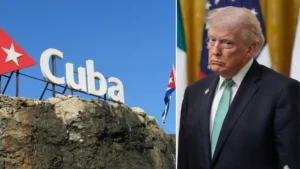

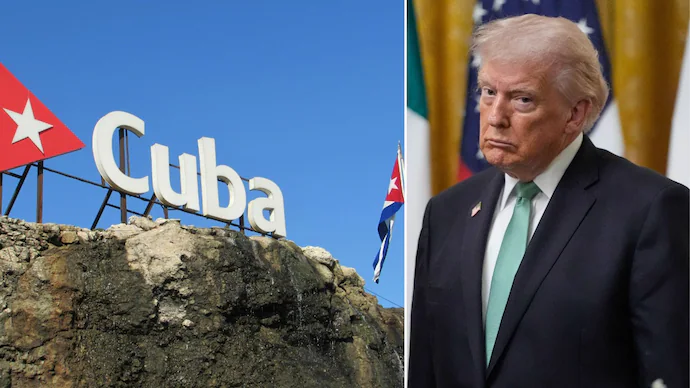
U.S. President Donald Trump has stirred global attention by suggesting that the United States may turn its focus toward Cuba after recent military and diplomatic moves in the Middle East and Latin America. The remark came during a high‑profile speech where he highlighted what he described as American military successes.
According to Daljoog News analysis, his comment “Cuba is next” — even without specific policy detail — represents an escalation in rhetoric that could influence diplomatic and strategic calculations in the Western Hemisphere.
This statement arrives against a backdrop of heightened tensions, ongoing negotiations between Washington and Havana, and an evolving Cuban crisis fueled by economic strain and disrupted energy supplies.
What Happened?
On March 27, 2026, speaking at an investment forum in Miami, President Trump touted recent U.S. operations, including actions involving Venezuela and Iran, and then made the striking remark that “Cuba is next.” He did not outline concrete military plans or policy steps tied to Cuba.
The comment immediately generated media attention and concern because it followed ongoing U.S.–Cuba tensions driven by a U.S.‑imposed oil blockade that has deepened Cuba’s economic challenges. Discussions between U.S. and Cuban officials are reportedly underway but have not produced detailed agreements.
Trump commented after describing his administration’s actions and framing U.S. strength and security as central priorities, though he also asked media to “disregard that statement” shortly after making it.
Why This Matters
Trump’s “Cuba is next” remark, even in an informal context, matters for several reasons. It highlights how foreign policy rhetoric can influence geopolitical calculations and regional stability. Cuba is currently facing a severe economic crisis partly tied to the loss of Venezuelan oil supplies and U.S. sanctions, which have contributed to energy shortages and social strain on the island.
Diplomats and analysts are watching closely because ambiguous statements from world leaders can have real impacts on markets, diplomatic negotiations, and the confidence of allies and adversaries alike. Continued U.S. pressure or hints of intervention could further destabilize Havana’s fragile economy and complicate ongoing negotiations.
What Analysts or Officials Are Saying
International observers emphasize that Trump’s statement was not accompanied by an official policy announcement. Cuban leaders have stressed their preparedness for any potential threats while also engaging in diplomatic talks with U.S. representatives. Havana has insisted that regime change is not currently on the negotiation table.
At the same time, stakeholders in Washington, including U.S. legislators and Cuban‑American political figures, continue to discuss how best to address Cuba’s political and economic challenges. The combination of economic pressure and diplomatic engagement reflects a strategy focused on leverage rather than overt military action — at least publicly.
Experts note that ambiguous or provocative remarks from leaders can complicate diplomatic efforts and raise concerns among regional partners and humanitarian groups, especially when the subject is a nation facing deep economic hardship.
Daljoog News Analysis
Donald Trump’s “Cuba is next” comment illustrates how presidential rhetoric can shape international perceptions without clear policy backing. It reflects a broader political narrative that positions Cuba as the next geopolitical challenge after actions in the Middle East and Latin America.
In diplomatic terms, such statements can signal intent, test political waters, and influence public opinion — both domestically and internationally. Yet without a concrete, transparent strategy and diplomatic communication, rhetoric alone can deepen uncertainty and strain already tense bilateral relations.
From a strategic viewpoint, if the U.S. continues to leverage economic pressure alongside diplomatic talks, the outcome could reshape Cuba’s internal politics, but it also risks provoking a backlash among Cubans and regional actors. Whether these comments signal a shift toward actual policy change remains unclear.
What Happens Next
In the coming weeks, attention will center on developments in U.S.–Cuba talks and how both sides navigate diplomatic engagement amid economic crisis. Markets, regional governments, and international organizations will assess how Trump’s remarks impact stability and negotiations.
If diplomatic channels advance, there could be opportunities for de‑escalation and humanitarian cooperation. If tensions rise, Cuba’s fragile economy and social conditions may face additional strain. For now, the situation remains ambiguous, with rhetoric and policy still evolving on both sides.