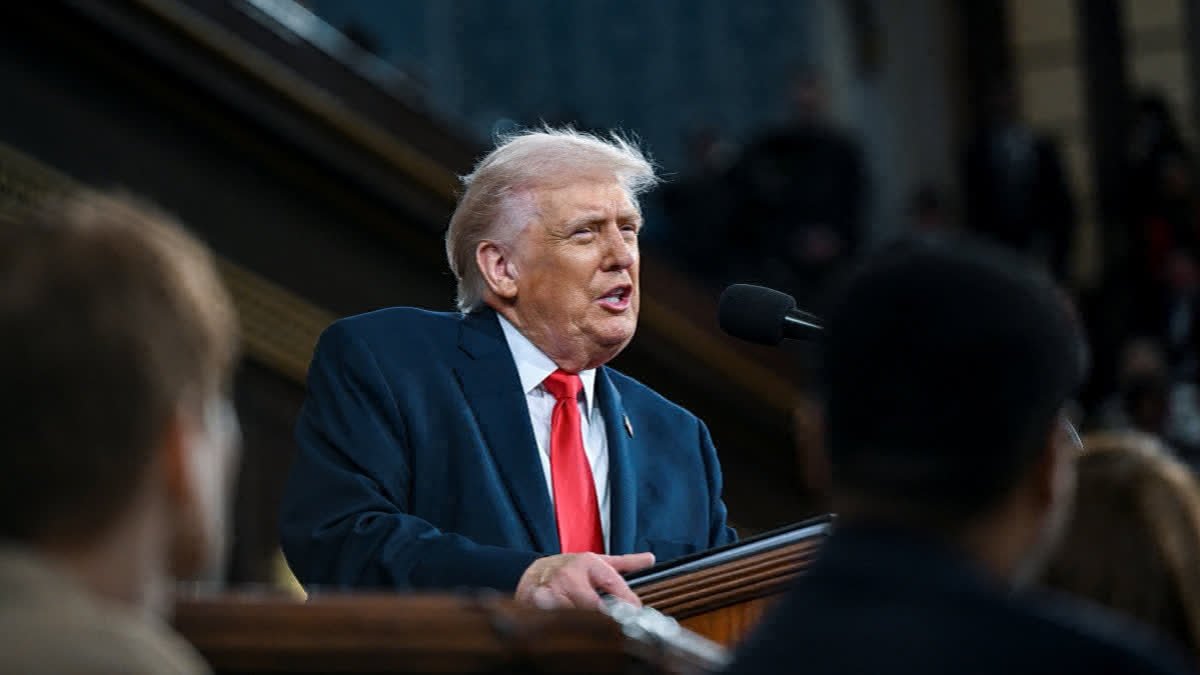

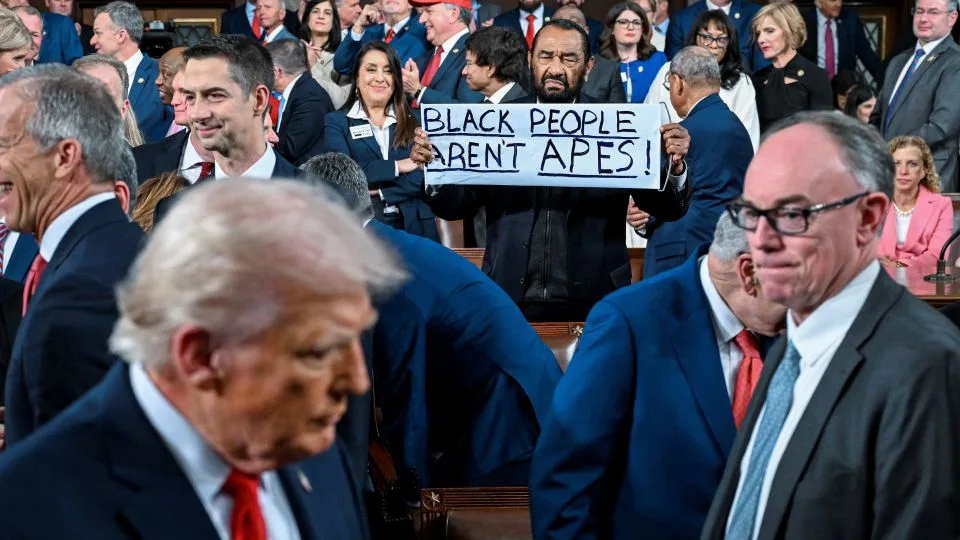
Texas Democrat Rep. Al Green was escorted from the House chamber just minutes into President Donald Trump’s State of the Union address Tuesday night after holding a sign stating, “Black people aren’t apes!”
According to Daljoog News analysis, Green’s protest underscores both the personal and political tensions surrounding Trump’s appearances in Congress. It highlights how a single member’s symbolic action can draw national attention, even as party leaders try to manage messaging during high-profile events.
The incident comes amid Green’s ongoing anti-Trump stance and just a week ahead of a difficult primary, adding layers of both political strategy and personal conviction to his demonstration.
What Happened?
Green held the protest sign during the early moments of the State of the Union, prompting security to escort him from the chamber. At 78, the Texas Democrat has a long record of opposing Trump, including multiple impeachment efforts and prior disruptions at presidential addresses in the Capitol.
Shortly after being removed, Green told CNN that the protest was meant for the president’s attention. “Black people are not apes, and for him to do what he did was racist, and he knows it,” he said. He emphasized that public acknowledgment of such issues is necessary to confront ongoing racism.
The protest references a recent incident in which Trump posted a video on Truth Social depicting former President Barack Obama and former First Lady Michelle Obama as apes in a jungle. The video was later deleted, and Trump refused to apologize, claiming he had not seen the final frames and placing blame on a staffer.
Why This Matters
Green’s removal reflects ongoing struggles within the Democratic Party over how to respond to Trump in high-profile settings. Party leaders had urged members to remain quiet during the address or boycott it altogether, warning that disruptions could detract from messaging and highlight divisions.
The incident illustrates the tension between party discipline and individual lawmakers’ desire to protest what they see as offensive or immoral behavior. It also highlights the continuing political fallout from Trump’s racially charged social media posts and the broader conversation about accountability in public office.
What Analysts or Officials Are Saying
House Democratic leadership, including Hakeem Jeffries, had issued clear guidance that members should avoid public disruptions during Trump’s speech. Officials indicated that the priority was to maintain focus on the president without internal spectacle.
Political analysts note that Green’s action, while controversial, aligns with his long-standing public opposition to Trump and may resonate with constituents who prioritize civil rights and anti-racism advocacy. Some see it as a calculated risk, drawing attention to both personal convictions and political identity ahead of his primary challenge.
Observers also highlight the broader narrative around Trump’s social media behavior, noting that the deleted Obama video and lack of apology continue to fuel criticism and protest from Democrats.
Daljoog News Analysis
Green’s protest underscores the evolving dynamics in Congress, where symbolic acts can amplify national debate. Daljoog News notes that while leadership often seeks unity and discipline, individual lawmakers can use high-visibility moments to spotlight issues that party strategy may otherwise sideline.
The timing of this protest is politically significant. Green is navigating both a primary race and a polarized national landscape where Trump remains a central figure. His removal from the chamber draws attention to the intersection of race, politics, and accountability, illustrating how personal actions can quickly become news events with lasting impact.
What Happens Next
Green’s protest is likely to fuel ongoing discussion about congressional responses to presidential behavior and social media controversies. Party leaders may revisit strategies for managing future high-profile addresses, balancing discipline with members’ desire for public statement-making.
For Trump, incidents like this continue to shape his public perception, particularly regarding allegations of racism and his willingness to engage in politically sensitive content online.