
At least 15 people died Friday when a Bolivian military cargo plane carrying cash crashed while attempting to land near La Paz, authorities said. The accident prompted chaotic scenes as bystanders rushed to collect scattered banknotes, forcing police to intervene.
According to Daljoog News analysis, the combination of a high-altitude airport, a heavily loaded aircraft, and urban proximity made the disaster particularly deadly. The crash underscores challenges faced by Bolivia’s aviation authorities in ensuring safety for cargo flights near densely populated areas.
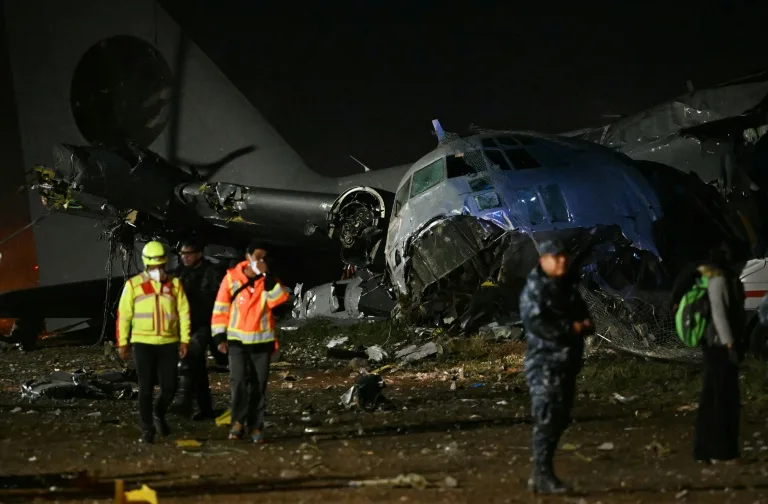
The C-130 Hercules transport plane, operated by the Bolivian Air Force, veered off the runway at El Alto International Airport and smashed into a busy avenue, destroying several cars and damaging trucks. Officials said dozens of people were also injured in the incident.
What Happened?
The aircraft had departed from Santa Cruz, in eastern Bolivia, carrying large quantities of Bolivian banknotes. Upon landing, it ran off the runway, leaving mangled wreckage on the avenue below. Videos from local media showed fragments of the plane scattered across the road and civilians attempting to grab bundles of cash before police used tear gas to disperse them.
Colonel Pavel Tovar of the National Fire Department confirmed that between 15 and 16 fatalities had been counted and said rescue teams were recovering the bodies. The Ministry of Defense confirmed the crash but provided few details, while NAABOL, Bolivia’s air navigation authority, said the airport temporarily suspended operations.
The cause of the crash is still under investigation. Witnesses reported seeing the aircraft lose control shortly before touchdown, though no official statement on mechanical failure or human error has been released.
Why This Matters
The crash is one of the deadliest aviation incidents in Bolivia in recent years and highlights the risks associated with transporting valuable cargo through urban airports. El Alto International Airport sits at 3,650 meters (11,975 feet) above sea level, making it one of the highest commercial airports in the world and challenging for large aircraft operations.
Beyond the tragic loss of life, the incident caused significant property damage to vehicles on the avenue and forced airport closures, disrupting flights and commerce. The chaos over scattered banknotes also raised concerns about public safety and crowd control in emergencies.
What Analysts or Officials Are Saying
Aviation experts note that high-altitude operations require precise calculations for aircraft weight, fuel, and landing approach. Cargo flights, especially those carrying heavy loads like currency, present additional hazards.
Bolivian authorities stressed that police and emergency responders were focused on securing the site and treating the injured. Colonel Tovar emphasized that recovery efforts continue and that authorities are working to prevent additional casualties from the scattered cash.
Daljoog News Analysis
The crash demonstrates a convergence of factors that amplify risk in aviation: altitude, heavy cargo, and urban proximity. Daljoog News observes that while military transport planes are designed for robustness, operational safety remains critical, particularly when flights involve populated areas.
The incident also exposes bystanders’ vulnerability during unexpected disasters. The scramble for cash could have led to further injuries, highlighting the need for rapid crowd management protocols in similar emergencies.
Finally, the event may prompt Bolivia to review procedures for cash transport and cargo flights, especially near major population centers, to prevent similar tragedies in the future.
What Happens Next
Investigators are expected to examine the C-130’s flight recorders, maintenance logs, and pilot actions to determine the cause of the crash.
Authorities are also reviewing airport safety protocols at El Alto and evaluating emergency response procedures to manage future incidents better. Compensation and support for victims’ families are likely to be addressed as part of the official investigation.