

Iran’s latest military escalation triggered street demonstrations across major Western cities on Sunday, as supporters and critics responded to the unfolding crisis.
According to Daljoog News analysis, the rallies highlight how developments involving Iran are no longer confined to the Middle East. They now influence public sentiment, diplomacy, and markets across continents.
The protests came as Israel launched renewed strikes on Tehran and Iran answered with missile attacks, deepening fears of a prolonged confrontation with global consequences.
What Happened?
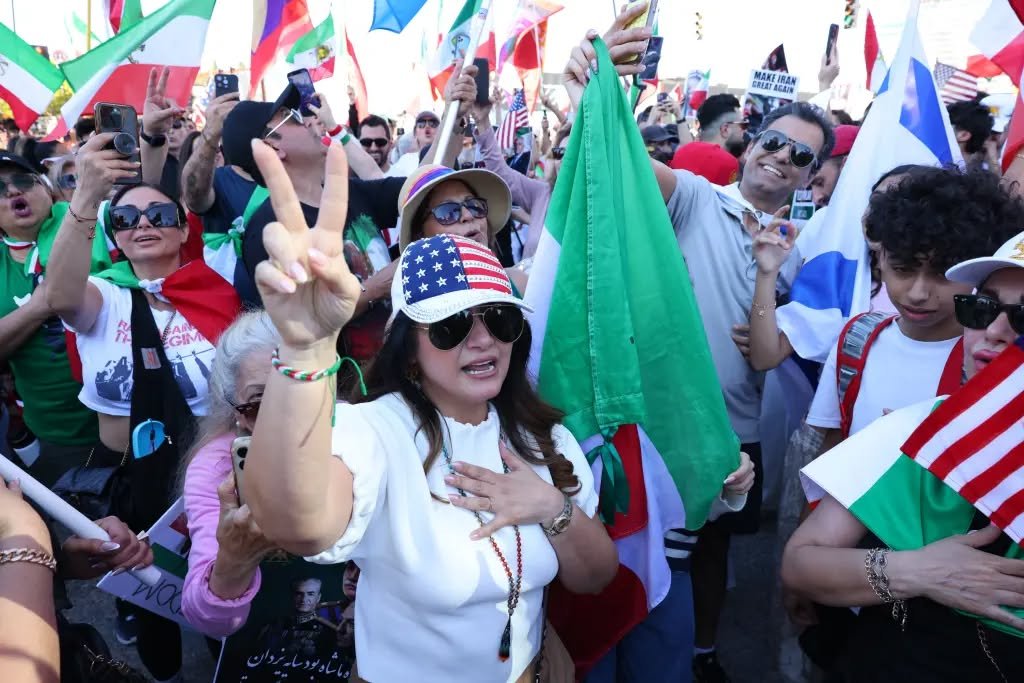
In New York City, several hundred demonstrators marched through Manhattan backing the United States and President Donald Trump. The rally began near Dag Hammarskjöld Plaza, moved along 42nd Street, and concluded in Times Square.
Participants waved American flags and voiced support for Washington’s actions. Police monitored the march, which remained orderly.
Public opinion in the United States appears divided. A survey conducted during the crisis found that 27 percent of Americans supported the strike, while 43 percent opposed it. Another 29 percent said they were uncertain. The poll did not include data about possible American casualties.
In Paris, thousands gathered in celebration. French President Emmanuel Macron stated that France had not received prior notice of the strike and was not involved in the operation.
Rome saw Iranian expatriates assemble at Piazza Santi Apostoli. Many opposed the Islamic Republic and displayed images of Reza Pahlavi, presenting him as a potential figure for peaceful political change.
London recorded one of the largest turnouts, with about 2,000 people rallying. American and Israeli flags were visible as demonstrators marched through the city center, accompanied by music and chants.
In Berlin, smaller groups gathered near the Brandenburg Gate. Some participants voiced support for opposition movements seeking democratic reforms in Iran.
Similar demonstrations occurred in Istanbul, Athens, and Lisbon. In some cities, Iranian expatriates handed out sweets and flowers while calling for political change. At the same time, Iranian diplomatic missions lowered flags to half-mast in mourning.
Why This Matters
The protests reveal how rapidly regional conflict can become a global political moment.
Iran’s internal transition, combined with escalating military exchanges, has energized diaspora communities. Many see this period as a turning point in the country’s political future.
Western governments face diplomatic challenges. Public rallies may reflect strong emotions, but official positions remain cautious. European leaders, in particular, appear careful not to be drawn directly into military escalation.
The economic implications are equally serious. Shipping companies are reviewing routes through the Gulf. Airlines are adjusting flight paths. Energy traders are watching oil supply risks closely.
Any sustained disruption near key maritime corridors could affect fuel prices and global trade.
What Analysts or Officials Are Saying
Security analysts say the demonstrations show how Iran’s crisis resonates far beyond its borders. Diaspora activism often intensifies during moments of political uncertainty.
European officials emphasize restraint. While some political groups sympathize with opposition figures, governments have largely focused on preventing further escalation.
In the United States, political leaders remain split. Some describe the strike as a firm response meant to deter threats. Others warn that continued escalation could pull Washington into a broader conflict.
Observers note that succession uncertainty inside Iran adds another layer of unpredictability to the situation.
Daljoog News Analysis
The rallies unfolding across New York, Paris, London, and other cities are not merely symbolic gatherings. They represent a global reaction to a rapidly evolving power struggle.
Public demonstrations abroad can influence political narratives, even if they do not directly shape decisions in Tehran. Images of celebration or protest travel quickly and shape perceptions.
The bigger concern lies in escalation dynamics. Israel’s follow-up strikes and Iran’s missile response have raised the stakes. Each move narrows diplomatic space.
Markets have already begun reacting. Energy volatility often precedes broader economic ripple effects. Even short-term instability can shift investor confidence and supply chain planning.
What Happens Next
Attention now turns to whether the cycle of retaliation slows or intensifies.
Further strikes could trigger larger protests abroad and prompt heightened security around embassies and public spaces. Governments may increase diplomatic engagement to contain risks.
Energy markets will continue tracking developments closely. Shipping firms and airlines are likely to maintain contingency plans.
For now, global streets reflect a world watching events in Iran with strong emotion and growing concern about where the confrontation may lead next.