


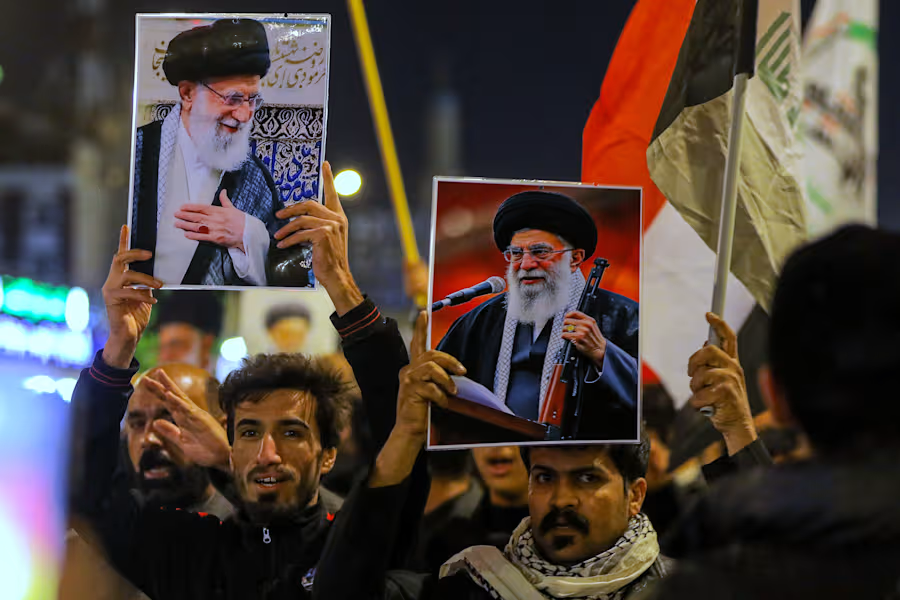
Unverified claims surrounding the death of Iran’s Supreme Leader have sent shockwaves across the Middle East. A senior Iranian representative in India alleged that Ayatollah Ali Khamenei died in a hospital hours after a joint US-Israeli airstrike targeted a high-level meeting in Tehran.
According to Daljoog News analysis, the absence of immediate official confirmation from Tehran has deepened uncertainty, fueling speculation about leadership stability in one of the region’s most influential states. The allegations, if confirmed, would mark the most dramatic turning point in Iranian politics in decades.
The reported development comes at a moment of intense regional escalation, with missile exchanges and rising military alerts across several Middle Eastern countries.
What Happened?
The claim emerged from Abdol Majid Hakim Elahi, described as Iran’s representative in India. He stated that Ali Khamenei succumbed to injuries sustained during coordinated airstrikes allegedly conducted by the United States and Israel.
According to the account, Khamenei was attending a strategic meeting in Tehran when the strike occurred. Around ten senior military and administrative officials were reportedly killed at the scene. Elahi claimed that Khamenei was critically wounded, transported to a hospital, and died the following day while receiving treatment.
The representative further alleged that members of Khamenei’s immediate family, including his daughter and son-in-law, were killed in the attack.
As of publication, Iranian state media has not issued definitive confirmation of the Supreme Leader’s death, and independent verification remains pending.
In the immediate aftermath of the reported strike, Iran launched retaliatory missile attacks targeting Israeli positions and US military installations in neighboring countries. Heightened security alerts were issued in the United Arab Emirates, Bahrain, Kuwait, Saudi Arabia, Qatar, Iraq, Oman, and Jordan, all of which host varying degrees of US military presence.
Explosions were also reported in central Israel, including areas around Tel Aviv, with injuries among civilians. Projectiles were reportedly launched from southern Lebanon toward Israeli territory as tensions widened.
Why This Matters
Khamenei has stood at the center of Iranian political power since 1989. As Supreme Leader, he shaped the country’s foreign policy, nuclear strategy, military doctrine, and regional alliances for more than four decades.
If confirmed, his death would trigger a constitutional and political transition with profound implications. The Assembly of Experts would be tasked with appointing a successor, but the process could unfold under extraordinary military pressure.
Beyond Iran’s borders, markets are reacting to the risk of broader regional war. Oil prices are vulnerable to sharp fluctuations, particularly if maritime routes or energy infrastructure come under threat. Diplomatic relations between Western powers and Middle Eastern states may also enter a new phase of confrontation.
The situation carries direct consequences for global security calculations. Iran’s leadership structure is deeply intertwined with its military command, including the Revolutionary Guard. A sudden vacuum at the top could reshape decision-making at a critical moment.
What Analysts or Officials Are Saying
Regional analysts caution that until Tehran issues formal confirmation, the claims must be treated carefully. The Iranian political system places immense symbolic and institutional weight on the Supreme Leader’s position, making any announcement highly sensitive.
Security experts suggest that even rumors of Khamenei’s death could embolden hardline factions or accelerate retaliatory actions. Others argue that internal power consolidation could occur quickly to project stability.
International observers are closely monitoring Washington and Tel Aviv for official responses. Neither government has publicly confirmed targeting Khamenei directly.
Meanwhile, diplomatic sources note that several Gulf states have quietly elevated defensive postures, anticipating potential spillover from further Iranian retaliation.
Daljoog News Analysis
Daljoog News assesses that the real story at this stage is not only whether Khamenei has died, but how the uncertainty itself is shaping events. In highly centralized systems, ambiguity can be destabilizing.
Iran’s political architecture concentrates authority in the office of the Supreme Leader. Any disruption — real or perceived — affects military coordination, diplomatic messaging, and domestic cohesion.
If Tehran confirms the death, succession politics could unfold rapidly but not without friction. Rival power centers may compete to influence the transition. Conversely, if the reports prove inaccurate, Iran may leverage the episode to justify intensified military action and internal consolidation.
The broader region now stands on edge. Missile exchanges between Iran and Israel, combined with US military assets spread across Gulf states, create multiple flashpoints. Miscalculation remains a serious risk.
The unfolding crisis signals more than a leadership question; it marks a potential inflection point in Middle Eastern geopolitics.
What Happens Next
Attention now turns to Tehran for official clarification. Confirmation would initiate a formal succession mechanism, though extraordinary security conditions could shape the process.
Further Iranian retaliation cannot be ruled out, especially if leadership figures were indeed killed in the strike. Israel’s defensive posture is expected to remain elevated, and US bases across the Gulf region will likely maintain high alert.
Global markets, particularly energy traders, will watch developments closely. Diplomatic channels may attempt emergency de-escalation, but rapid military exchanges complicate such efforts.