

Heavy fighting erupted in Lebanon’s Bekaa Valley after Israeli forces attempted a helicopter deployment that triggered intense resistance from Hezbollah fighters. The clash quickly escalated into a wider confrontation involving gun battles and multiple airstrikes across several Lebanese cities.
According to Daljoog News analysis, the confrontation reflects a growing expansion of hostilities between Israel and Hezbollah, with both sides showing readiness to escalate military operations beyond routine border exchanges.
The violence comes amid a broader regional crisis that has already strained Lebanon’s fragile security environment. Rising civilian casualties, air raids on multiple cities, and reports of attacks near international peacekeeping positions have raised fresh fears of a prolonged conflict.
What Happened?
The latest confrontation began in Lebanon’s eastern Bekaa Valley, a strategic region close to the Syrian border that has long served as a stronghold for Hezbollah forces.
Local security sources and Hezbollah representatives reported that four Israeli military helicopters carrying troops crossed into Lebanese territory near the town of Nabi Chit after approaching from Syrian airspace. The helicopters reportedly attempted to land troops as part of what appeared to be a rapid ground operation.
Hezbollah fighters quickly detected the movement and launched heavy gunfire aimed at preventing the aircraft from landing. The clash soon escalated into intense fighting, with continuous bursts of gunfire reported across parts of the valley.
Israeli aircraft then carried out airstrikes in the area in an apparent effort to support the operation and suppress Hezbollah positions. Despite the aerial support, Hezbollah claimed its fighters forced Israeli troops to withdraw from the attempted landing zone.
As the helicopters retreated, Hezbollah units reportedly fired rockets toward the departing aircraft.
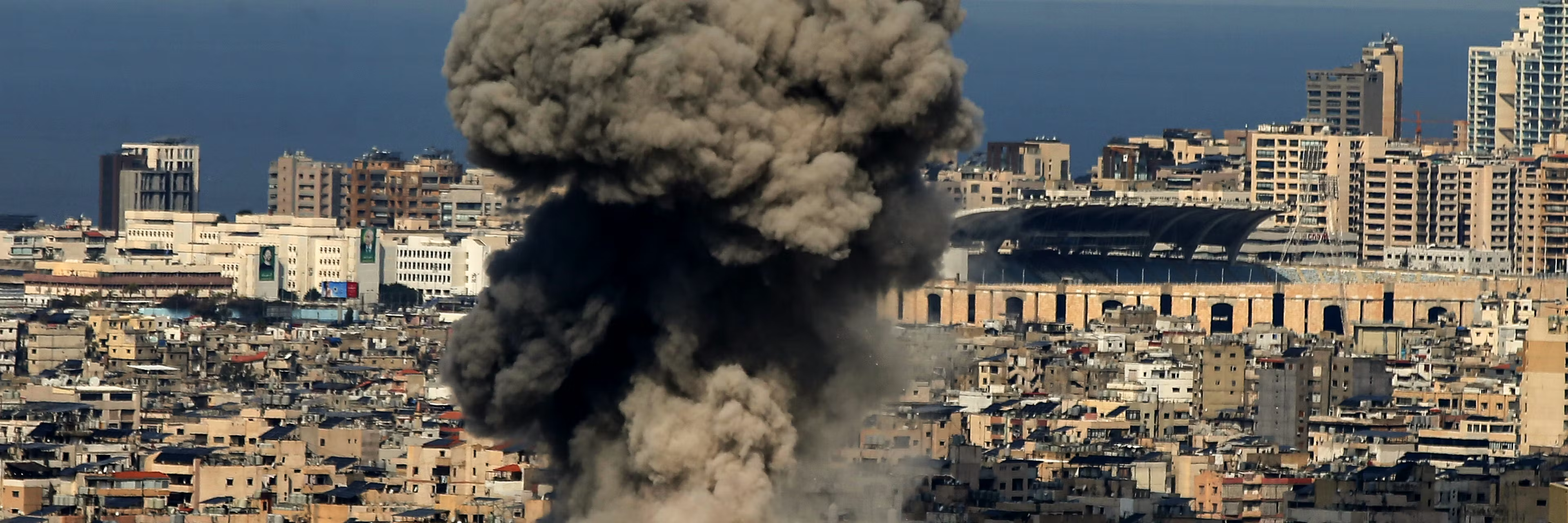
The fighting in the Bekaa Valley was followed by a broader wave of Israeli airstrikes across southern Lebanon. Cities including Tripoli, Tyre, and Sidon were reportedly hit by Israeli aircraft, expanding the scope of the conflict beyond a single battlefield.
Lebanese officials said at least nine people were killed in the latest round of airstrikes. Many others were injured as residential areas and civilian infrastructure were caught in the bombardment.
Reports also indicated that areas near a United Nations peacekeeping base in southern Lebanon were affected during the strikes, raising concern among international observers about the risk to UN personnel.
The Israeli military later acknowledged carrying out strikes against approximately 115 targets linked to Hezbollah infrastructure. Among those targets, officials said, were facilities believed to support the group’s military activities.
However, Lebanese authorities say several residential buildings and civilian structures were also damaged during the attacks.
Why This Matters
The Bekaa Valley holds strategic importance for Hezbollah because it connects Lebanon to neighboring Syria. The region is widely believed to host logistical routes, weapons storage sites, and operational bases used by the group.
An attempted Israeli helicopter insertion into the area signals a potential shift in tactics. Rather than relying solely on airstrikes or cross-border artillery exchanges, the move suggests Israel may be testing limited ground operations deeper inside Lebanese territory.
Such actions carry significant risks.
If ground incursions increase, Hezbollah could escalate its own responses, potentially widening the battlefield across southern Lebanon and even toward Israel’s northern frontier.
Civilian impact is already severe. Lebanese authorities report that more than 222 people have been killed since Monday in the ongoing escalation.
More than 800 others have been injured.
The fighting has also displaced an estimated 500,000 residents across Lebanon, according to government figures.
Most of those displaced come from Beirut’s southern suburbs—known as Hezbollah’s political and military base—as well as communities across southern Lebanon.
Humanitarian agencies warn that continued airstrikes and rocket exchanges could rapidly deepen Lebanon’s already fragile economic and social crisis.
What Analysts or Officials Are Saying
Israeli military officials maintain that the strikes and operations are aimed at neutralizing Hezbollah’s military capabilities and preventing attacks on Israeli territory.
Defense planners in Tel Aviv view Hezbollah’s expanding missile arsenal and drone capabilities as one of the most serious security threats facing Israel.
Hezbollah leaders, however, have framed the fighting as defensive resistance against Israeli aggression.
The group says its fighters acted to prevent Israeli troops from establishing positions inside Lebanese territory and to defend areas under its control.
Lebanese government officials have also voiced concern about the widening scope of Israeli air operations.
Authorities warn that continued strikes in densely populated areas risk causing further civilian casualties and increasing the displacement crisis.
International observers, including United Nations representatives, have urged restraint from all sides.
Diplomatic sources say regional and global powers are quietly attempting to prevent the conflict from turning into a full-scale war between Israel and Hezbollah.
Daljoog News Analysis
The clash in the Bekaa Valley signals a potentially dangerous shift in the Israel–Hezbollah confrontation.
Until now, most hostilities have consisted of cross-border rocket fire, targeted airstrikes, and limited engagements near the frontier. An attempted helicopter troop insertion suggests Israeli planners may be experimenting with more aggressive tactics aimed at disrupting Hezbollah positions inside Lebanon.
But such moves carry strategic risks.
Hezbollah has spent years preparing for the possibility of an Israeli ground incursion. The group maintains extensive defensive networks across southern and eastern Lebanon, including tunnels, fortified positions, and mobile rocket units.
If Israeli operations expand further inland, Hezbollah could respond by intensifying missile strikes against northern Israeli cities.
That escalation could quickly transform the current conflict into a wider regional war.
The humanitarian situation also adds pressure.
Lebanon is already facing a deep economic collapse, and the displacement of hundreds of thousands of civilians could overwhelm the country’s fragile institutions.
International peacekeeping forces operating in southern Lebanon could also find themselves increasingly exposed if fighting spreads near their positions.
These factors make the Bekaa Valley clash more than a local battlefield incident. It may represent an early sign of a broader military phase.
What Happens Next
Military analysts expect Israel to continue targeting Hezbollah infrastructure through airstrikes in the coming days.
At the same time, Hezbollah is likely to maintain pressure through rocket launches and localized engagements aimed at preventing Israeli incursions.
Diplomatic channels are also likely to intensify as international actors attempt to contain the conflict.
The key question now is whether both sides will keep the confrontation limited—or whether further ground operations or large-scale missile attacks will push the region into a much wider war.
For Lebanon’s civilian population, the immediate concern remains survival as the fighting spreads and displacement continues to grow.