

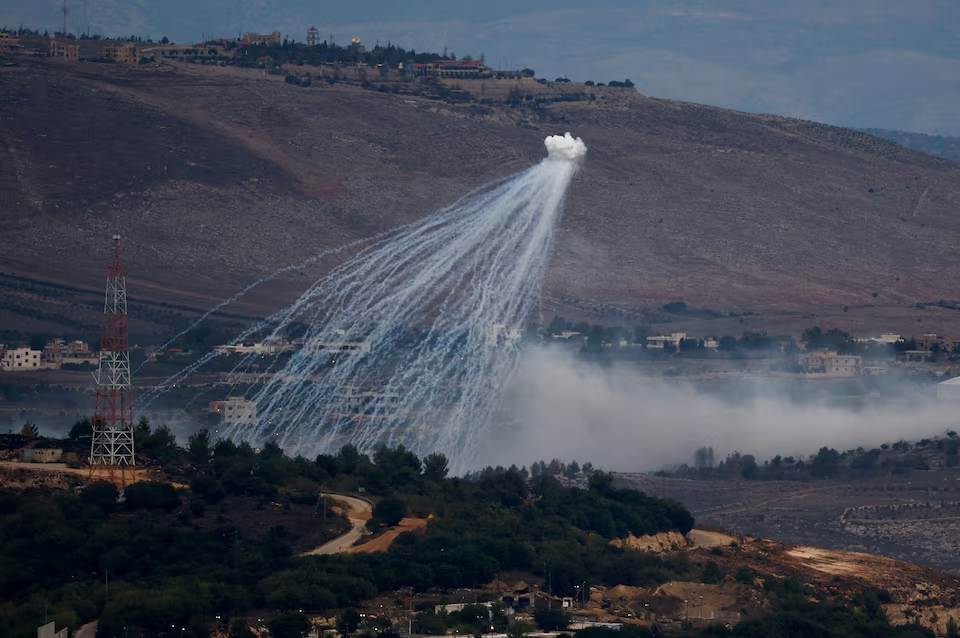
Human rights investigators have accused Israeli forces of using white phosphorus munitions during recent military operations in southern Lebanon, raising new legal and humanitarian concerns amid the expanding regional conflict.
According to Daljoog News analysis, the allegation comes at a time when hostilities between Iran, Israel, and their regional allies are intensifying, increasing the risk that controversial weapons and tactics may be used in densely populated areas.
The accusations surfaced as Iran launched another round of missile and drone attacks against Israeli and U.S.-linked targets across the Middle East, further escalating an already volatile confrontation.
What Happened?
Human Rights Watch reported evidence suggesting that white phosphorus was used during Israeli military strikes in southern Lebanon earlier this month.
The organization said investigators identified signs of the substance in at least two residential buildings in the town of Yahmor following an attack on March 3.
White phosphorus is a chemical substance that ignites when exposed to oxygen and produces intense heat and thick smoke. While it can be used legally for creating smoke screens on battlefields, its use near civilian areas is widely criticized because it can cause severe burns and uncontrollable fires.
Human Rights Watch stated that the evidence pointed to the material being used in areas where civilians were present, raising concerns about potential violations of international humanitarian law.
The allegations come during a broader military escalation across the Middle East.
Iran began a new phase of its retaliatory campaign during the Islamic holy month of Ramadan, launching a wave of missiles and explosive drones toward Israeli targets and U.S. positions in the region.
Iranian military sources said the attacks included several missile systems, including the Khorramshahr medium-range missile, the Fattah hypersonic missile, and the Khaibar ballistic missile.
Air raid sirens were activated across large areas of Israel, from the northern port city of Haifa to regions near Dimona. Israeli authorities said air defense systems intercepted most incoming drones and missiles, although debris reportedly fell in several locations and caused injuries.
Why This Matters
The use of controversial weapons such as white phosphorus significantly raises the stakes in armed conflicts.
Although international law does not completely ban the substance, strict rules govern its use, particularly in areas where civilians may be present.
When used in populated areas, the material can ignite fires that spread rapidly and cause severe injuries.
As a result, allegations involving white phosphorus often trigger international scrutiny and calls for independent investigations.
The accusations also come at a time when the Middle East is already facing one of its most dangerous military escalations in recent years.
Missile launches, drone strikes, and cross-border attacks have been reported across multiple countries, including Israel, Iran, Lebanon, and several Gulf states.
These developments increase the likelihood that humanitarian issues will become a central focus of international diplomatic pressure.
What Analysts or Officials Are Saying
Human Rights Watch urged international authorities to investigate the reported incidents and determine whether the use of white phosphorus violated the laws of armed conflict.
Legal experts say the key issue is not the weapon itself but where and how it is used.
If deployed in open battlefield areas for smoke or signaling purposes, its use may be considered lawful.
However, using it near residential neighborhoods or civilian infrastructure can raise serious legal concerns.
Israeli officials have not publicly confirmed the specific details of the incident described in the report.
Meanwhile, regional governments are expressing alarm over the widening conflict.
Iran’s missile and drone operations have already prompted several Gulf states to activate air defenses and issue security warnings to their populations.
In Kuwait, authorities recently raised the national security alert level following nearby missile threats.
Officials in the United Arab Emirates also reported intercepting drones and missiles that appeared to be part of the broader escalation.
Daljoog News Analysis
The allegations surrounding white phosphorus illustrate how quickly humanitarian concerns can become central to geopolitical conflicts.
Modern warfare increasingly unfolds near urban areas where civilians, infrastructure, and military targets exist side by side.
When controversial weapons are reportedly used under such conditions, the political and legal consequences can extend far beyond the battlefield.
For Israel, accusations involving banned or restricted weapons could intensify international scrutiny at a time when it is already facing pressure over regional military operations.
For Iran and its allies, such allegations may also serve as part of a broader narrative aimed at rallying diplomatic support and international criticism of Israeli actions.
However, determining the facts in active war zones remains extremely difficult.
Independent verification often requires on-site inspections, access to impact locations, and cooperation from local authorities—conditions that are rarely available during ongoing military operations.
Until more evidence emerges, the claims will likely remain the subject of international debate.
What Happens Next
Several developments could shape how the situation evolves.
First, international organizations may push for investigations into the alleged use of white phosphorus.
Second, the wider military confrontation between Iran, Israel, and allied forces could continue to escalate if missile attacks and airstrikes persist.
Third, diplomatic efforts may intensify as regional and global powers attempt to prevent the conflict from spreading further.
Turkey has already begun reinforcing its military posture by deploying additional air defense systems and fighter aircraft to strategic positions in the eastern Mediterranean.
At the same time, several countries are preparing for potential disruptions to regional security and energy infrastructure.
For now, the Middle East remains in a highly unstable phase.
Missile exchanges, humanitarian concerns, and rising geopolitical tensions are combining to create one of the region’s most uncertain moments in years.