


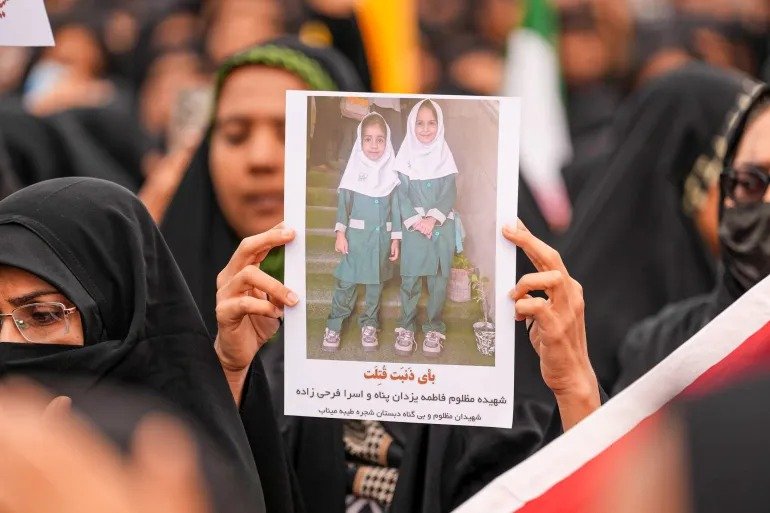
A missile strike on a girls’ school in Minab, southern Iran, killed over 170 people on February 28, most of them children. The Shajareh Tayyebeh school was destroyed in the morning hours as students attended class, leaving dozens injured.
According to Daljoog News analysis, the incident underscores the severe civilian toll of the ongoing US-Israel military campaign in Iran. Preliminary evidence points to a US Tomahawk missile, though both Washington and Tel Aviv initially denied responsibility.
The attack occurred during the first hours of the conflict, as Iran’s strategic Hormozgan province, home to IRGC naval facilities near the Strait of Hormuz, became a central target. The tragedy has already shaped perceptions of the war’s human cost and intensified international scrutiny.
What Happened?
The missile struck Shajareh Tayyebeh girls’ school at approximately 10:45 am local time on February 28. The blast destroyed the two-story building, collapsing the roof and killing at least 170 students and staff. Dozens more were injured.
The school is located near a base operated by the Islamic Revolutionary Guard Corps navy. While initially part of a military compound, the building had been a school for several years, with independent walls and entrances separating it from nearby facilities. Satellite imagery confirmed the school was intact earlier that morning, before air raids began.
Iran immediately blamed the US and Israel, citing the proximity of the strike to civilian areas and the scale of the casualties. Footage and expert analysis suggest that a US Tomahawk missile may have hit the site due to outdated targeting information, misidentifying the school as part of the IRGC base.
Why This Matters
The bombing represents one of the deadliest single incidents in the early phase of the US-Israel campaign in Iran. It raises urgent questions about civilian protection, targeting procedures, and accountability in military operations.
Hormozgan province’s strategic importance amplifies the stakes. Any miscalculation or civilian casualties there could provoke wider regional retaliation. Iran has already launched missiles and drones in response, targeting US and Israeli facilities as well as Gulf states attempting to avoid involvement.
The attack may also shape international discourse on the conflict, influencing public opinion and diplomatic pressure on the US to ensure stricter safeguards against civilian casualties.
What Analysts or Officials Are Saying
Analysts suggest the strike likely resulted from outdated US intelligence. The school was on the same block as IRGC facilities, but for years had been operating independently as a civilian school. Retired Marine Colonel Mark Cancian noted that US Central Command apparently did not update its target list to reflect the change in building use.
US officials have provided conflicting accounts. President Donald Trump suggested Iran might have been responsible, while Secretary of Defense Pete Hegseth stated the Pentagon was investigating. The New York Times reported that preliminary findings indicate a US missile was responsible, though the investigation is ongoing.
Israel has consistently denied involvement, with military spokespeople confirming no connection to the school attack. Meanwhile, nearly all US Senate Democrats have called for a full investigation, emphasizing the death of so many young girls and seeking clarity on targeting protocols, civilian protection measures, and AI tools in military operations.
Daljoog News Analysis
The Minab school bombing exemplifies the lethal consequences of targeting errors in high-intensity conflicts. Even advanced military forces with precision weapons remain vulnerable to misidentification, particularly in areas where civilian and military infrastructure overlap.
Historical patterns show that civilian casualties in US operations often spark political backlash without resulting in substantial accountability. From the 1999 bombing of the Chinese embassy in Belgrade to the 1991 Amiriyah bunker attack, errors have caused hundreds of civilian deaths, with limited disciplinary or legal consequences.
The Minab incident risks reinforcing antiwar sentiment domestically in the US and internationally, while strengthening Iran’s narrative of victimization and justifying retaliatory actions. It highlights the broader dangers of civilian casualties in modern conflicts and the strategic and ethical challenges posed by military interventions in densely populated regions.
What Happens Next
Confirmation of responsibility and investigation results will be closely watched. Even if the strike is officially acknowledged as a US targeting error, experts suggest disciplinary actions are likely to be limited.
Iran is expected to continue retaliatory strikes in the region, heightening risks for neighboring countries and maritime shipping lanes. Diplomatic channels may attempt to prevent escalation, but tensions remain high.
International scrutiny, congressional oversight in the US, and continued analysis by independent observers will shape how the Minab tragedy is addressed in both operational and political terms.