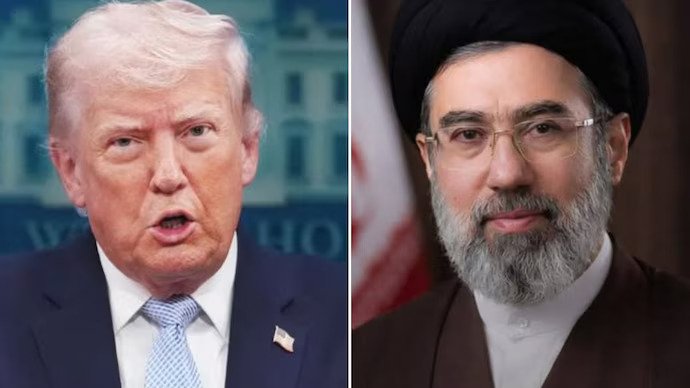



Russia may hold a high-level meeting with Iran’s newly appointed Supreme Leader, Mostafa Khamenei, later this year, according to Tehran’s ambassador to Moscow, Kazem Jalali. The potential encounter could occur during a summit on the Caspian Sea scheduled for August 12 in Tehran.
According to Daljoog News analysis, such a meeting would mark Mostafa Khamenei’s first interaction with a foreign head of state since assuming leadership after the death of his father, Ayatollah Ali Khamenei, in late February.
The announcement comes as Iran remains engaged in a military conflict with Israel and the United States, underlining Moscow’s interest in deepening strategic ties with Tehran amid heightened regional tensions.
What Happened?
Kazem Jalali, Iran’s ambassador to Russia, confirmed to a Russian media outlet that the Caspian Sea summit in Tehran could serve as the venue for a meeting between President Vladimir Putin and Iran’s Supreme Leader.
The summit is set for August 12 and will focus on regional security, trade, and cooperation among the Caspian Sea bordering nations.
If the meeting occurs, it will be Mostafa Khamenei’s first official discussion with a foreign leader since his appointment on March 8, nine days after his father’s reported death in a US-Israel airstrike on February 28.
Following his selection, Mostafa Khamenei delivered his first public statement on March 12 via state television, issuing directives related to the ongoing conflict and issuing warnings to Israel and the United States.
Moscow’s confirmation suggests that Russia is positioning itself as a key diplomatic interlocutor during a period of escalating military and geopolitical tensions in the Middle East.
Why This Matters
A meeting between Putin and Mostafa Khamenei would carry both symbolic and strategic significance.
For Iran, it signals international recognition of its new leadership amid a volatile conflict, potentially strengthening Tehran’s negotiating leverage.
For Russia, it represents an opportunity to consolidate influence in the region and demonstrate its role as a mediator and strategic partner to Tehran.
The timing of the potential meeting is particularly noteworthy, as Iran remains engaged in an ongoing conflict with Israel and the United States, with missile exchanges and military operations intensifying in the Gulf and surrounding areas.
Such a diplomatic encounter could also affect regional alliances and recalibrate the balance of power in the Middle East.
What Analysts or Officials Are Saying
Analysts note that Mostafa Khamenei’s first foreign meeting would provide insight into Tehran’s approach to international diplomacy under his leadership.
Some experts suggest that Russia’s outreach reflects Moscow’s intent to maintain influence in Middle Eastern conflicts while balancing relations with both Tehran and Washington.
Officials also highlight the broader context: the Caspian Sea summit brings together several regional actors, offering a platform for Iran to present its positions on security, trade, and energy matters.
Observers caution that any statements or agreements resulting from the potential meeting could signal Tehran’s future diplomatic priorities and its stance toward the US-Israel conflict.
Daljoog News Analysis
Mostafa Khamenei’s rise to power comes at a critical juncture for Iran. His leadership begins amid an active military confrontation with Israel and the United States, making early foreign engagements highly symbolic.
A meeting with Putin could help Tehran signal stability and continuity in governance, while simultaneously reinforcing strategic ties with a key global actor.
Russia’s involvement may also serve to mediate or influence the trajectory of the conflict, particularly in regions where Russian and Iranian interests converge.
This early diplomatic move underscores the intersection of military and political strategy, highlighting how emerging leaders seek international legitimacy during crises.
What Happens Next
The Caspian Sea summit in August will likely reveal whether the meeting between Putin and Mostafa Khamenei proceeds as anticipated.
Observers will closely watch the agenda, statements, and any joint initiatives that may emerge from the encounter.
Meanwhile, the ongoing Iran-Israel-US conflict will continue to shape the context in which this potential diplomatic engagement occurs.