

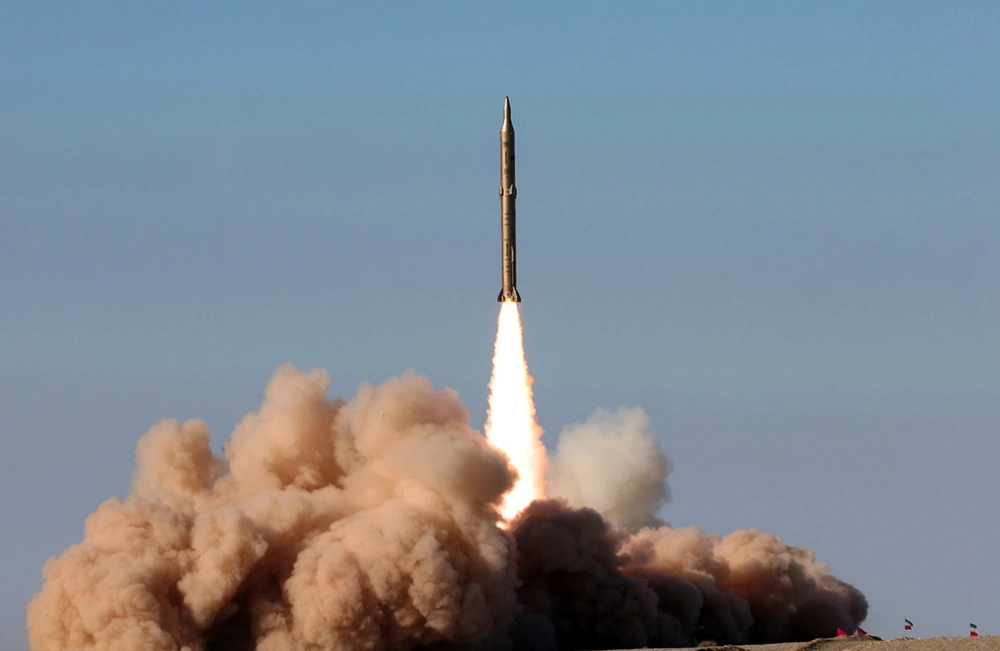
Iran has fired its advanced Sejil-2 ballistic missile, marking the first operational use of the weapon in an active conflict. The missile targeted multiple U.S. and Israeli military positions in the region on Sunday, according to Iranian state media reports.
According to Daljoog News analysis, the Sejil-2’s deployment signals Tehran’s intention to project both technological and strategic power, demonstrating capabilities that could challenge even the most advanced missile defense systems in the Middle East.
The attack comes as the Gulf region remains in heightened turmoil following the recent killing of Iran’s Supreme Leader Ayatollah Ali Khamenei in earlier hostilities. This launch further escalates a conflict that has already caused thousands of casualties and threatens broader regional stability.
What Happened?
The Sejil-2 is a two-stage, solid-fuel medium-range ballistic missile entirely developed in Iran. It has a maximum range of approximately 2,000 kilometers, allowing it to reach critical military targets across the Middle East from Iranian territory. The missile can carry up to 700 kilograms of explosives and measures about 18 meters in length, 1.25 meters in diameter, with a total weight of nearly 23,600 kilograms.
Experts describe it as a “dancing missile” because of its advanced maneuverability. Unlike traditional ballistic missiles, the Sejil-2 can alter its trajectory mid-flight and perform altitude adjustments, making interception by missile defense systems, such as Israel’s Iron Dome, significantly more challenging. The solid-fuel technology enables rapid launch preparation, reducing the time window for adversaries to detect and respond.
Iran first initiated the Sejil missile program in the early 1990s. Following years of development and testing, the first experimental launch of the Sejil occurred in 2008, covering roughly 800 kilometers. Subsequent tests improved guidance and navigation systems, culminating in a 2009 launch that reached approximately 1,900 kilometers over the Indian Ocean.
Why This Matters
The introduction of Sejil-2 into active combat represents both a technological demonstration and a strategic message. Its maneuverability and speed challenge conventional defense systems, potentially altering the balance of power in the region. For global energy and trade security, any escalation around Iranian territory raises concerns about oil transportation through critical maritime routes.
The missile’s use comes against a backdrop of sustained conflict. Following joint U.S.-Israeli strikes last month, tensions surged dramatically. Iran retaliated with attacks targeting military bases in Israel and the Gulf region, while U.S. and Israeli forces have continued precision strikes against Iranian military installations. Casualty reports indicate more than 2,000 deaths so far, most of them Iranian civilians.
What Analysts or Officials Are Saying
Military analysts note that the Sejil-2’s deployment complicates regional defense planning. Its solid-fuel propulsion allows rapid launch and reduces warning, creating a challenging scenario for missile defense operators. Experts highlight that the missile’s ability to perform evasive maneuvers—hence the “dancing” nickname—reduces the reliability of interception technologies.
U.S. defense officials confirm that over 15,000 targets in Iran have been struck since the conflict began, emphasizing the scale and intensity of ongoing hostilities. Analysts warn that further escalation could draw in additional regional and global powers, increasing both civilian and military risks.
Daljoog News Analysis
The Sejil-2 missile launch underscores the technological sophistication and strategic ambitions of Iran’s military programs. Beyond the immediate battlefield impact, it sends a clear message to both regional rivals and global powers that Iran possesses high-precision strike capabilities.
Daljoog News notes that such deployments may force Israel, the U.S., and Gulf allies to reassess missile defense strategies while signaling to the international community that conventional deterrence may no longer be sufficient. The conflict now hinges not just on numbers or territory but on technological leverage and strategic messaging.
What Happens Next
The coming weeks are likely to see continued missile exchanges and targeted strikes, with the risk of escalation remaining high. Analysts will monitor the effectiveness of the Sejil-2 in active combat, its potential use in future attacks, and how adversaries adapt their defense systems.
For the international community, the situation reinforces the urgency of diplomatic engagement and conflict containment measures. The trajectory of this conflict could shape not only regional security but also global energy markets and geopolitical alignments for months to come.