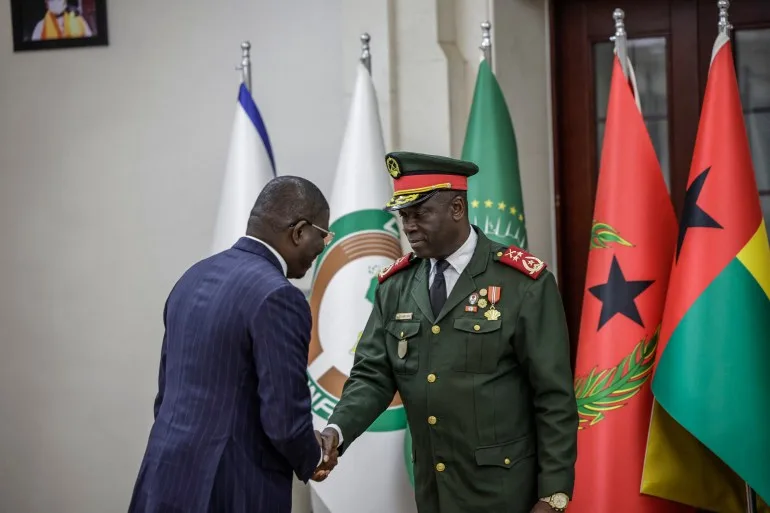
Guinea-Bissau’s new military leaders have moved quickly to consolidate power days after overthrowing President Umaro Sissoco Embalo. On Friday, General Horta Inta-A appointed Finance Minister Ilidio Vieira Te as the country’s new prime minister.
Inta-A, who was sworn in as transitional president on Thursday, told Te during the swearing-in ceremony that the people “expect a lot” from their leaders. He expressed hope that the military government and the prime minister would “work hand-in-hand” to govern the country.
Both Inta-A and Te are closely linked to the deposed president, Embalo. Te previously served in Embalo’s government and managed his campaign in last Sunday’s presidential election.
The appointment comes shortly after military officers declared they had taken “total control” of Guinea-Bissau, just as provisional election results were expected. Embalo had sought re-election against challenger Fernando Dias, with both candidates claiming victory ahead of the official results, which have not yet been released.
The coup has drawn swift condemnation from regional and global leaders. The African Union suspended Guinea-Bissau immediately, while ECOWAS barred the country from participating in all decision-making bodies. United Nations Secretary-General Antonio Guterres called the military’s actions an “unacceptable violation of democratic principles.” The European Union urged a quick return to constitutional order and the resumption of the electoral process.
Senegal’s Prime Minister, where Embalo is now in refuge, described the coup as a “sham” and insisted that the electoral commission should declare a winner. Dias, the opposition candidate, claimed on Thursday that he had defeated Embalo and accused him of orchestrating the power grab to remain in office.
Former Nigerian President Goodluck Jonathan, who was observing elections in Guinea-Bissau, described the takeover as a “ceremonial coup,” questioning how the military could allow the deposed president to address the media while being arrested.
Calm returned to the capital, Bissau, on Friday after an overnight curfew was lifted. People and vehicles moved freely through the streets, army checkpoints were removed, and commercial banks, markets, and the main stock exchange reopened. Street vendor Boubacar Embalo said, “I resumed my work because if I stay home, I will have nothing to eat.”
Meanwhile, the UN human rights chief, Volker Turk, reported that at least 18 people, including government officials, magistrates, and opposition leaders, were arbitrarily detained during the coup, with most still held incommunicado. Turk expressed concern over human rights violations, including threats to media houses and journalists, and called for the immediate release of all detainees and the restoration of constitutional order.
Turk emphasized that military authorities must respect fundamental freedoms, including the right to peaceful assembly. The new government’s moves to consolidate power have heightened fears of political instability in the West African nation, which has experienced several coups since gaining independence from Portugal in 1974.