


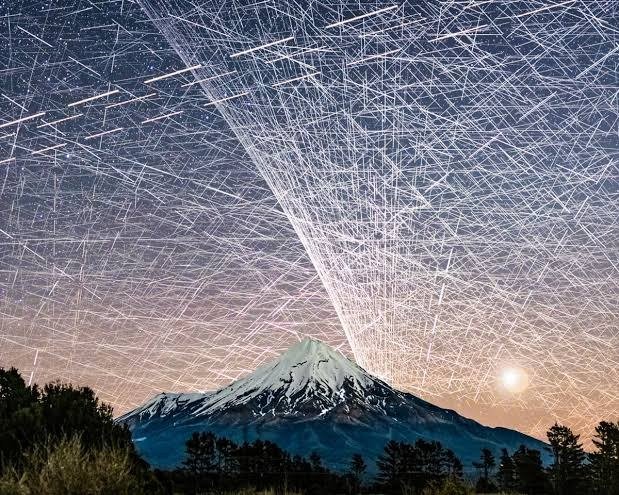
A remarkable photograph of the night sky above Mount Taranaki in New Zealand has attracted millions of views and sparked a debate about the growing number of satellites orbiting Earth. Photographer Brendan Larsen created the image by combining hundreds of photographs taken over several hours. The final result shows thousands of bright trails crossing the dark sky, creating a striking pattern that has led some viewers to question whether the image was produced using artificial intelligence. Larsen says the photograph is genuine and has shared details of his process to explain how the unusual image was created.
Larsen said he took 578 photographs, each with an exposure time of eight seconds, over a period of approximately two hours. He then spent around 40 hours working with the images in Photoshop, layering the photographs and removing stars to make the satellite trails easier to see. The result brought together an estimated 1,400 satellites and around 14,000 visible trails. The scale of the image surprised many viewers because most people are not used to seeing so many objects moving across the night sky at the same time.
The photographer understood why some people questioned the image’s authenticity. Artificial intelligence tools have become increasingly capable of producing realistic photographs and detailed visual scenes. Online users are now more likely to question unusual images, particularly when they show patterns or details that appear difficult to capture in a single photograph. Larsen responded by explaining how he created the work and documenting the steps involved. He said the image was built from photographs taken with his camera rather than generated by an AI system.
The image has also drawn attention to the growing presence of satellites in Earth’s orbit. Around 16,000 active satellites are currently operating above the planet, alongside defunct spacecraft and other debris. Many of these objects support communication, navigation, weather forecasting and other services used around the world. Satellite networks have expanded rapidly as companies and governments seek to improve internet access and develop new space-based technology. However, the increasing number of objects has created concerns among astronomers and environmental researchers.
For people who study the night sky, satellite trails can interfere with astronomical observations. Bright objects crossing a telescope’s field of view may affect images and make it harder to study distant stars and galaxies. The issue has become more important as satellite networks grow and more companies launch spacecraft into orbit. Researchers have also raised questions about the long-term effects of space activity on the atmosphere and the environment. These concerns include the effects of satellite re-entry, debris and the increasing number of launches.
Larsen has spent six years photographing the night sky and says he has noticed changes during that time. He has seen more satellites moving across his photographs and has become increasingly aware of light pollution. The bright lights from cities already make it difficult to observe faint stars in many places. Satellite trails add another challenge because they move across the sky even in locations far from major urban areas. His photograph has helped bring these changes to a wider audience by showing the scale of the activity in a single image.
The photographer hopes the attention will encourage a discussion about responsible satellite use and the future of astronomy. Satellite technology provides important services, but its rapid expansion also creates questions about how space should be managed. Larsen’s image offers a striking reminder that human activity is changing the view of the night sky. It also demonstrates how photography can turn a technical issue into something people can understand and discuss. The picture may have begun as an artistic project, but it has become part of a wider conversation about technology, the environment and the future of space.