

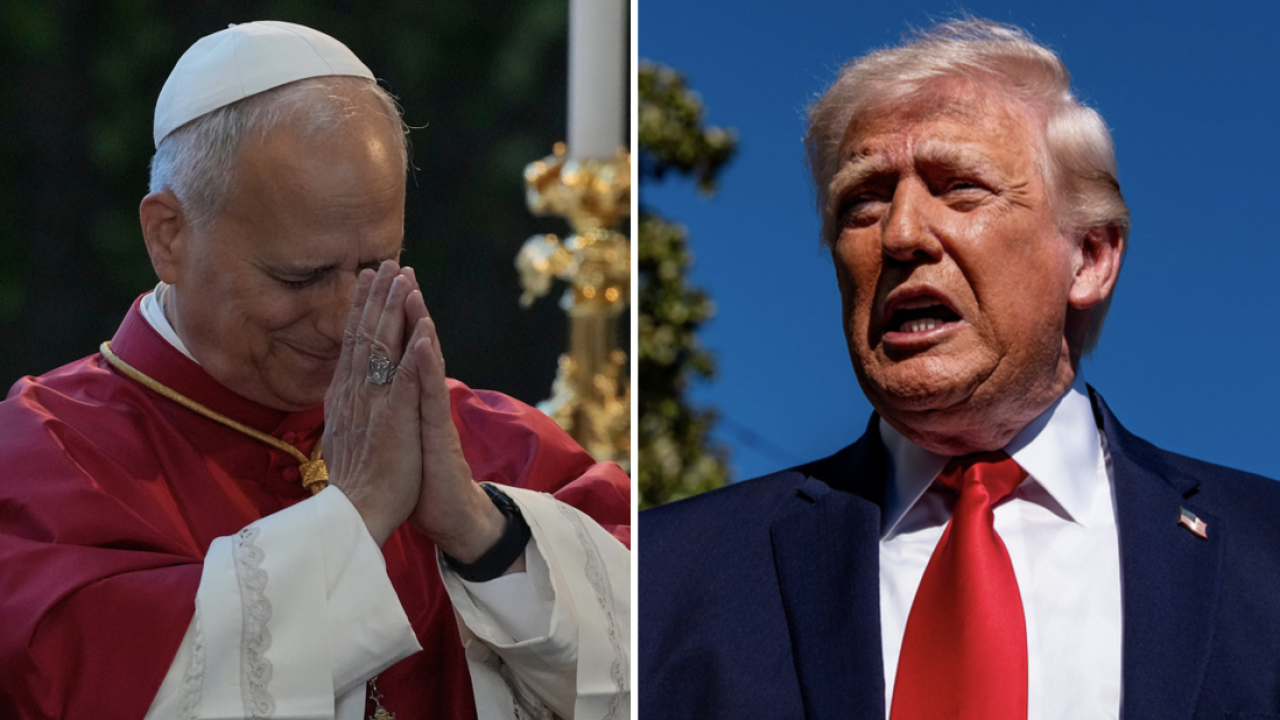
Trump Pope Leo clash has triggered a wave of global controversy after US President Donald Trump publicly exchanged sharp criticism with Pope Leo XIV over the ongoing Iran conflict and US military actions. The dispute quickly escalated beyond diplomacy into a broader political and cultural debate.
According to Daljoog News analysis, the confrontation highlights how modern geopolitical tensions increasingly spill into public messaging, where social media statements and symbolic imagery can escalate international disagreements within hours.
The controversy deepened further after additional comments and an AI-generated image shared by Trump sparked accusations of religious insensitivity, drawing reactions from global political and religious figures.
What Happened?
Trump Pope Leo clash began after Pope Leo XIV publicly criticized US military operations in Iran, urging restraint, de-escalation, and a renewed focus on peace-building efforts. The Pope emphasized the importance of avoiding further escalation in an already fragile global security environment.
In response, Donald Trump strongly rejected the Pope’s remarks, describing them in interviews with journalists as weak and politically misaligned with global security realities. He argued that excessive restraint toward nuclear-capable states could increase international risk.
Trump further accused the Pope’s position of potentially encouraging dangerous leniency toward hostile actors, framing it as inconsistent with global security needs. His comments immediately triggered diplomatic concern across Europe and beyond.
Italian Prime Minister Giorgia Meloni responded directly, calling Trump’s remarks unacceptable. She stressed that religious leaders have a moral responsibility to advocate for peace, and personal attacks on such figures undermine diplomatic respect and global stability.
The situation escalated further when Trump posted an AI-generated image on his social platform, Truth Social. The image depicted him in a Christ-like appearance, dressed in white robes and assisting a sick individual, with symbolic American imagery in the background, including flags and military aircraft.
The post quickly went viral and faced intense backlash online. Religious advocacy groups and critics accused it of being disrespectful and potentially offensive to Christian sentiments. The post was removed within hours amid growing pressure.
Later, Trump stated in remarks to journalists that the image was not intended to portray him as Jesus, but rather as a symbolic representation of humanitarian support or medical assistance, according to his interpretation.
Why This Matters
The Trump Pope Leo clash is significant because it brings together political leadership, religious authority, and digital communication in a single global controversy. The rapid escalation shows how symbolic messaging can influence international relations in real time.
Religious institutions, particularly the Vatican, often play a stabilizing role in global conflicts. When such figures enter geopolitical debates, their statements carry moral weight that can influence public opinion and diplomatic narratives.
At the same time, political leaders using social media platforms to respond directly to religious criticism introduces a new layer of unpredictability in international communication. This increases the risk of misinterpretation and diplomatic friction.
The controversy also reflects deeper divisions over how military intervention should be justified in modern conflicts, especially in sensitive regions like Iran where nuclear and regional security concerns overlap.
What Analysts or Officials Are Saying
Political analysts describe the Trump Pope Leo clash as an example of how traditional diplomatic boundaries are being reshaped by direct public communication. Instead of private diplomatic channels, disputes now unfold publicly and instantly.
European officials, particularly in Italy, have emphasized the importance of maintaining respectful discourse when addressing religious leaders. The reaction from Giorgia Meloni reflects broader European sensitivity toward religious and cultural institutions.
Digital communication experts highlight that AI-generated imagery is increasingly becoming a source of political controversy, especially when it involves religious symbolism or identity representation.
Religious commentators have also expressed concern that blending political messaging with sacred imagery risks deepening cultural divisions and eroding trust in public discourse.
Meanwhile, US political observers note that the controversy could influence domestic debate over foreign policy, particularly regarding military strategy in Iran and broader Middle East engagement.
Daljoog News Analysis
The Trump Pope Leo clash reveals how modern geopolitical disputes are no longer confined to policy disagreements alone. They now extend into symbolic and cultural spaces where perception can be as powerful as policy.
The Pope’s intervention reflects a long-standing tradition of religious diplomacy advocating restraint in global conflicts. However, Trump’s direct rebuttal demonstrates a growing trend where political leaders openly challenge moral authority figures.
The use of AI-generated imagery adds another layer of complexity. In the digital era, visual symbolism can spread faster than official statements, often shaping public interpretation before clarification is issued.
This incident also highlights the fragile balance between free expression and cultural sensitivity. While political figures have wide latitude in communication, religious symbolism remains highly sensitive across global audiences.
Daljoog News analysis suggests that such clashes will likely become more frequent as digital platforms, AI tools, and real-time political messaging continue to merge, reshaping the boundaries of diplomatic communication.
What Happens Next
The Trump Pope Leo clash is expected to continue generating diplomatic and media discussion in the coming days, particularly as reactions from international religious and political institutions develop.
Further clarification from the Vatican or US administration could help reduce tensions, but the public nature of the dispute makes full de-escalation unlikely in the short term.
European leaders may continue to emphasize restraint in public political discourse, especially when addressing religious figures or institutions.
At the same time, analysts expect continued debate over the role of AI-generated political imagery and its impact on global communication norms.
The situation remains fluid, with the potential to influence both diplomatic tone and public perception in ongoing discussions about Iran and broader international security policy.