


President Donald Trump is escalating pressure on Congress to approve a strict new voting law, warning that he will refuse to sign any other legislation until lawmakers pass the measure.
According to Daljoog News analysis, the demand places the voting bill at the center of a growing political confrontation in Washington, with Republicans divided on strategy and Democrats strongly opposed.
The move comes months before the U.S. midterm elections, a period when election rules and voter access often become major political battlegrounds.
What Happened?
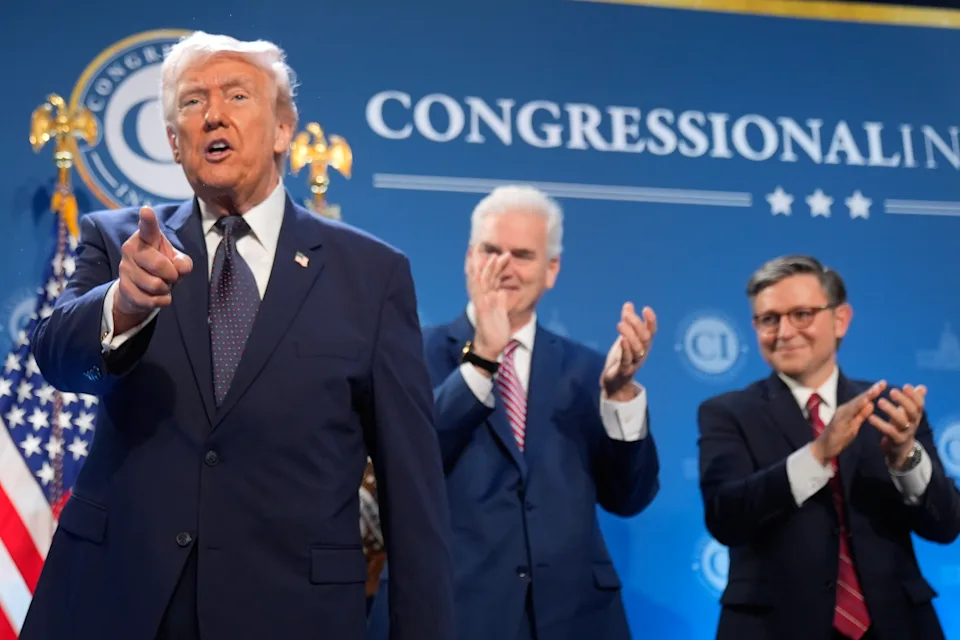
Speaking to House Republicans during their annual retreat at his Florida golf resort, Trump told lawmakers that election reforms must be approved before he signs any additional bills into law.
The president is pushing Congress to strengthen the Safeguarding American Voter Eligibility Act, widely known as the SAVE America Act.
The House of Representatives has already passed a version of the bill, but it faces significant hurdles in the Senate.
Trump said the legislation must require voters to provide proof of U.S. citizenship and also eliminate most forms of mail-in voting. He argued that tighter rules are necessary to prevent election fraud.
Under the proposal already approved by the House, Americans registering to vote in federal elections would need to present documents such as a passport or birth certificate to prove citizenship.
Trump wants the legislation expanded further to largely ban voting by mail. Limited exceptions would apply to certain groups, including military personnel, people with disabilities, and voters in special circumstances.
The president also told lawmakers he would not sign a diluted version of the bill and described the issue as his top legislative priority.
Why This Matters
The debate over voting rules could shape the political landscape heading into the upcoming midterm elections.
Election laws in the United States are primarily administered by individual states, and rules vary widely across the country.
Mail-in voting expanded significantly during the COVID-19 pandemic and remains widely used in several states.
Supporters argue that mail ballots help millions of Americans vote more easily, especially those who cannot reach polling stations in person.
Critics, including Trump and many of his allies, claim the system creates opportunities for fraud, although election experts say documented cases remain extremely rare.
Voting rights organizations warn that the proposed proof-of-citizenship requirement could create barriers for many eligible voters.
Some experts estimate that millions of Americans may not have immediate access to documents such as birth certificates or passports, particularly older voters or those who changed their names after marriage.
Because Republicans hold only narrow majorities in Congress, the issue is also testing party unity.
What Analysts or Officials Are Saying
Democratic leaders have strongly criticized the proposal and warned that it could limit access to the ballot.
Senate Democratic leadership has argued that the president’s demand could stall legislative work and create political gridlock.
Republican leaders are more divided.
House Speaker Mike Johnson appeared alongside Trump at the Florida retreat and voiced support for the effort to pass the voting bill.
However, Senate Republicans face a major procedural obstacle known as the filibuster, which allows a minority of senators to block most legislation unless 60 votes are secured.
Trump has urged Senate Republicans to bypass the rule by using a “talking filibuster,” which would require senators to physically hold the floor to block a vote.
But Senate Majority Leader John Thune has cautioned that such a strategy could open the chamber to unlimited debate and amendments, potentially weakening the legislation or dividing Republican lawmakers.
Election experts say procedural battles in the Senate could determine whether the bill advances at all.
Daljoog News Analysis
Trump’s demand reflects a long-running political strategy centered on election security and voter eligibility.
Since the 2020 presidential election, the issue has remained a core theme within the Republican Party, particularly among voters aligned with Trump’s political movement.
By tying the bill to his willingness to sign other legislation, Trump is attempting to force congressional action on the issue.
This approach increases pressure on Republican lawmakers who may support stricter voting laws but remain cautious about altering Senate rules or pushing legislation that could face legal challenges.
The move also raises questions about the balance of power between federal and state governments.
The U.S. Constitution gives states primary authority over elections, meaning federal mandates on voter eligibility or ballot procedures often face intense political and legal scrutiny.
Another factor is timing.
Midterm elections traditionally shift political momentum in Washington, and both parties are preparing for a competitive contest that could reshape control of Congress.
If the voting bill becomes a central issue in the campaign season, it may energize supporters on both sides while deepening partisan divisions.
What Happens Next
The future of the legislation will depend largely on the Senate, where Republicans must decide how aggressively to push the bill.
Party leaders are expected to discuss possible strategies in private meetings this week.
One option is to attempt a procedural workaround to move the bill forward despite Democratic opposition. Another is to negotiate a narrower version that could attract broader support.
Meanwhile, Trump has signaled that he is prepared for a prolonged battle.
The president suggested that even if the effort takes months, he wants the legislation approved before other priorities move forward.
That stance could complicate the legislative agenda in Washington, where lawmakers are also facing urgent debates over government funding and immigration enforcement programs.
For now, the dispute over voting rules is emerging as one of the most significant political fights ahead of the midterm elections.