

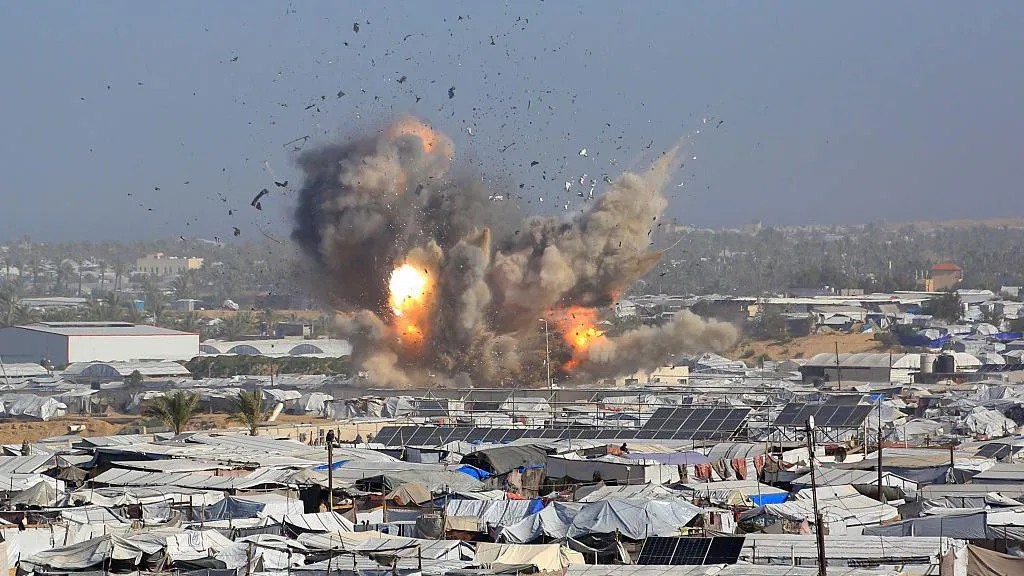
Gaza airstrike ceasefire violation reports have intensified after an Israeli airstrike hit an area outside a school in the Terdal Bala region of Gaza, killing and injuring civilians who had gathered nearby. The attack triggered panic and chaos as emergency responders rushed to the scene.
According to Daljoog News analysis, the incident underscores the fragile nature of the current ceasefire framework, where formal agreements exist but ground-level violence continues almost daily.
The strike comes at a time of heightened diplomatic activity, as mediators struggle to prevent renewed escalation while casualty figures continue to rise across the enclave.
What Happened?
Gaza airstrike ceasefire violation was reported after Israeli forces carried out an airstrike near a school in the Terdal Bala area of the Gaza Strip. Civilians were reportedly gathered outside the facility when the strike hit, causing immediate casualties.
Witnesses described scenes of destruction and confusion, with survivors attempting to rescue the wounded amid ongoing fear of further attacks. Several people were killed instantly, while others were transported to medical centers, including Al-Aqsa Hospital.
Inside the hospital, the situation quickly became overwhelmed. Bodies of victims were brought in as grieving families gathered, creating a deeply distressing atmosphere marked by shock and mourning.
Local accounts suggest that despite the declared ceasefire, military strikes have not fully stopped. Residents report repeated incidents of violence affecting civilian areas, including schools and residential zones.
According to Gaza health authorities, at least 750 people have been killed and more than 2,000 injured since the ceasefire took effect. These figures have fueled growing allegations of ongoing violations.
The Israeli government has not issued a detailed statement specifically addressing this latest incident at the time of reporting.
Why This Matters
The Gaza airstrike ceasefire violation raises serious concerns about the effectiveness of the current truce arrangement. While ceasefires are intended to reduce hostilities, repeated incidents suggest limited control over ground realities.
Civilians continue to bear the heaviest burden, especially in densely populated areas where schools and shelters are located near potential conflict zones. Each new strike deepens humanitarian pressure and public fear.
The reported casualty numbers also intensify international scrutiny of the ceasefire mechanism. Without effective enforcement, agreements risk losing credibility among both local populations and global observers.
Humanitarian operations are also being strained as hospitals struggle with limited resources and increasing patient loads, particularly in emergency trauma cases.
What Analysts or Officials Are Saying
Health officials in Gaza continue to report rising casualties despite the ceasefire announcement, stating that the situation on the ground remains unstable and unpredictable.
Diplomatic mediators from Egypt, Turkey, and Qatar are currently engaged in negotiations in Cairo, attempting to advance the next phase of the ceasefire agreement. Palestinian representatives, including Hamas-linked delegations, are participating in discussions.
A key obstacle remains the issue of disarmament. Palestinian factions argue that earlier ceasefire commitments must be fully implemented before any weapons-related negotiations can proceed.
The United States has supported a proposal for a transitional Palestinian administrative structure, where disarmament would be introduced gradually alongside political reforms.
Israel, however, has warned that failure to reach an agreement on demilitarization could result in a return to full-scale military operations.
These conflicting positions continue to stall progress despite ongoing diplomatic engagement.
Daljoog News Analysis
The Gaza airstrike ceasefire violation highlights the widening gap between diplomatic agreements and operational realities on the ground. Ceasefires often depend on mutual trust, but that trust remains deeply fragile in this conflict.
Even as negotiations continue, parallel military actions undermine confidence in the process. This creates a cycle where diplomacy and violence occur simultaneously rather than sequentially.
The disagreement over sequencing—whether disarmament should come before or after political guarantees—remains the central barrier to progress. Neither side appears willing to shift its core position.
Meanwhile, civilian infrastructure continues to be exposed, raising serious concerns about the long-term humanitarian impact. Schools, hospitals, and residential areas are increasingly caught in the crossfire of strategic calculations.
Daljoog News analysis suggests that without a credible enforcement mechanism or third-party monitoring system, ceasefire violations may continue regardless of diplomatic announcements.
What Happens Next
Diplomatic talks in Cairo are expected to continue as mediators attempt to bridge the divide between security demands and political conditions. A phased implementation plan remains under discussion.
However, the risk of escalation remains high. Israeli officials have indicated that military operations could resume at full intensity if negotiations fail to produce security guarantees.
Palestinian groups maintain that any disarmament discussion must be preceded by full implementation of existing ceasefire terms.
On the ground, civilians remain exposed to uncertainty as sporadic violence continues alongside ongoing negotiations.
The coming days will be crucial in determining whether the ceasefire framework stabilizes or further deteriorates into renewed large-scale conflict.