



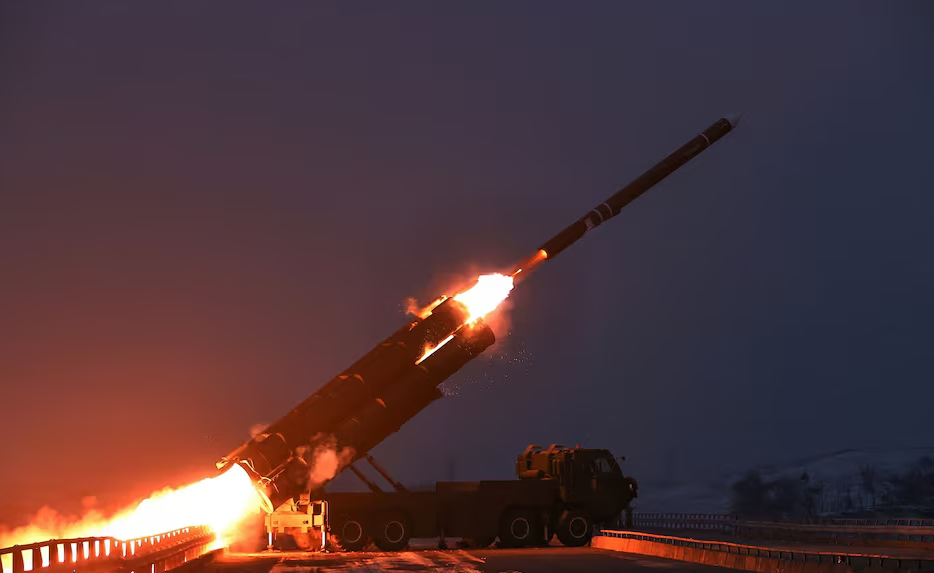
North Korea’s cruise missile test has once again raised security concerns in East Asia after Pyongyang confirmed the launch of multiple strategic missiles from a naval destroyer during a recent military exercise. The drill included both cruise and anti-ship missile systems.
According to Daljoog News analysis, the North Korea cruise missile test reflects a continued push by Pyongyang to strengthen its naval strike capabilities while showcasing resilience against modern electronic warfare threats.
The timing of the exercise, personally observed by North Korean leader Kim Jong Un, adds additional geopolitical sensitivity at a time when regional military tensions remain elevated.
What Happened?
North Korea cruise missile test operations were carried out from the naval destroyer Choe Hyon, according to state media reports released by the Korean Central News Agency. The drill involved the launch of two strategic cruise missiles and three anti-ship missiles.
The exercise took place on Sunday and was overseen by North Korean leader Kim Jong Un, who observed the operation alongside senior military and naval officials. The leadership presence highlights the strategic importance assigned to the test.
Officials stated that the purpose of the North Korea cruise missile test was to evaluate the destroyer’s integrated weapons control system and its ability to function under advanced combat conditions.
A key focus of the drill was testing navigation and targeting systems designed to operate even in environments affected by electronic interference or GPS jamming attempts. This reflects growing emphasis on electronic warfare resilience in modern military planning.
State media reported that both cruise and anti-ship missiles completed their trajectories over waters near the Korean Peninsula. The missiles reportedly struck designated targets within specified flight times, demonstrating coordinated launch capability from a single platform.
The reported flight durations varied between systems, indicating separate operational testing for different missile categories within the same exercise.
Why This Matters
The North Korea cruise missile test is significant because it demonstrates continued expansion of North Korea’s naval strike capabilities, an area that adds flexibility to its broader military strategy.
Unlike land-based missile systems, naval platforms allow for extended operational range and different deployment scenarios, making them an increasingly important component of modern military deterrence strategies.
The reported focus on anti-jamming and navigation resilience is particularly important, as electronic warfare has become central to global military planning. Systems capable of functioning under GPS disruption are considered strategically advanced.
This development also contributes to ongoing regional security concerns involving South Korea, Japan, and the United States, all of which closely monitor North Korean missile activity for signs of escalation or technological advancement.
Even when no direct conflict is involved, repeated missile testing can increase uncertainty and pressure neighboring countries to adjust defense readiness levels.
What Analysts or Officials Are Saying
Military analysts view the North Korea cruise missile test as part of a consistent pattern of incremental capability development rather than a single breakthrough event. Each test is seen as a step in refining operational reliability and system integration.
Defense experts note that naval missile platforms provide North Korea with increased tactical flexibility, including coastal defense and potential maritime strike options. This diversification complicates regional defense planning.
Analysts also highlight the significance of electronic warfare resistance systems, suggesting that North Korea is aligning its weapons development with modern conflict environments where communication disruption is a key factor.
While state media claims successful outcomes, independent verification remains limited due to restricted access to testing data and controlled reporting environments.
Regional defense authorities continue to track such activities closely, as they often provide insight into future missile development directions and strategic priorities.
Daljoog News Analysis
The North Korea cruise missile test highlights Pyongyang’s ongoing strategy of demonstrating military capability while reinforcing deterrence messaging to regional and global powers.
Rather than signaling immediate escalation, these tests appear designed to show technological progress and operational readiness under complex conditions. The emphasis on naval systems suggests a gradual shift toward more flexible deployment options.
The inclusion of anti-jamming and navigation resilience features reflects awareness of modern warfare trends, where electronic interference can be as decisive as kinetic force.
However, such tests also contribute to a cycle of military signaling in East Asia. Even routine demonstrations can influence defense planning and heighten sensitivity among neighboring states.
From a strategic perspective, the continued pace of testing reinforces the fragile nature of regional security dynamics, where each advancement is closely watched and often met with counter-preparedness measures.
What Happens Next
The North Korea cruise missile test is expected to be followed by additional trials as Pyongyang continues refining its naval and missile systems.
Regional powers are likely to respond with increased surveillance activity and continued joint military exercises aimed at deterrence and preparedness.
Diplomatic efforts to reduce tensions remain limited, and future developments will depend heavily on broader geopolitical negotiations involving major global actors.
For now, the situation suggests continued testing activity focused on improving accuracy, electronic resilience, and multi-platform coordination in North Korea’s military capabilities.