

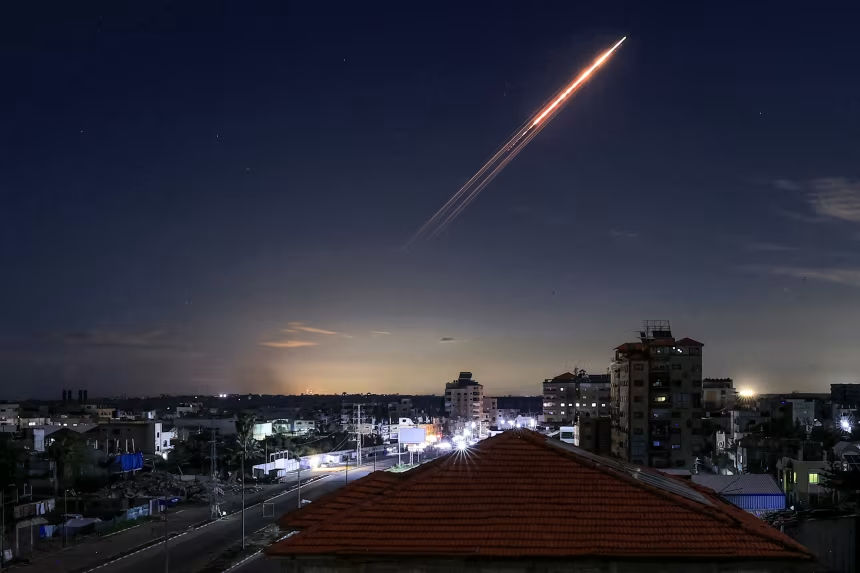
Israel faced a sudden wave of ballistic missile strikes early Thursday morning, sending shockwaves across the region. Civilians sought shelter as air-raid sirens sounded across major cities.
According to Daljoog News analysis, Iran’s coordinated missile operation represents a dramatic escalation in its military posture, signaling Tehran’s readiness to target both regional rivals and U.S. installations.
The timing is particularly sensitive, coming amid ongoing tensions over Iran’s regional influence and recent U.S.-Israeli operations in Tehran. Neighboring Gulf states are now on high alert, raising the stakes for international security.
What Happened?
In the early hours, Iran launched multiple ballistic missiles toward Israel, striking near major urban centers and military installations. The strikes were part of what Iranian officials described as “Operation Fateh Khaibar,” a large-scale military campaign demonstrating Tehran’s long-range capabilities.
Concurrently, Iranian forces targeted U.S. assets in the Gulf, including the American embassy in Riyadh, Saudi Arabia. Reports indicate that American personnel were instructed to evacuate from 14 countries in the region as a precautionary measure.
Additional strikes were reported near U.S. bases in Qatar, Kuwait, and the United Arab Emirates. Media outlets have confirmed six U.S. military personnel were killed during the attacks, though exact details remain limited. Israeli authorities confirmed widespread alerts and the activation of protective bunkers for civilians.
Why This Matters
The attacks mark one of the most serious escalations in the Middle East in recent years. Israel, historically a key U.S. ally in the region, now faces direct missile threats on its territory.
The simultaneous targeting of American facilities underscores Iran’s willingness to expand hostilities beyond a bilateral conflict, raising the potential for a broader confrontation involving multiple Gulf states.
Global energy markets could feel immediate effects, as shipping lanes in the Strait of Hormuz are already under heightened threat. Insurance rates for commercial vessels and oil prices are expected to spike, creating a ripple effect across international trade.
What Analysts or Officials Are Saying
Military analysts suggest the precision and coordination of the strikes indicate Iran’s strategic intent to demonstrate power and deter future U.S.-Israeli operations. Regional security experts note that the attacks may compel Gulf nations to reassess their military posture and alliances.
U.S. officials are reportedly evaluating additional evacuations and reinforcing defenses at American installations. Analysts caution that miscalculations on either side could rapidly escalate into a wider regional conflict.
Daljoog News Analysis
From a strategic perspective, Iran’s operation is a calculated signal of strength, aimed both at Israel and the United States. The targeting of multiple Gulf states highlights Tehran’s intent to create a perimeter of pressure that extends beyond immediate borders.
While the strikes have clear military objectives, the broader implication is the destabilization of regional security. International actors, including the EU and major Asian powers, are likely monitoring the situation closely, as any further escalation could impact global trade and diplomacy.
The attack also reveals vulnerabilities in regional defense coordination, suggesting that Gulf nations and Israel may need to rethink air defense and intelligence-sharing mechanisms.
What Happens Next
Immediate attention will focus on whether Israel and U.S. forces respond with counter-strikes or defensive operations. Heightened tensions may prompt further diplomatic interventions from international organizations.
U.S. citizens in the Gulf are expected to remain on high alert, with potential for additional evacuation directives. Meanwhile, energy markets and regional trade routes may continue to experience instability.
Diplomatic negotiations, intelligence operations, and military posturing are all likely to intensify in the coming days. Analysts warn that a single misstep could escalate the situation, making careful monitoring essential for regional and global stability.