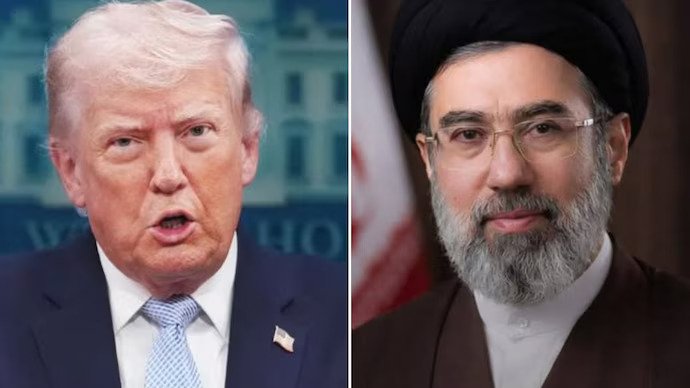


US-Iran nuclear talks are showing signs of movement after US President Donald Trump claimed that negotiations with Iran are progressing with no major unresolved disputes blocking a potential deal. He made the remarks during a briefing with reporters, pointing to what he described as improving diplomatic momentum involving Iran and regional discussions linked to Lebanon.
According to Daljoog News analysis, the public optimism from Washington contrasts sharply with Tehran’s firm stance on uranium enrichment and sovereignty, suggesting that both sides are still far from a shared framework for agreement despite ongoing dialogue.
The timing of these statements comes as tensions remain high over Iran’s nuclear program and control of key maritime routes in the Gulf, especially the Strait of Hormuz, which plays a critical role in global energy shipments and regional security dynamics.
What Happened?
US-Iran nuclear talks gained renewed attention after President Donald Trump claimed that Iran had agreed in principle to send enriched uranium material to the United States as part of ongoing negotiations. He presented this as evidence that discussions were moving forward and that significant breakthroughs were possible.
However, Iranian authorities immediately rejected this claim. Esmail Baghaei, spokesperson for Iran’s Foreign Ministry, said enriched uranium is a protected national asset and cannot be transferred under any circumstances. He emphasized that Iran views its nuclear materials as integral to national sovereignty and security.
Alongside the nuclear dispute, maritime tensions also surfaced. Trump stated that while the Strait of Hormuz remains open for navigation, pressure on Iranian ports would continue. Iran responded by warning that any sustained restrictions could trigger reciprocal measures.
A senior Iranian military official further added that passage through the Strait of Hormuz would require authorization from the Islamic Revolutionary Guard Corps (IRGC), reinforcing Tehran’s strategic influence over one of the world’s most sensitive shipping corridors.
At the same time, an Iranian official speaking to Reuters clarified that commercial shipping, including US-flagged vessels, would still be permitted to pass through the strait. However, military naval ships would face restrictions, signaling a differentiated approach between civilian and military traffic.
Why This Matters
The developments surrounding US-Iran nuclear talks carry major implications for global security and energy stability. The Strait of Hormuz alone handles a significant portion of the world’s oil shipments, making it one of the most strategically important maritime chokepoints on the planet.
Any uncertainty in this region can quickly ripple through global energy markets, affecting fuel prices, shipping costs, and economic stability across multiple regions. Even diplomatic friction, without direct conflict, can create volatility in international trade expectations.
On the nuclear side, Iran’s enrichment program remains one of the most sensitive geopolitical issues. Western governments continue to express concern over enrichment levels, while Iran insists its program is peaceful and fully within its sovereign rights.
These overlapping disputes—nuclear control and maritime security—create a complex negotiation environment where progress on one issue does not guarantee resolution on the other.
What Analysts or Officials Are Saying
Observers of US-Iran nuclear talks note that both sides continue to communicate in sharply different narratives. While Washington highlights progress and possible concessions, Tehran maintains a strict position on nuclear sovereignty and rejects external control over its enrichment activities.
Policy analysts suggest that such messaging often reflects strategic positioning rather than final negotiation outcomes. The US administration appears focused on demonstrating diplomatic progress, while Iran is signaling red lines to strengthen its bargaining position.
Security experts also warn that developments in the Strait of Hormuz could escalate quickly if restrictions intensify. Given its global importance, even limited disruptions could draw international attention and potentially involve external naval forces in the region.
Daljoog News Analysis
The current phase of US-Iran nuclear talks reflects a deeper structural divide that has persisted for years. While both sides publicly express willingness to negotiate, their definitions of acceptable outcomes remain fundamentally incompatible.
Trump’s statements suggest an expectation of tangible concessions, particularly regarding uranium handling and strategic security guarantees. Iran’s response, however, reinforces a consistent position that nuclear capability and maritime control are non-negotiable elements of its national policy.
This gap between diplomatic messaging and policy reality continues to slow meaningful progress. Even when dialogue is active, trust deficits and competing strategic priorities prevent the formation of a stable agreement framework.
The situation also highlights how regional security issues are tightly linked with global economic stability. Any miscalculation in the Gulf region could extend far beyond bilateral relations, affecting energy markets and international trade routes.
What Happens Next
The next phase of US-Iran nuclear talks will likely depend on whether backchannel diplomacy can reduce the gap between public statements and private negotiation terms. Key issues expected to dominate future discussions include uranium enrichment verification and maritime navigation guarantees.
If negotiations advance, formal mechanisms for monitoring nuclear materials and ensuring safe passage through the Strait of Hormuz may become central elements of any agreement.
However, if positions harden, the risk of renewed regional tension remains. This could include increased naval activity, port restrictions, or diplomatic escalation involving allied powers.
For now, both Washington and Tehran appear committed to continuing dialogue, even as their core demands remain far apart, leaving the outcome of US-Iran nuclear talks uncertain in the near term.