


Close Menu
Daljoog News
    What's Hot
    Grindr Settles Data Sharing Lawsuit For Millions

    Grindr Settles Data Sharing Lawsuit For Millions

    September 13, 2026
    Modi Hosts BRICS Summit With Putin And Xi

    Modi Hosts BRICS Summit With Putin And Xi

    September 13, 2026
    Fortune Cookie Day Adds Fun To Dessert Time

    Fortune Cookie Day Adds Fun To Dessert Time

    September 13, 2026
    Facebook X (Twitter) Instagram
    Sunday, September 13
    Daljoog News
    Facebook X (Twitter) YouTube Instagram
    • Home
    • General
    • World
    • Business
    • Technology
    • Politics
    • Finance
    • Health
    • Lifestyle
    • Sports
    • Travel
    Daljoog News
    Home»Diplomacy»Geneva Nuclear Talks Shadowed by Military Tension
    Diplomacy

    Geneva Nuclear Talks Shadowed by Military Tension

    Andrew RogersBy Andrew RogersFebruary 18, 2026No Comments4 Mins Read
    Facebook Twitter Pinterest LinkedIn Tumblr Email
    Follow Us
    Google News
    Geneva Nuclear Talks Shadowed by Military Tension
    Geneva Nuclear Talks Shadowed by Military Tension
    Share
    Facebook Twitter LinkedIn Pinterest Email

    High-risk nuclear negotiations between the United States and Iran are set to resume in Geneva, as military signaling and political warnings intensify across the region.

    According to Daljoog News analysis, the second round of talks comes at a moment when both diplomacy and deterrence are moving in parallel — raising the stakes well beyond the negotiating table.

    The discussions are unfolding in Geneva, long considered neutral ground for sensitive diplomacy, yet the atmosphere surrounding this round is anything but calm.

    What Happened?

    The renewed negotiations follow months of rising tension between Washington and Tehran.

    U.S. President Donald Trump indicated he will not personally attend the Geneva meeting but will remain closely engaged in the process.

    Earlier, Secretary of State Marco Rubio suggested that direct talks with Iran’s supreme leader were possible if necessary.

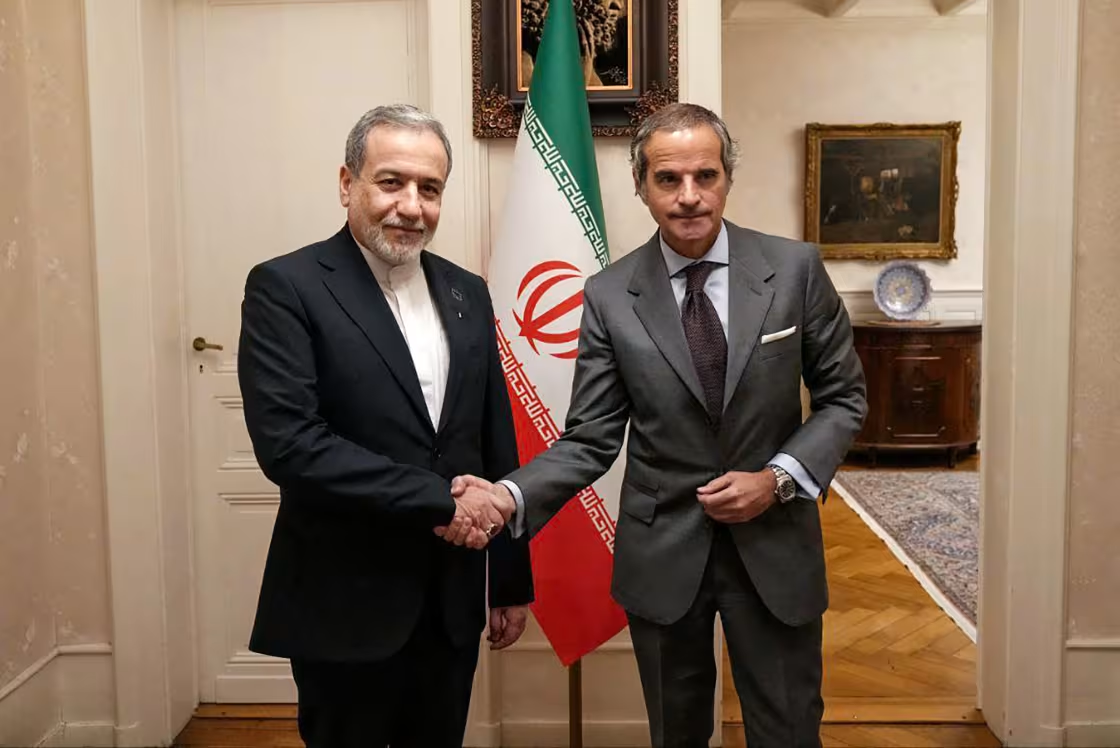
    Iran’s Foreign Minister Abbas Araghchi has already arrived in Geneva to lead Tehran’s delegation. He stated that Iran seeks a fair and balanced agreement but will not negotiate under pressure or threats.

    Meanwhile, Iran’s Supreme Leader Ali Khamenei issued a stern warning that any military strike against Iran could escalate into a wider regional conflict.

    Ahead of the talks, reports indicate that the United States increased its military presence in the Gulf region, deploying an additional aircraft carrier.

    At the same time, Iran’s Islamic Revolutionary Guard Corps conducted naval drills in the Strait of Hormuz, reinforcing its strategic leverage over a key global oil transit route.

    Why This Matters

    The central obstacle remains uranium enrichment.

    Washington demands that Iran halt enrichment activities on its soil entirely and expand negotiations to include ballistic missile capabilities and other military programs.

    Tehran rejects that framework. Iranian officials maintain that their nuclear program is peaceful and insist they will not agree to zero enrichment.

    Iran has signaled openness to limited restrictions, but only in exchange for meaningful sanctions relief.

    The dispute is not technical alone. It reflects deeper mistrust accumulated over years of sanctions, withdrawals from agreements and regional confrontation.

    The outcome of these talks could shape Middle Eastern security for years.

    If negotiations fail, the risk of escalation rises. If they succeed, they could stabilize energy markets and reduce immediate military tension.

    What Analysts or Officials Are Saying

    International observers describe the situation as a classic case of negotiation under pressure.

    Diplomats point out that military posturing often accompanies high-level talks, especially when credibility and leverage are central concerns.

    Araghchi also met with the head of the International Atomic Energy Agency in Geneva for technical discussions.

    The agency seeks clarity on Iran’s stockpile of highly enriched uranium following recent strikes on facilities at Natanz, Fordow, and Isfahan.

    Inspectors aim to resume comprehensive monitoring at these sites, though Iran has limited access, citing safety and radiation concerns.

    Energy analysts warn that any disruption in the Strait of Hormuz would immediately affect global oil flows, as a significant portion of world crude passes through the narrow corridor.

    Daljoog News Analysis

    This round of talks reflects a paradox.

    Both sides appear serious about diplomacy, yet neither is stepping back from military positioning.

    Washington wants structural limits on enrichment and expanded oversight. Tehran wants sanctions relief without surrendering sovereign nuclear rights.

    Neither position leaves much room for easy compromise.

    Iran’s naval drills and U.S. carrier deployment function as silent messages: negotiations are backed by force readiness.

    Such parallel signaling increases complexity. A single miscalculation — whether maritime or rhetorical — could derail diplomacy.

    Yet history shows that breakthroughs often emerge precisely when tension peaks.

    Geneva now carries symbolic weight. It represents not only a venue for negotiation but a test of whether deterrence and dialogue can coexist without tipping into confrontation.

    The coming days will reveal whether rhetoric gives way to pragmatic compromise.

    What Happens Next

    Delegations are expected to continue technical and political consultations in Geneva over the coming days.

    Progress will depend on whether both sides narrow their differences on enrichment levels, inspection access, and phased sanctions relief.

    Regional actors will watch closely, particularly Gulf states whose economies depend on stable oil exports.

    If preliminary understandings emerge, follow-up meetings could be scheduled quickly.

    If talks stall, military signaling may intensify further — especially around the Strait of Hormuz.

    For now, global attention remains fixed on whether diplomacy can prevent another escalation cycle in the Middle East.
    Share. Facebook Twitter Pinterest LinkedIn Tumblr Email
    Andrew Rogers
    Andrew Rogers
    • Website
    • Facebook

    Andrew Rogers is a seasoned journalist and news analyst specializing in global affairs, politics, and finance. With a passion for investigative reporting, he delivers accurate, insightful stories that inform and engage readers worldwide.

    Related Posts

    Modi Hosts BRICS Summit With Putin And Xi

    Modi Hosts BRICS Summit With Putin And Xi

    September 13, 2026
    Day For South South Cooperation Highlights Ties

    Day For South South Cooperation Highlights Ties

    September 12, 2026
    NATO Allies Discuss Patriot Missile Shortages

    NATO Allies Discuss Patriot Missile Shortages

    September 11, 2026

    Comments are closed.

    Our Picks
    Modi Hosts BRICS Summit With Putin And Xi

    Modi Hosts BRICS Summit With Putin And Xi

    September 13, 2026
    Day For South South Cooperation Highlights Ties

    Day For South South Cooperation Highlights Ties

    September 12, 2026
    NATO Allies Discuss Patriot Missile Shortages

    NATO Allies Discuss Patriot Missile Shortages

    September 11, 2026
    Iran Says Ready To Return To Islamabad Pact

    Iran Says Ready To Return To Islamabad Pact

    September 10, 2026
    Stay In Touch
    • Facebook
    • Twitter
    • Instagram
    • YouTube
    Don't Miss
    John Johnson

    John Johnson Eyewitness Account of Southend Airport Crash

    General July 14, 2025

    John Johnson was at London Southend Airport with his family when a small plane crashed…

    Mahmoud Khalil Freed from Immigration Detention After 104 Days

    Mahmoud Khalil Freed from Immigration Detention After 104 Days

    June 21, 2025
    US visa limits Chinese journalists

    China Criticizes US Visa Limits on Chinese Journalists

    September 11, 2025
    Tamil Nadu election row escalates as Vijay faces case

    Tamil Nadu election row escalates as Vijay faces case

    April 18, 2026
    About Us

    Daljoog News is a trusted news platform that brings you the latest global and local updates with accuracy and fairness. We are committed to clear and unbiased reporting, covering topics like politics, business, technology, science, and culture and more. Using the latest technology and expert journalism, we provide reliable coverage of important stories. Stay informed, inspired, and empowered with Daljoog News—your source for breaking news, the latest updates, and videos that matter.

    Email Us: info@daljoognews.com

    Our Picks
    Wall Street Eyes Fed Decision After Volatile Week

    Wall Street Eyes Fed Decision After Volatile Week

    September 13, 2026
    GE Aerospace Buys Parts Maker For 12 Billion

    GE Aerospace Buys Parts Maker For 12 Billion

    September 12, 2026
    Wall Street Eyes August CPI Report Today

    Wall Street Eyes August CPI Report Today

    September 11, 2026
    Latest News
    Grindr Settles Data Sharing Lawsuit For Millions

    Grindr Settles Data Sharing Lawsuit For Millions

    September 13, 2026
    Modi Hosts BRICS Summit With Putin And Xi

    Modi Hosts BRICS Summit With Putin And Xi

    September 13, 2026
    Fortune Cookie Day Adds Fun To Dessert Time

    Fortune Cookie Day Adds Fun To Dessert Time

    September 13, 2026
    Facebook X (Twitter) RSS YouTube Instagram
    • Home
    • About Us
    • Contact Us
    • Our Authors
    • Privacy Policy
    • Terms & Conditions
    • Sitemap
    © 2026 DaljoogNews.com

    Type above and press Enter to search. Press Esc to cancel.