



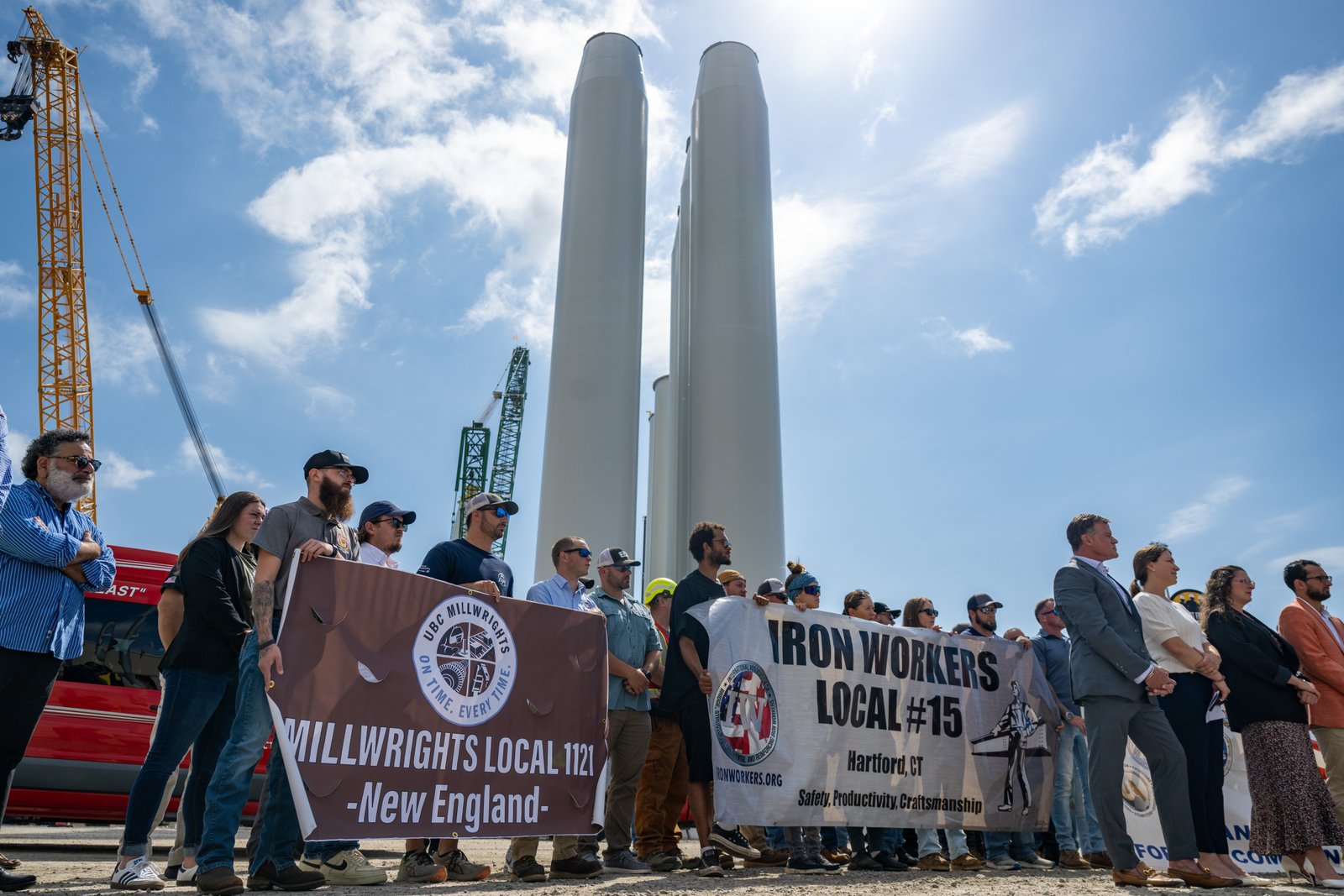
Offshore wind workers across the United States are fighting to protect thousands of clean energy jobs as federal policy changes create new uncertainty for the industry. Labor unions say the fight is about more than renewable energy. They say it is about protecting good wages, stable careers, and long-term opportunities for skilled workers.
Ryan McElroen knows what that change looks like. For years, he repaired New York City’s subway system deep underground. Then he received the chance to train for offshore wind construction through the International Brotherhood of Electrical Workers Local 3. The move changed both his workplace and his future.
McElroen has spent the past two years working on New York’s first large offshore wind projects. He completed several work rotations on Sunrise Wind and Empire Wind, two projects located off the coast of Long Island. Instead of dark tunnels, he now works in the open ocean.
He says the new job gave him a better work environment and a new career path. During his shifts, he has seen dolphins, seals, and wide ocean sunsets. He hopes offshore wind will remain his career for many years.
Labor leaders say stories like McElroen’s are the reason unions have invested heavily in clean energy jobs. They believe renewable energy projects should create union careers that offer strong pay, training, and benefits.
The labor movement in New York began focusing on climate jobs after Hurricane Sandy hit the state in 2012. The storm caused widespread damage and showed many union leaders how climate change could affect workers and local communities.
At that time, labor groups felt climate policy focused mainly on reducing emissions. Union leaders wanted workers to have a stronger voice in the clean energy transition. They pushed for policies that would create high-quality jobs instead of temporary work with weak labor protections.
Labor organizations joined researchers and policy experts to create a clean energy plan that placed workers at the center of New York’s climate strategy. The coalition later grew to include unions representing millions of workers across the state.
The group identified offshore wind as one of the biggest opportunities for new union jobs. Union leaders pushed New York officials to adopt an ambitious offshore wind target. The state later committed to building nine gigawatts of offshore wind capacity by 2035.
New York also approved labor standards for large renewable energy projects. These standards included prevailing wages, project labor agreements, and rules that made it easier for workers to organize unions during project operations and maintenance.
Union leaders say these protections changed how many workers viewed offshore wind. The industry became a source of long-term union employment instead of short-term construction work.
The clean energy job movement expanded beyond New York in the following years. Labor organizations helped build similar coalitions in several other states, including Massachusetts, Connecticut, Rhode Island, Illinois, Maine, and Texas.
The Inflation Reduction Act, signed in 2022 during the Biden administration, gave the movement a major boost. The law offered tax incentives for clean energy projects that met wage and apprenticeship standards. Union leaders say this encouraged developers to hire skilled workers, train apprentices, and create family-supporting jobs.
The law also helped speed up offshore wind development along the East Coast. By 2024, the federal government had approved several commercial-scale offshore wind projects that would supply electricity to millions of homes.
The situation changed after President Donald Trump returned to office. His administration moved to roll back parts of the previous clean energy agenda and reduce support for wind and solar projects.
Federal officials also targeted offshore wind development through temporary stop-work orders on projects already under construction. Sunrise Wind, Empire Wind, Revolution Wind, Vineyard Wind, and Coastal Virginia Offshore Wind all faced federal action at different times.
McElroen was working on Sunrise Wind when construction suddenly stopped. Many workers had to leave the site immediately. Electricians stayed behind to maintain equipment already installed offshore and prevent damage during the shutdown.
He said the experience created uncertainty for everyone on the project. Workers did not know when construction would restart or whether their jobs would continue.
Labor unions responded quickly. Union leaders organized rallies, press events, and public campaigns to oppose the shutdowns. They argued that thousands of workers risked losing paychecks because of federal decisions.
Labor organizations in New York, Rhode Island, Connecticut, and Massachusetts also worked with state officials to defend ongoing offshore wind projects.
The legal battle eventually shifted in favor of the projects. Courts blocked the stop-work orders, allowing construction and operations to continue.
Several projects have already reached important milestones. Vineyard Wind is now operating commercially. Revolution Wind has started delivering electricity to the power grid. Sunrise Wind, Empire Wind, and Coastal Virginia Offshore Wind have also resumed development.
McElroen says returning to work allowed him to continue building financial security. After saving money from offshore wind work, he recently qualified for a mortgage, bringing him closer to buying his first home.
Even with those victories, labor leaders say the industry’s future remains uncertain. The Trump administration canceled several offshore wind lease agreements and reduced support for future clean energy development.
Industry forecasts now expect much slower offshore wind growth over the next decade than previously projected. Union leaders warn that fewer projects could mean fewer jobs, slower investment in ports and factories, and fewer opportunities for workers entering the industry.
Despite the setbacks, labor organizations say they will continue pushing for clean energy jobs across the country. They believe offshore wind remains an important source of reliable electricity and economic growth for coastal states. They also say future energy policy must protect workers through fair wages, apprenticeships, and strong union standards as the clean energy industry continues to evolve.