


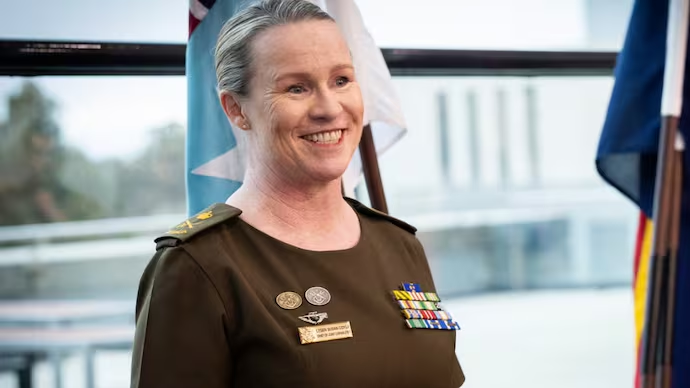
Australia’s female army chief appointment marks a historic shift as Lieutenant General Susan Coyle is named the next head of the Australian Army, becoming the first woman to hold the role in the country’s 125-year military history. She is set to formally assume command in July.
According to Daljoog News analysis, the Australia female army chief decision reflects a broader transformation in modern defense leadership, where operational experience, technological expertise, and long-term service are increasingly valued over traditional command pathways.
The announcement has drawn significant attention across military and political circles, highlighting Australia’s evolving approach to senior leadership within its armed forces at a time of global security change.
What Happened?
Australia female army chief history was made when the government confirmed Lieutenant General Susan Coyle as the next Chief of the Australian Army. She will officially take over leadership responsibilities in July, becoming the first woman ever to hold the position.
Coyle has served in the Australian Army for nearly four decades, beginning her career at just 17 years old. Over time, she rose through multiple command and strategic roles, gaining extensive experience in both domestic and international operations.
Her military background includes deployments in Afghanistan, East Timor, and the Solomon Islands, where she was involved in operational planning, logistics coordination, and mission execution. These assignments placed her in some of the most complex environments faced by Australian forces.
In addition to field operations, she has played a key role in managing large-scale military systems, including overseas troop deployments and logistical frameworks in the Middle East. Her responsibilities have often extended to coordination between allied forces in multinational operations.
More recently, her focus has shifted toward modern defense domains such as cyber warfare, space-based defense systems, and information security. This reflects Australia’s growing emphasis on technologically advanced military capabilities.
Her academic background further strengthens her profile. She holds multiple advanced degrees and has completed senior military education programs, including training at the United States Army War College and an advanced management program at Harvard University.
Why This Matters
The appointment of the Australian female army chief represents more than a personnel change; it signals a structural shift in how military leadership is defined in the 21st century. Modern armed forces increasingly require leaders who can operate across traditional warfare, cyber domains, and strategic international coordination.
Coyle’s selection highlights the importance of long-term operational experience combined with adaptability to new forms of warfare. Her background reflects the evolving demands placed on senior military leaders in an era shaped by hybrid threats and digital security challenges.
This decision also carries institutional significance for gender representation in defense leadership. While many militaries have gradually expanded opportunities for women, top command positions remain rare. Australia’s move places it among a small group of nations to break this barrier at the highest level.
Beyond symbolism, the appointment may influence recruitment, retention, and promotion pathways within the armed forces. It could also encourage similar reforms in allied military structures, particularly in countries reassessing leadership diversity and modernization strategies.
What Analysts or Officials Are Saying
Defense analysts describe the Australian female army chief’s decision as a merit-based outcome grounded in decades of service rather than symbolic intent alone. Her operational record across multiple theaters is seen as a key factor in her selection.
Experts also emphasize her growing role in modern defense areas such as cyber security and information warfare. These capabilities are increasingly central to national defense strategies, making her experience particularly relevant to current military challenges.
Officials within defense circles have pointed to her leadership in multinational operations, noting that her ability to coordinate complex missions with allied forces has prepared her for top-level command responsibilities.
Commentators also suggest that her appointment could have a wider cultural impact within the military, reinforcing the idea that senior leadership is based on capability, experience, and strategic competence rather than traditional expectations.
Daljoog News Analysis
The appointment of an Australian female army chief reflects a broader evolution in global defense institutions, where leadership is no longer defined solely by battlefield command experience but also by technological fluency and strategic adaptability.
Susan Coyle’s career illustrates how modern military leadership pathways are changing. Her progression through operational, logistical, and cyber-focused roles demonstrates the increasing complexity of defense structures in contemporary security environments.
This development also highlights how militaries are adapting to hybrid warfare challenges. Future conflicts are expected to involve not only physical combat but also cyber operations, intelligence systems, and space-based capabilities, requiring highly versatile leadership.
From a strategic standpoint, Australia’s decision strengthens its position as a modernizing defense partner within global alliances. It also signals confidence in long-term institutional reform aimed at improving both effectiveness and representation.
While the appointment is historic, its lasting significance will depend on how leadership strategies evolve under her command and how effectively the army adapts to emerging security threats.
What Happens Next
The transition to Australia female army chief leadership will now move into its formal phase as Susan Coyle prepares to assume command in July. Early expectations suggest a focus on modernization, readiness, and strengthening international defense cooperation.
Her leadership will likely be closely observed both domestically and internationally, particularly in how she manages technological integration and operational restructuring within the army.
Attention will also remain on broader cultural and institutional changes within the Australian military, as her appointment may influence future leadership development pathways.
Globally, this development could contribute to ongoing discussions about diversity in defense leadership and the future structure of military command systems in allied nations.